
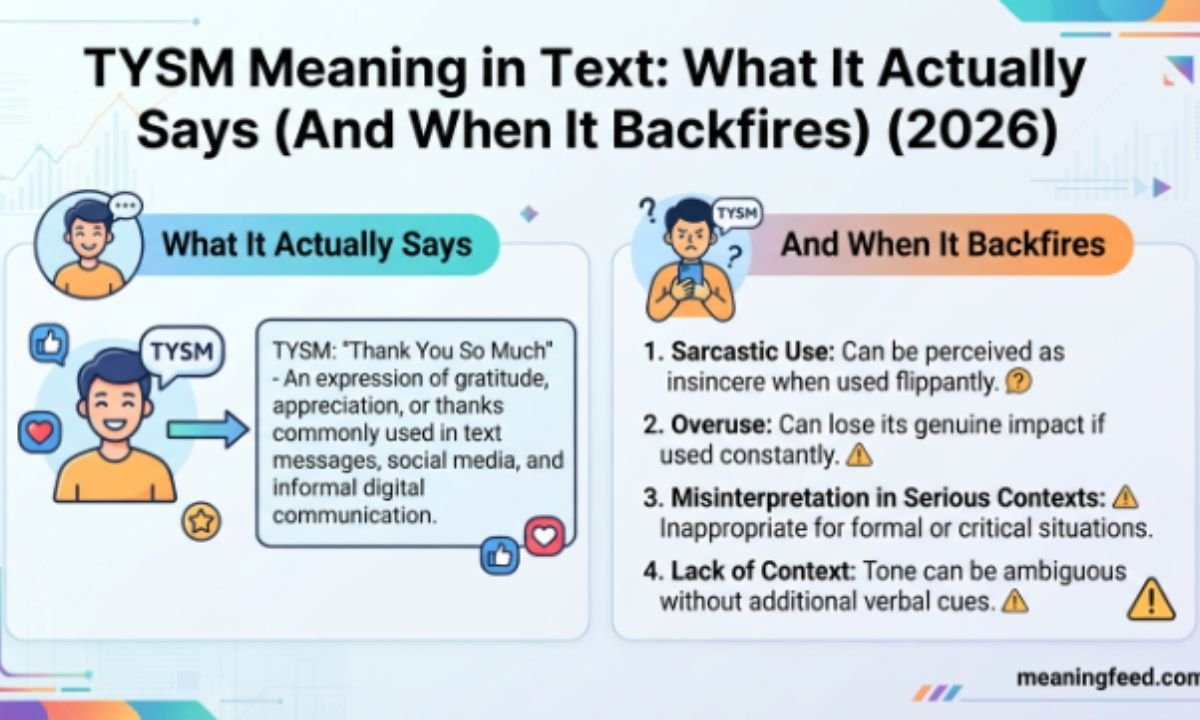

You just got a “tysm” back after sending someone a birthday gift, a favor, or a long paragraph of advice at 1 a.m. Cool. But something about it feels… short. Was that genuine? Rushed? A little cold, even?
TYSM meaning in text is simple on the surface — it stands for “thank you so much.” Four letters, one polite gesture, done. But if you’ve ever sat there re-reading a “tysm” trying to figure out the tone behind it, you already know the real story isn’t the definition. It’s the delivery.
That’s the part almost nobody talks about, and it’s exactly what we’re digging into here.
The Basic Definition (Out of the Way First)
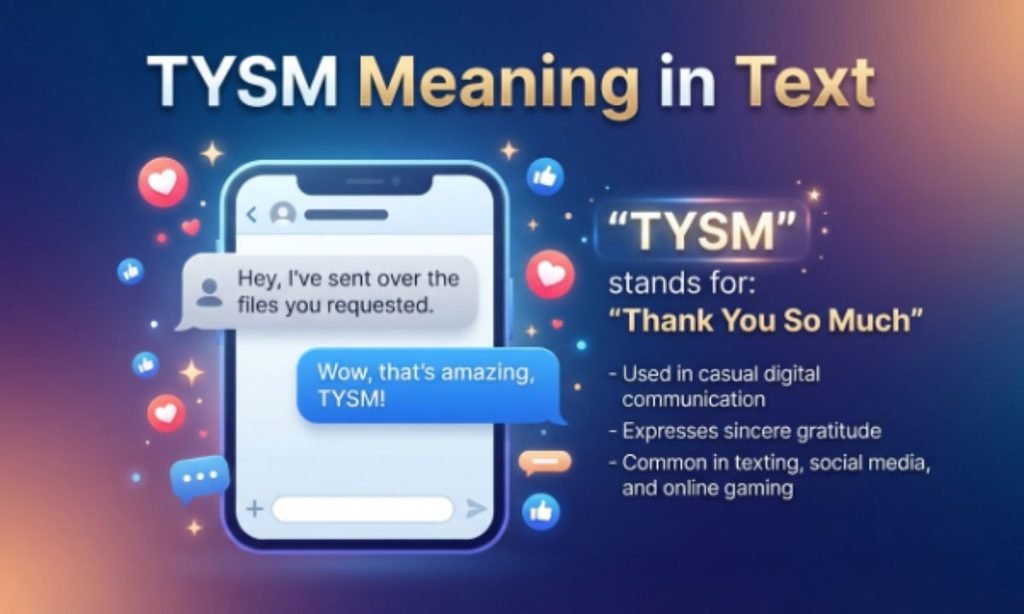
TYSM stands for “Thank You So Much.” It’s a texting abbreviation used to express gratitude, usually in casual conversations over text, DMs, group chats, or comments.
It sits one notch above a plain “ty” or “thx” in warmth, and one notch below writing out the full phrase. Think of it as the middle setting on a gratitude dial — more than a reflex, less than a heartfelt paragraph.
Quick facts:
| Detail | Info |
| Full form | Thank You So Much |
| Type | Gratitude acronym / texting shorthand |
| Common on | iMessage, Instagram, Snapchat, Discord, TikTok comments, WhatsApp |
| Tone | Casual to semi-casual |
| Capitalization matters? | Yes — see below |
| Formal use? | Not recommended without adjustment |
Why “TYSM” Isn’t as Simple as Its Definition Suggests
Here’s the gap most explainers skip: TYSM doesn’t have one fixed tone. It has at least four, and the one your reader picks up depends entirely on context clues that have nothing to do with the letters themselves.
Send “tysm” after someone compliments your outfit, and it reads warm and light. Send the exact same “tysm” as your only reply after a friend spends twenty minutes helping you through a breakup, and it can read as dismissive — like you wanted the conversation to end.
Same word. Completely different message. That’s the part that trips people up, and it’s why this abbreviation causes more low-key awkwardness than almost any other gratitude term in texting.
The Four Tones “TYSM” Can Carry
- Genuine-casual — used with friends, feels natural and warm
- Polite-distant — used with acquaintances or in DMs, feels correct but not close
- Rushed-dismissive — used to end a conversation quickly, can feel cold
- Sarcastic — used with extra punctuation or caps, flips the meaning entirely
Let’s break down how to tell these apart, because the difference is almost always in the formatting, not the phrase.
How Punctuation and Capitalization Change What TYSM Means
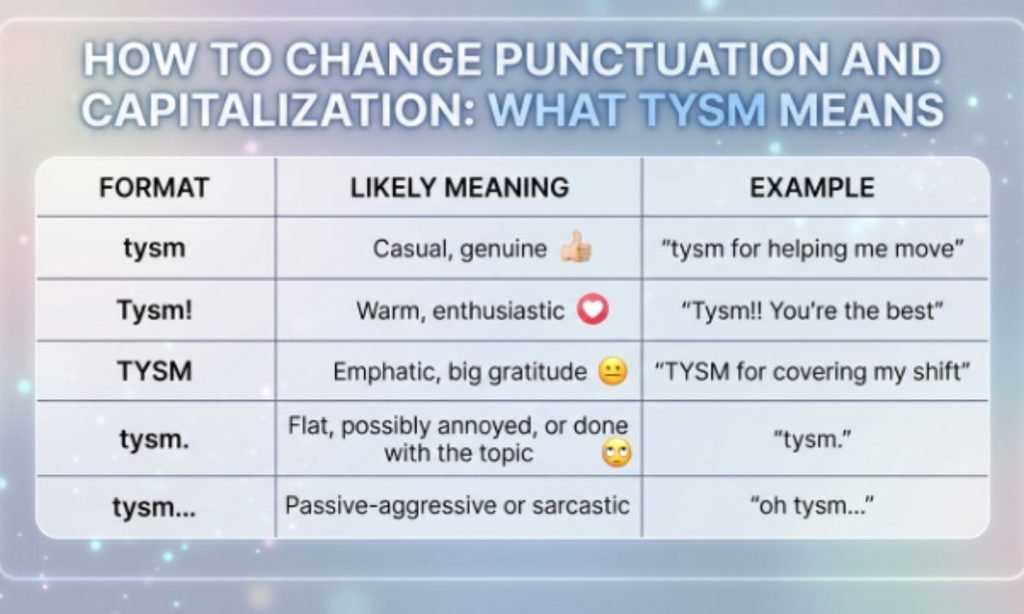
This is the content gap. Most articles define TYSM and move on. Almost none explain how the exact same three letters can flip from sincere to sarcastic based on nothing but formatting.
| Format | Likely Meaning | Example |
| tysm | Casual, genuine | “tysm for helping me move” |
| Tysm! | Warm, enthusiastic | “Tysm!! You’re the best” |
| TYSM | Emphatic, big gratitude | “TYSM for covering my shift” |
| tysm. | Flat, possibly annoyed or done with the topic | “tysm.” |
| tysm… | Passive-aggressive or sarcastic | “oh tysm…” |
| TYSM in all caps with no punctuation, mid-argument | Sarcastic, often frustrated | “TYSM for telling me now” |
Notice the pattern: a trailing period after a short, punchy text almost always reads as clipped or annoyed in modern texting norms — not just with TYSM, but generally. A double exclamation point does the opposite. This isn’t a TYSM-specific rule, but almost nobody applies it directly to this acronym, and it’s exactly why so many “was that sarcastic?” moments happen with this word specifically.
TYSM vs. Similar Gratitude Texts: A Side-by-Side Look
People often use these interchangeably, but they carry different weight. Here’s how they actually stack up:
| Term | Full Meaning | Formality Level | Best For |
| ty | Thank you | Very casual | Quick acknowledgments |
| thx | Thanks | Very casual | Quick, slightly more common in older millennial texting |
| tysm | Thank you so much | Casual-warm | Friends, group chats, favors |
| tyvm | Thank you very much | Slightly more formal-casual | Coworkers, semi-formal DMs |
| ty so much | Thank you so much (unabbreviated middle) | Warm, personal | When you want it to read as more deliberate |
| thank you so much | Full phrase | Formal to warm | Work emails, formal thank-yous, anything you want to feel intentional |
The takeaway: TYSM sits in a sweet spot. It’s warmer than “thx,” but it still reads as fast and casual. If the moment calls for more weight — someone did something that actually mattered to you — typing it out in full communicates that you slowed down to say it properly.
When TYSM Works Great (And When It Quietly Backfires)
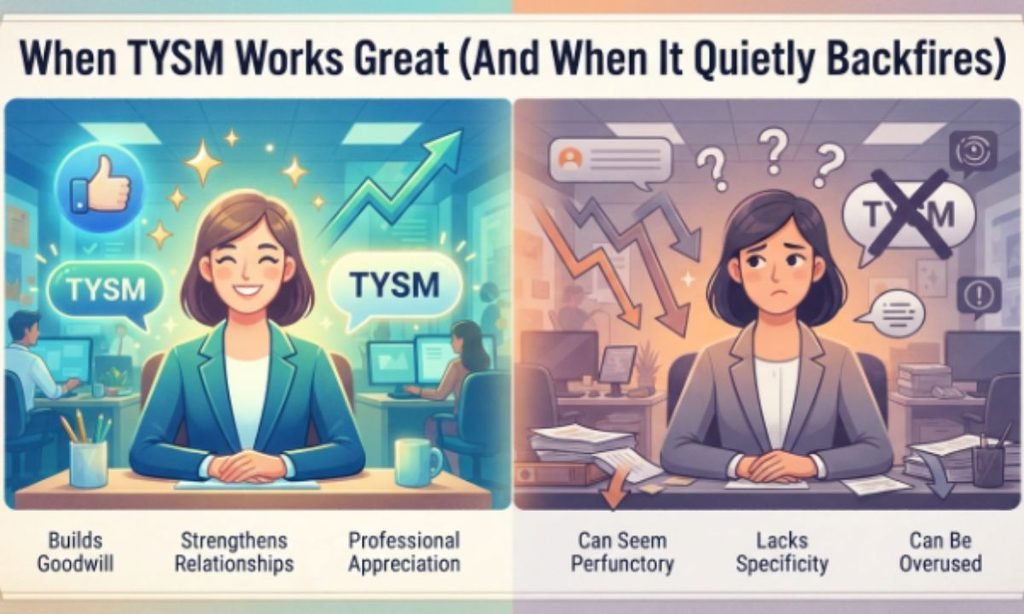
This is the part that actually helps you text better, not just understand a definition.
TYSM works well when:
- Someone gives you a small compliment or favor
- You’re replying quickly in a group chat and want to sound appreciative without derailing the conversation
- The relationship is already casual and established
- You add an emoji, exclamation point, or follow-up sentence to soften it
TYSM can backfire when:
- It’s your only reply to something emotionally significant (a long supportive message, advice, or a big gesture)
- You send it with a period and nothing else — it can read as “conversation over”
- You use it in a first DM or professional context without any warm-up
- The other person put real effort into what they did, and a three-letter reply feels disproportionate
A simple rule that solves most of this: match effort to effort. If someone wrote you three sentences, “tysm” alone can feel like a letdown. Add one more line — “tysm, this actually made my day” — and the exact same abbreviation reads completely differently.
Does TYSM Work in Professional or Semi-Formal Texting?
Short answer: sometimes, but adjust it first.
Workplace Slack messages, client texts, and professional DMs are more casual than they used to be, but “tysm” still skews younger and more Gen Z/Gen Alpha in tone. If you’re texting a manager, client, or someone outside your peer group, here’s a safer scale:
| Context | Safer Choice |
| Close coworker, casual Slack | tysm is usually fine |
| Manager or client | “Thank you so much” or “Really appreciate this” |
| First-time professional contact | Full phrase, no abbreviation |
| Group chat with mixed ages | tysm still lands, but read the room |
If you’re ever unsure, typing the full phrase costs you three extra seconds and removes all ambiguity. TYSM is a convenience tool, not a requirement.
There’s also a generational layer here that’s worth naming directly. TYSM skews younger — it’s common in Gen Z and Gen Alpha texting, especially on Snapchat, Discord, and TikTok comment sections. Older millennials and Gen X texters tend to reach for “thx” or the full phrase instead. That doesn’t make TYSM wrong to use with an older manager or relative, but it does mean it might read as slightly unfamiliar or overly casual to them, even when you mean it warmly. If you know your audience skews older, that’s another good reason to spell it out in full.
Platform also shapes how TYSM lands. A “tysm” left as a TikTok comment barely registers — it’s the digital equivalent of a nod. The same “tysm” sent as a lone iMessage reply carries more weight, because texting feels more personal and one-on-one than a public comment thread. The fewer people involved, the more each word counts.
How to Reply If Someone Sends You “TYSM”
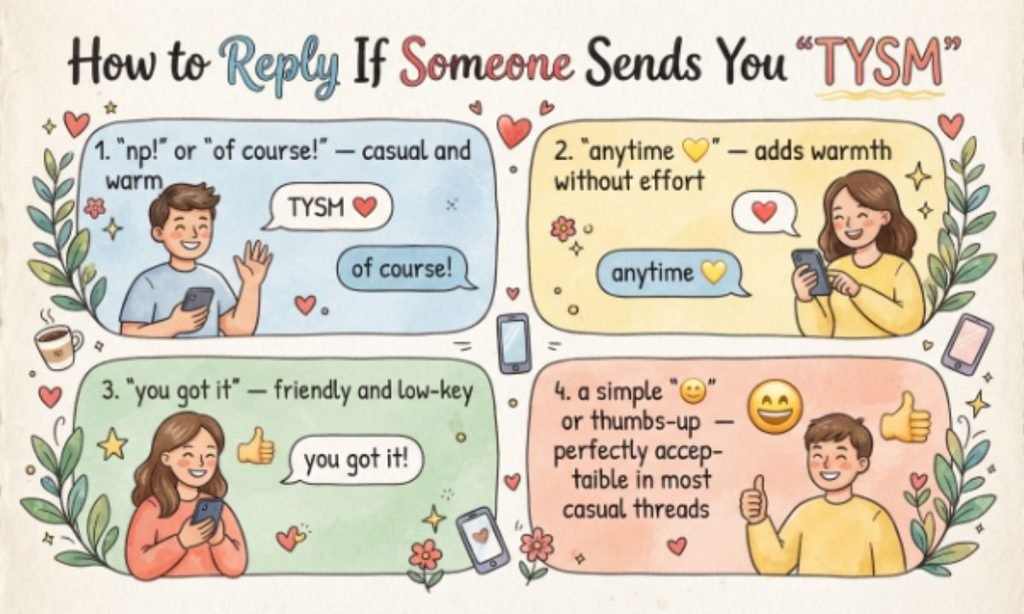
You don’t need to overthink this one. A few solid go-tos:
- “np!” or “of course!” — casual and warm
- “anytime 💛” — adds warmth without effort
- “you got it” — friendly and low-key
- A simple “😊” or thumbs-up — perfectly acceptable in most casual threads
If their “tysm” felt oddly short or flat and you’re worried it read as sarcastic or upset, it’s completely fine to just ask: “all good?” That one text clears up 90% of tone confusion instantly — way more reliable than trying to decode punctuation forever.
Quick Reference: TYSM Meaning in Text, Summed Up
- TYSM = Thank You So Much
- Tone shifts based on punctuation, caps, and context — not the letters themselves
- Best for casual, established relationships
- Pair it with a follow-up sentence when the moment deserves more
- Use the full phrase in professional or first-time conversations
- If a “tysm” feels off, just ask — don’t guess
Final Thought
TYSM meaning in text is easy to memorize and slightly harder to use well. The abbreviation itself is neutral — it’s the punctuation, timing, and effort behind it that decide whether it reads as heartfelt or hollow. Once you notice that pattern, you’ll never send (or misread) a flat “tysm.” again without thinking twice.
FAQs
What does TYSM mean in a text message?
TYSM stands for “Thank You So Much.” It’s a casual way to express gratitude in texts, DMs, and comments, slightly warmer than “ty” or “thx.”
Is TYSM rude or sarcastic?
Not by default. TYSM only reads as sarcastic or dismissive when paired with flat punctuation (like a trailing period) or sent as the only reply to something emotionally significant.
Can I use TYSM at work?
You can, but it’s safer with close coworkers than with managers or clients. For professional messages, “thank you so much” in full reads more polished.
What’s the difference between TYSM and TYVM?
TYSM means “thank you so much,” while TYVM means “thank you very much.” They’re close in meaning, but TYVM leans very slightly more formal.
How do I reply to someone who texts me TYSM?
Simple replies like “np!”, “of course!”, or “anytime” work well. If the tone felt off, it’s fine to just ask if everything’s okay.
