

A friend admits they ate a whole pizza by themselves, and someone replies with a lone “TSS.” So what does TSS mean in text, and is it a tease or a compliment? It depends on the chat, and that is why these three letters trip so many people up.
People search for it because TSS is slang that doesn’t spell itself out. You’ll meet it in text messages, WhatsApp threads, Instagram comments, TikTok replies and Snapchat stories, and more than one reading floats around for the same letters. Add medical, business and gaming acronyms to the mix and confusion is easy.
This guide covers the main meanings, where they likely came from, and how to tell them apart in a real conversation. You’ll also get everyday examples, replies you can copy, and the mistakes I see most often.
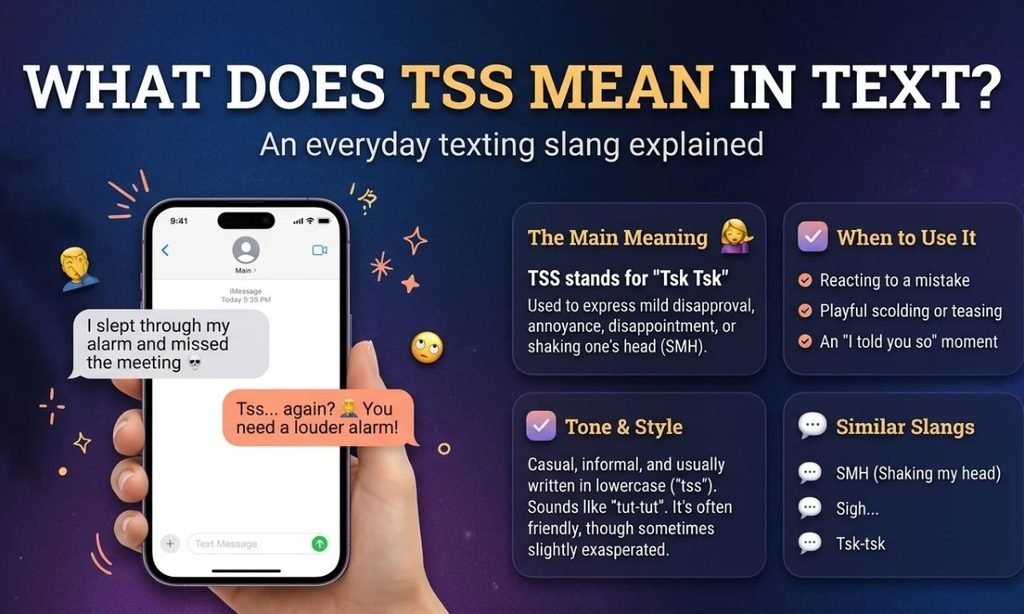
TSS in text has two common meanings. In many chats it’s the typed sound of “tsk tsk,” a playful way to tease or mildly disapprove. In others it means “That’s So Sweet,” a warm reaction to a kind gesture. Context decides which one you’re reading, and the surrounding messages almost always make it clear.
What Does TSS Mean in Text? The Two Main Readings
Two readings dominate casual chat, and I’ve seen both in the same week. Which one you’re looking at depends on the message before it.
TSS as “Tsk Tsk”
The first reading is the written version of “tsk tsk,” the clicking sound people make when they disapprove. It works as a quick reaction that carries disappointment, disapproval, teasing or playful criticism. Sometimes there’s sarcasm or mock judgment in it, but it usually reads as mild disappointment, not anger.
Picture the head shake that goes with “Come on now.” Strip out the face and the sound, type three letters, and you get TSS. It’s mild disapproval with a wink, and it works as chat slang because everyone already knows the sound.
Here’s a quick example:
Friend: “I ate the entire pizza by myself.”
You: “TSS 😂”
Nobody is being scolded. That’s the usual tone.
TSS as “That’s So Sweet”
The second reading is “That’s So Sweet.” It’s the positive one, used for compliments and kind gestures. Someone does something nice, and you answer with TSS. It’s short, warm and natural, and it works as a thank you.
Other Chat Readings
A few other readings circulate. “Tough Situation Sorry” is the sympathetic one, sent when someone shares bad news and you want to offer support. “Total Social Shutdown” is a negative, niche version I’ve only run into in a handful of online discussions.
Some users read TSS as “Hit Me Back,” a nudge that asks for a reply, but that’s a minority use. Others assume it means “That’s So Sad.” The letters seem to fit, which is why people guess it. I’ve watched friends argue about this in a group chat, and in online chats “tsk tsk” is more commonly the answer.
| Reading | Tone | Typical trigger |
| Tsk Tsk | Teasing, mild disapproval | A small, silly mistake |
| That’s So Sweet | Warm, appreciative | A kind gesture or compliment |
| Tough Situation Sorry | Sympathetic | Bad news |
| Total Social Shutdown | Negative, niche | Rare online discussions |
| Hit Me Back | Nudge for a reply | Minority use |
TSS Full Form and Short Meaning
People search for the TSS full form, so here’s the awkward part: there’s no official one in texting. The “tsk tsk” answer isn’t really words at all. It’s sound imitation, a disappointment expression typed the way it would be spoken.
That makes TSS unusual among internet abbreviations. Most compress a phrase, while this one can copy a noise. The “That’s So Sweet” reading does compress a phrase, which is part of why the same letters pull in two directions.
Slang evolves naturally, too, so specific groups and communities attach their own meanings to the same letters. You’ll see claims online that it stands for other things. Treat those as local habits, not rules.
Origin and First Known Use of TSS
The “tsk” is a clicking sound you make by pulling your tongue off the roof of your mouth. It has lived in spoken language for centuries. People use it for disapproval, sympathy, mild annoyance or plain disappointment.
The TSS origin is a typing story. Once texting took off, people stopped writing complete sentences and started typing reactions: Haha, Ugh, Hmm, tsk, TSS. Those typed sounds became a shorthand reaction that fit social media conversations and chats.
As for TSS history and a first known use, I can’t point you to a verified date or a first post. Anyone who gives you an exact one is guessing. What we can say is that the sound is old, the typed version spread with texting, and it became fairly popular in casual chat.
The acronym readings follow the usual pattern of people shortening everything and cutting vowels until a phrase fits in a few characters. I haven’t seen anyone document whether those came before, after or alongside the sound version, so the order is unclear.
How to Tell Which TSS Meaning You’re Reading
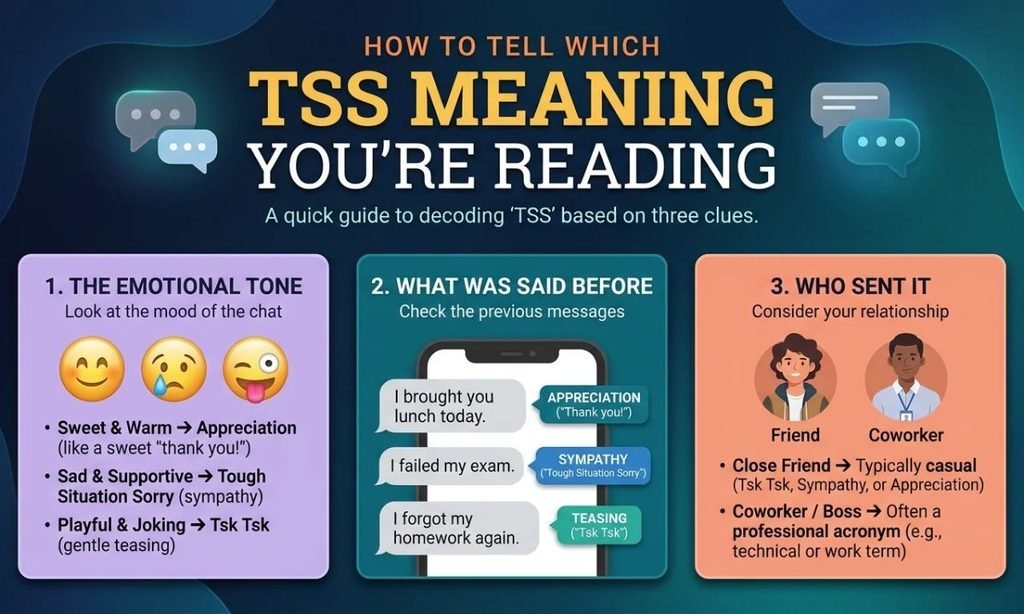
So what does TSS mean in text when it lands in your own chat? Run three quick checks.
- Emotional tone. Is the conversation happy, sad, neutral or joking? Sweet belongs to appreciation, “Tough Situation Sorry” to sympathy, and tsk tsk to teasing.
- What was said before. If a friend writes “I brought you lunch today,” TSS means appreciation. If the earlier message was “I failed my exam,” it means sympathy. If it was “I forgot my homework again,” it’s a tsk tsk.
- Who sent it. A close friend usually means the casual version. A coworker or one of your professional contacts might be using a work acronym, which I cover below.
When I’m unsure, one question settles it: what tone fits the line above? That beats trying to guess blindly, and it’s the whole of tone detection. Context changes meaning every time.
Is TSS Rude or Positive?
Usually it’s not rude. It’s mild and playful, but tone matters. If someone uses it repeatedly or in the middle of an argument, it can sound judgmental or sarcastic. Whether it reads as rude depends on the situation.
As for whether it can be positive, the tsk tsk version generally isn’t. It leans toward mild disapproval, teasing or disbelief. Among friends, though, it can feel lighthearted and friendly. The “That’s So Sweet” version is positive outright.
Does It Change From a Girl or a Guy?
The meaning doesn’t change with gender. If a girl sends TSS, she’s likely teasing, showing mild disappointment, or joking about something you said or did. From a guy it’s the same: playful criticism, sarcasm or a joking reaction. The exact tone depends on the conversation.
Real Examples of TSS in Conversations
Theory is neat, but real usage is messier. Here is where I actually see it in text messages, social media comments and group chats, usually next to emojis.
Friendly Text Messages
Between friends, this is the most common situation. Say someone texts, “I saved you a slice of cake.” A reply of TSS is short and warm, and it means thank you. Another friend writes, “I stayed up late to help you finish your project.” You’d probably send “Aww” or TSS, and both work.
The teasing version looks different:
Alex: “I forgot my homework again.”
Sarah: “TSS 😅”
The forgetting is the trigger and the teasing is the reaction. Sarah isn’t angry, and a playful reply fits perfectly.
Social Media Comments
Under a post, someone might write, “He surprised me with flowers.” A comment of TSS 😭 fits perfectly. Someone else posts, “Stayed up until 4 AM watching videos,” and a comment underneath reads, “TSS… and now you’re tired 😂.”
Emojis do the tone work in comments. Without them, the abbreviation can look unclear. People love quick reactions online, and clarity matters less in a comment than in a DM.
Group Chats
In group chats, messages pile up quickly, so short replies win. Say a friend writes, “She made me coffee this morning,” and one of the guys answers TSS or “That’s cute.” Either one is a quick emotional reaction that suits a fast-moving thread.
The teasing kind shows up here too:
Friend: “I spent all my money on snacks.”
You: “TSS, bad decision 😂”
Someone does something mildly silly, and the reply is a gentle tease.
More Everyday Chat Examples
Here are more lines from real-life situations:
- “You forgot your wallet again? TSS 😂”
- “Stayed awake until sunrise? TSS 😅”
- Sent the text to the wrong person? “TSS 🤦”
- Another online shopping spree? “TSS 😂”
- Ate all the cookies? “TSS 😭”
- Didn’t study but expect an A? “TSS 🤔”
- Late for work again? “TSS 😬”
- Watched the whole season in one night? “TSS 😆”
- Missed the meeting because you overslept? “TSS 😅”
- Said you’d quit gaming yesterday? “TSS 😂”
- Forgot your anniversary? “TSS 😳”
- Bought something you didn’t need again? “TSS 🤣”
Notice the pattern: forgetting, oversleeping, bad decisions, overspending. The teasing is gentle every time.
Professional or Semi-Formal Conversations
In a work setting, I’d skip it. It’s strictly informal, it can seem lazy or unclear, and it’s risky because your reader may decode it differently. A better alternative is a simple change: “That’s very thoughtful, thank you.” It makes a better impression with almost no extra effort.
TSS Meaning Across WhatsApp, Instagram, TikTok and Snapchat

The core meaning stays similar across platforms, though usage shifts slightly. The differences are small, but you’ll notice them once you watch for them.
On WhatsApp, TSS tends to live between friends in casual conversations. It’s teasing with a hint of disappointment: “You forgot my birthday? TSS 😒.” It works best with people who already know your sense of humor.
On Instagram, users drop TSS into comments and replies, usually under photos and stories: “Another late-night post? TSS 😂.” If you see it there, it’s almost always a joke aimed at a friend. Instagram comments are public, so the humor needs to be obvious. It also appears in DMs, where it reacts to funny mistakes and questionable decisions.
TikTok
TikTok leans louder. TSS appears in comments reacting to funny mistakes and embarrassing moments, often under a video where someone has clearly gone too far: “You really posted that? TSS 😭.” It mostly lives in comments, rarely in a caption.
Snapchat
On Snapchat, TSS is a quick reaction to a snap or a friend’s story: “Skipped class again? TSS 😅.” It’s playful, fast and gone before you think about it. The “tsk tsk” meaning here carries playful disappointment, not serious criticism.
Twitter/X and Other Apps
On Twitter/X, I see it in replies and the occasional caption, mostly as a joking reaction. Across all of these apps, the sweet reading and the teasing reading both exist, and people use it for light engagement more than serious signalling.
Platform Comparison
| Platform | Typical use |
| Text messages | Mild disapproval or joking |
| Friendly teasing | |
| Comment reactions | |
| TikTok | Funny or sarcastic responses |
| Snapchat | Quick reactions to snaps and stories |
Other Meanings of TSS Beyond Texting
Outside chat, TSS means completely different things depending on the field. If you’re reading a medical article, it almost certainly refers to the health condition. Outside texting, nobody means tsk tsk.
| Field | Meaning |
| Medical | Toxic Shock Syndrome |
| Education | Teacher Support System, Training Support System |
| Business | Technical Support Services, Technical Support Specialist |
| Technology | Total System Services |
| Gaming | Team Support Strategy |
Some of these are less standard than others, and the forms vary from one organization to the next, so check the source before you rely on them.
Medical Meaning
The medical meaning is Toxic Shock Syndrome. It’s a serious condition caused by bacterial toxins, and it requires immediate medical attention. In social media chats it rarely refers to this unless health is being discussed. If nobody’s sick, that isn’t what they mean.
Business, Education, Technology and Gaming
Organizations create internal acronyms constantly, so the setting tells you which one you’re dealing with. You’ll see the business meaning in job posts and the education meaning in school software. Context is critical here.
Online Communities
Forums, niche groups and subcultures create their own meanings, and those meanings shift from one community to the next. Never assume a meaning without context, since that leads straight to misunderstandings. Community-specific meanings tend to stay inside the community.
TSS Meaning in Text for Dating Apps and Online Conversations
On dating apps, tone and timing matter, and every word counts. TSS can signal warmth and interest, keep things light, and show emotional engagement. It can also come across as low-effort, vague, or sarcastic.
How TSS Works in Dating
In the sweet sense, it shows warmth and interest and keeps the conversation light. In the teasing sense, it works as playful banter. Either way, it signals that you’re engaged.
Example in Dating Chat
Someone writes, “I made you a playlist.” You reply, “That’s adorable.” Or just TSS. In a dating chat, that feels friendly and builds connection. It works because the gesture was small and sweet.
Potential Risks
Used without emojis, TSS can read as vague or low-effort. It may also be misunderstood as sarcasm, and overused, it gets old fast. Add personality, and don’t rely on abbreviations alone. A tip: pair it with a real sentence, or the other person may think you’re bored.
Common Mistakes People Make With TSS
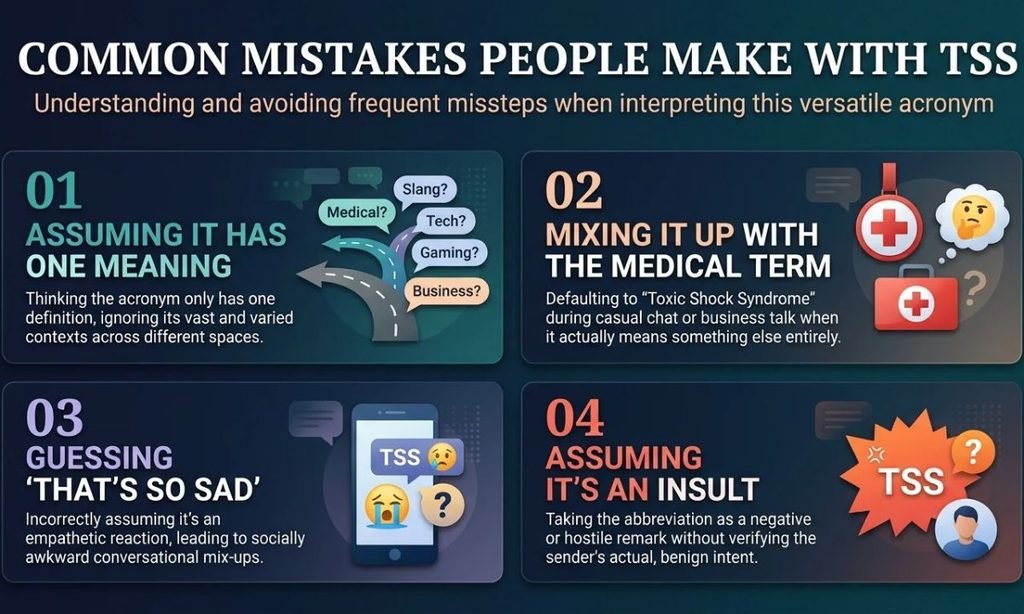
People misunderstand TSS for a few predictable reasons. Several meanings float around, so a wrong interpretation is easy. Even frequent texters get it wrong.
Assuming It Has One Meaning
This is the big mistake. The meaning is context-based, so a single-meaning assumption will bite you sooner or later. Plenty of short abbreviations work this way, and the common meanings of PIN in text are a good example of one term that shifts with the chat.
Mixing It Up With the Medical Term
In social media chats, TSS rarely refers to Toxic Shock Syndrome. Assuming the worst is the mistake. If health was never mentioned, the medical condition isn’t what they mean.
Guessing “That’s So Sad”
The letters seem to fit, so people guess it. Usually that’s wrong. The tsk tsk and “That’s So Sweet” readings are far more common in practice.
Assuming It’s an Insult
TSS is usually playful. Most people don’t mean to offend anyone, and friendly teasing is the norm. The serious misuse I see is confusing meaning with tone, so the same three letters get read as harsh when they weren’t.
Using It in Serious Situations
Imagine sending TSS after “Sorry for your loss.” It would feel cold and careless. Write the full message instead.
Misreading Tone
Is it sincere or sarcastic? Without emojis, it’s hard to tell. A flat “TSS.” can feel dry, while “TSS 😊” feels warm.
Overusing Abbreviations
Too many shortcuts make messages harder to read. Clear communication always wins, and a message packed with abbreviations is exhausting for the other person.
TSS vs Similar Slang Terms
TSS doesn’t stand alone. These related terms show how it differs.
| Term | Meaning | How it differs from TSS |
| SMH | Shaking my head | Stronger disappointment |
| LOL | Laughing out loud | Laughter, not judgment |
| BRUH | Seriously? | Surprise and disbelief |
| OOF | That’s unfortunate | Reaction to mistakes |
| YIKES | Awkward, embarrassing | Cringe at a situation |
| WOW | Surprise, good or bad | Neutral surprise |
| FACEPALM | Obvious mistake | Frustration |
| Aww | Soft emotional reaction | Close to the “sweet” reading |
| TYSM | Thank you so much | Says thanks outright |
| OMG | Surprise or shock | Bigger emotional spike |
| HMU / BRB | Hit me up / be right back | Different functions entirely |
Compared with these, TSS sits in the softer middle. In the teasing sense it’s usually friendlier than SMH. In the sweet sense, it’s a reaction, not gratitude. TYSM says thank you outright, and TSS only implies it.
It also doesn’t work alone. It needs context. To avoid confusing it with abbreviations like HMU or BRB, check the platform and the conversation tone, then compare.
When to Use TSS and When to Skip It
It’s natural with friends and close contacts. It’s quick, friendly and light. If I’m texting friends, it’s a friendly response. If I’m writing a formal message or dealing with a serious situation, I skip it. A good test: if the other person may not understand it, or if you wouldn’t say it out loud, don’t send it.
Use TSS When
Use it for a quick response when the tone is light and you’re texting friends, classmates or family. It suits a small mistake, a sweet gesture, or a joking moment.
Skip TSS When
Skip it when the message is formal, the situation is serious, or the reader may not understand slang. That covers condolences, workplace feedback and anything with real stakes.
How to Reply When Someone Sends TSS
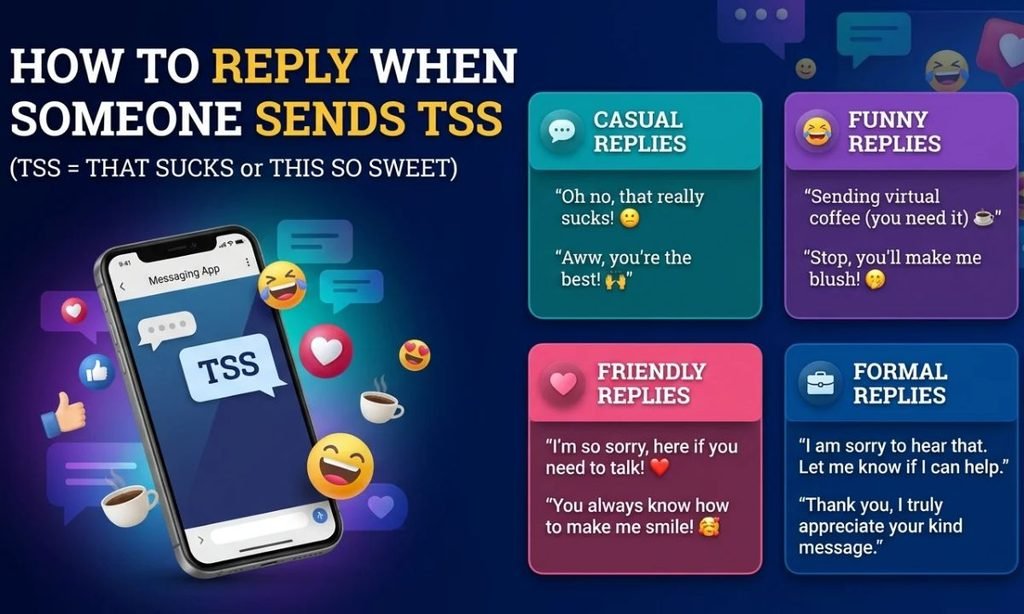
The best reply depends on the mood. Reading the message first is half the job.
Casual Replies
Keep things light, maybe with 😂 or 😅: “I know, I know.” “Don’t judge me.” “Oops, my bad.” “Fair enough.”
Funny Replies
Lean into it with 😎, 😂 or 😆: “No regrets.” “I’d do it again.” “Worth it!” “You’re just jealous.”
Friendly Replies
Keep the warmth, maybe with 😊: “You’re probably right.” “Lesson learned.” “I’ll do better next time.”
Formal Replies
TSS is rarely used in formal conversations, but if it turns up, try “Point taken,” “I understand,” or “That’s fair feedback.”
If It Means Appreciation
Keep it warm. “Glad you liked it” or “Anything for you” both work, and a 😊 doesn’t hurt.
If It Shows Sympathy
Acknowledge it. “Thanks, I appreciate that” or “Yeah, it’s been tough” is enough.
If You’re Unsure
Mirror the tone, or ask. “Haha, I know, right” works for light moments, and “What do you mean by that?” works when you honestly can’t tell. A clarifying question beats a wrong guess and causes no awkwardness.
Is TSS Still Popular?
It’s still used online, but it’s less common than major slang like LOL, SMH, OMG and BRUH. Language online changes fast, so here’s my read of the current picture.
Who Uses It Most
Teens, young adults, social media users and casual chat groups make up most of its users. Younger people are more likely to type it, and older users tend to prefer full phrases. It’s rarer outside those groups.
Is Usage Growing or Declining?
The trend looks fairly stable but niche. Many people reach for emojis, GIFs, voice notes or SMH to express the same feeling, and short phrases are replacing acronyms. So the answer is neither growing nor declining.
Where It Shows Up
You’ll see it on WhatsApp, Instagram, TikTok and Snapchat, plus group chats and online communities. It persists because it’s quick, expressive and fits casual chats.
Trend Insight
TSS hasn’t disappeared. It has become situational, and it fades quickly in some circles.
Case Study: How Context Changes Everything
Here are three real-style scenarios. In all of them, the abbreviation is unchanged.
Scenario one. Someone writes, “I bought you your favorite snack.” You reply TSS. The meaning is appreciation, and it’s a warm exchange.
Scenario two. Someone writes, “I didn’t get the job.” You reply TSS. Now it means sympathy, and you’d probably follow up with a full sentence.
Scenario three. Someone writes, “I spent my whole paycheck on snacks.” You reply TSS 😂. Now it’s a gentle tsk tsk.
What changed each time? Not the abbreviation. Just the context and tone. That’s what makes understanding what does TSS mean in text feel simple once you see it.
Quick Facts About TSS
| Detail | Summary |
| Common meanings | Tsk Tsk, That’s So Sweet |
| Category | Internet slang |
| Tone | Playful, teasing, warm, or mildly critical |
| Platforms | Texting, WhatsApp, Instagram, TikTok, Snapchat |
| Popularity | Moderately common, niche |
| Formality | Strictly informal |
Pro Tips to Use TSS Naturally
- Keep it balanced. Don’t use it in every message, because overuse makes you sound like a bot.
- Add emojis when needed. They clarify tone instantly.
- Match the other person’s style. If they use slang, you can too.
- Stay clear first. Clarity beats trendiness every time.
- Think before sending. Quick messages can still carry intention.
Think of TSS as seasoning in food. A little adds flavor, and too much ruins the dish. A pinch makes a message warm or playful, and a handful drowns it.
Reading the Room
Understanding context is the real skill here. After years of group chats, my takeaway is that TSS is reaction slang, not a verdict. It’s playful disappointment, a bit of teasing, maybe sarcasm, and mild disapproval at most. It can also be a warm “That’s So Sweet.” It’s lighthearted far more often than it’s a serious insult.
You’ll find it in text messages and on WhatsApp, Instagram, TikTok and Snapchat. Someone makes a mistake, a sweet gesture lands, or an embarrassing moment happens, and TSS follows as a quick reaction. It isn’t as widespread as LOL or SMH, but it keeps showing up in casual conversations.
Whenever you see it, check the surrounding conversation. That’s usually enough to tell you what the sender meant by what does TSS mean in text.
FAQs
What does TSS mean in text?
TSS is most often the typed version of “tsk tsk,” a playful way to tease or show mild disapproval. In some chats it also means “That’s So Sweet.” The message before it tells you which one the sender meant.
What is the full form of TSS in texting?
There’s no official full form. The “tsk tsk” reading imitates a sound, so it doesn’t spell out words. “That’s So Sweet” is the most common phrase people read into the letters.
What does TSS mean on Snapchat and Instagram?
On both apps it works as a quick reaction to a friend’s story, comment or message. It usually carries playful teasing or mock disappointment. Emojis like 😂 or 😅 usually confirm the joking tone.
Is TSS rude or offensive?
Usually not. It’s mild and playful, especially between friends. It can sound judgmental if someone repeats it during an argument, so tone and context matter.
Does TSS mean “That’s So Sad”?
Rarely. People guess it because the letters seem to fit, but “tsk tsk” and “That’s So Sweet” are far more common readings. If the chat is about bad news, ask the sender instead of assuming.
What does TSS mean from a girl or a guy?
The meaning is the same for both. It signals teasing, mild disappointment or a joking reaction. The conversation matters more than the sender’s gender.
How do I reply when someone sends TSS?
Match the mood. For teasing, try “I know, I know” or “No regrets 😂.” For a sweet meaning, try “Glad you liked it.” If you can’t tell, ask “What do you mean by that?”
Can TSS be a positive message?
Yes, when it means “That’s So Sweet.” That version is warm and appreciative. The “tsk tsk” version leans toward teasing, though friends often use it affectionately.
Is it okay to use TSS at work?
It’s best to skip it. TSS is informal slang, and a coworker may read it as unclear or dismissive. “That’s very thoughtful, thank you” or “Point taken” is safer.
What does TSS mean outside of texting?
It depends on the field. In medicine it stands for Toxic Shock Syndrome, a serious condition that needs urgent medical care. In business, education and tech it can stand for internal terms like Technical Support Services or Total System Services.
Is TSS still popular slang?
It’s still used, but it’s niche compared with LOL or SMH. Teens and young adults use it most, mainly on WhatsApp, Instagram, TikTok and Snapchat. Many people now use emojis or voice notes instead.
How is TSS different from SMH?
SMH (“shaking my head”) shows stronger disappointment. TSS is softer and usually friendlier. Think of it as a light tease, not a real scolding.
