
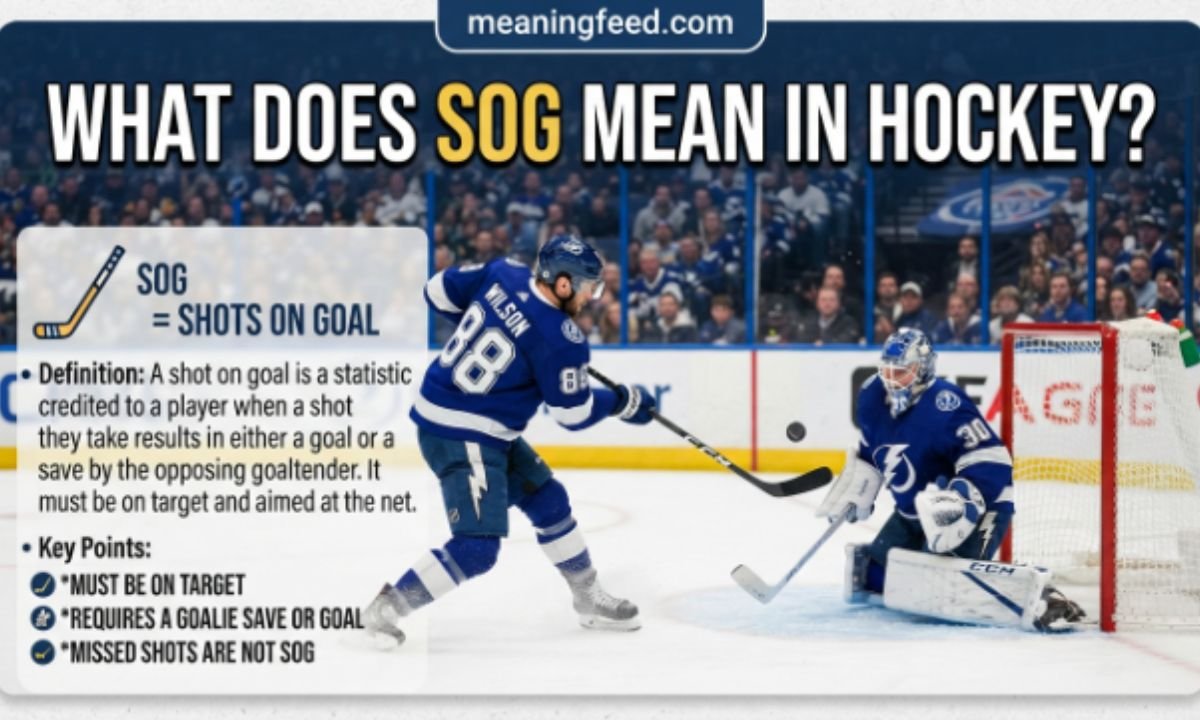

What does SOG mean in hockey? It’s one of those stats everyone sees on the scoreboard but almost nobody can define correctly on the spot. If you’ve ever glanced at a box score and wondered what that column actually tracks, you’re not alone. SOG stands for Shots on Goal, and it’s one of the most useful — and most misunderstood — stats in the entire sport.
It sounds simple. A player shoots, the puck goes toward the net, that’s a shot, right? Not quite. The NHL has a specific definition of what counts, and it trips up a lot of casual fans (and even some fantasy hockey managers who should know better).
This guide breaks down exactly what SOG means in hockey, how it’s counted, why it matters for player evaluation, and how it differs from the pile of other shot-related stats you’ll see on NHL.com or your favorite stats site.
What Does SOG Mean in Hockey? The Basic Definition
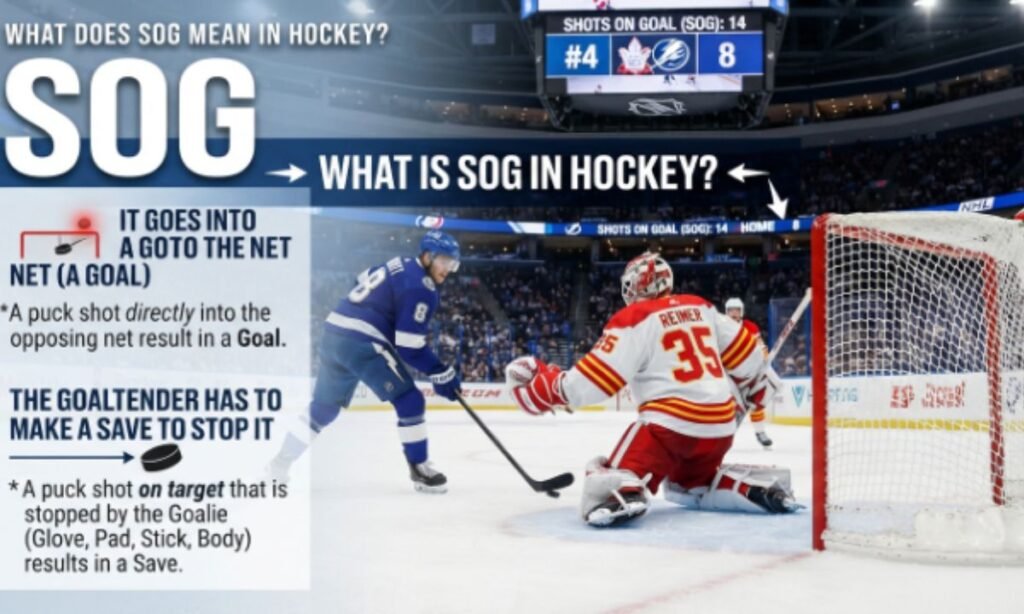
What does SOG mean in hockey, in the simplest terms? It means a shot on goal — any puck that’s directed at the net with real scoring intent, and would have gone in if the goalie hadn’t stopped it.
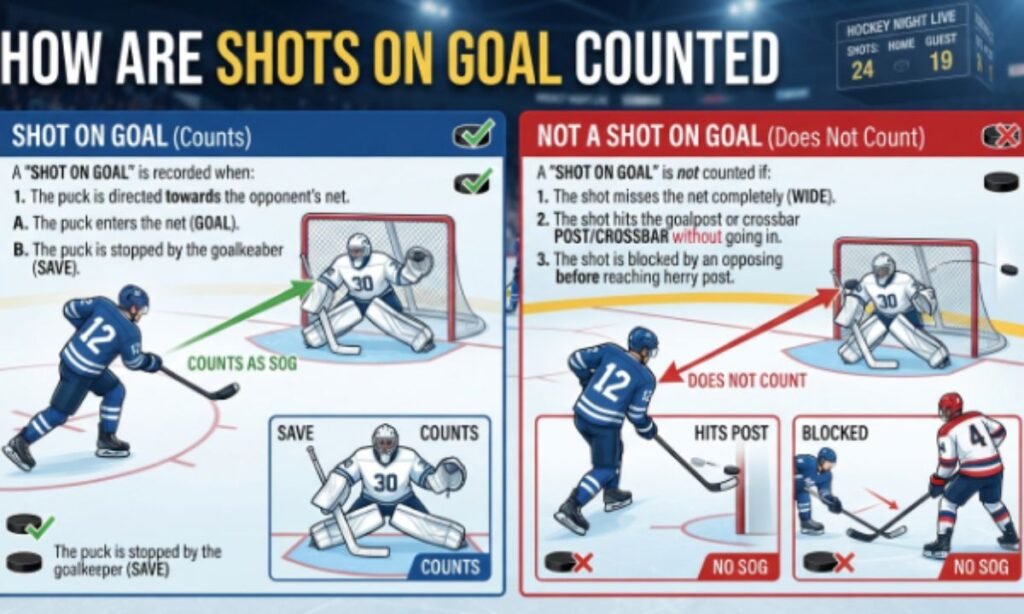
That last part is the key. A shot only counts as “on goal” if one of two things happens:
- It goes into the net (a goal), or
- The goaltender has to make a save to stop it
If neither of those happens — the puck sails wide, clangs off the post, or gets blocked by a defender before it ever reaches the goalie — it does not count as a shot on goal, even though the player clearly tried to score.
So when someone asks what does SOG stand for in sports, specifically in hockey, the answer is straightforward: it’s a running count of on-target scoring attempts, tracked individually for every player and totaled for each team.
Where You’ll See SOG Tracked
You’ll find SOG in a few places during any given broadcast or box score:
- The live scoreboard graphic during TV broadcasts
- The official NHL box score, usually right next to goals and assists
- Individual player stat pages on NHL.com, ESPN, or ESPN-style apps
- Fantasy hockey platforms, where it’s often a standalone scoring category
Shots on Goal Definition vs. Total Shot Attempts
This is where a lot of confusion creeps in. Hockey fans throw around terms like “shots,” “shot attempts,” “Corsi,” and “SOG” almost interchangeably — but they’re not the same thing at all.
Here’s the breakdown of the difference between shots and SOG:
| Term | What It Includes | Counts Toward SOG? |
|---|---|---|
| Shot on Goal (SOG) | Shots that score or force a save | Yes |
| Missed Shot | Wide of the net or off the crossbar/post | No |
| Blocked Shot | Stopped by a defender before reaching the goalie | No |
| Shot Attempt (Corsi) | SOG + missed shots + blocked shots | N/A (it’s the umbrella stat) |
So SOG vs shots attempted really comes down to scope. A “shot attempt” is the broadest possible measure — it’s every single time a player tries to put the puck on net, whether it gets there or not. SOG is the narrower, more refined slice of that pie: only the attempts that actually challenged the goaltender.
This matters more than it sounds like it should. A player can rack up a huge number of shot attempts while posting a modest SOG total, usually because too many of his shots are getting blocked or sailing off target. Coaches and analysts watch that gap closely — it often says something about shot selection.
Does a Blocked Shot Count as SOG?
No. This is probably the single most common question people have, so it’s worth stating plainly: a blocked shot does not count as a shot on goal.
If a defenseman drops down and takes the puck off the shin pad before it ever gets near the goalie, that’s recorded as a blocked shot — a completely separate stat from SOG, and one that’s credited to the defender, not deducted from the shooter’s total shot attempts in a punitive way. It just doesn’t add to his SOG count.
What About a Shot That Hits the Post?
Same story. A puck that clangs off the iron and stays out is scored as a missed shot, not a shot on goal — even though, to the naked eye, it looked like about the closest thing to a goal you can get without actually scoring. The rulebook doesn’t care about “close.” It cares about whether the goaltender was forced to make a save.
Beyond What Does SOG Mean in Hockey: How Shots Are Officially Counted
Every NHL game has an official scorer sitting in the press box whose job includes tracking shots in real time. This is part of how officials track SOG — it isn’t automated or crowd-sourced, it’s a trained scorekeeper making judgment calls play by play, following NHL Rule 33.
Here’s the general workflow for how to calculate SOG in hockey:
- A player shoots the puck with clear intent to score.
- The scorer determines whether the shot was on a path to enter the net.
- If the goalie touches it, blocks it with a pad, glove, or stick, or it goes in — it’s logged as a shot on goal.
- If a defender blocks it first, it’s logged as a blocked shot instead, credited to that defender.
- If it misses the net entirely or hits the post/crossbar and stays out, it’s logged as a missed shot.
- Goals are automatically included in the SOG total — a goal is technically the most successful version of a shot on goal.
One quirk worth knowing: a puck that’s deflected or tipped by a teammate is scored as a new, separate shot attempt credited to whoever got the final touch. The original shooter doesn’t get credit for that one — the tip does.
There’s also a bit of subjectivity built in. Scorers occasionally have to make quick judgment calls on tricky sequences — a partially blocked shot that still trickles toward the net, for example, or a puck the goalie plays that was arguably headed wide anyway. Stat corrections do happen after the fact, which is why box score numbers sometimes shift slightly in the hour after a game ends.
SOG Rules for Youth Hockey
At the youth and amateur level, the definition of a shot on goal stays essentially the same — it’s still any puck directed at the net that requires a save or scores. The difference is mostly in who’s tracking it and how rigorously. Many youth leagues rely on parent volunteers or assistant coaches keeping a manual tally rather than a trained NHL-style official scorer, so consistency can vary from rink to rink. Some smaller leagues don’t track SOG at all and stick to goals and assists. If your kid’s league does track it, the counting logic mirrors the pro game: missed shots and blocked shots don’t count, saves and goals do.
Why SOG Matters for Player Evaluation
Shots on goal isn’t just trivia — it’s one of the better proxies coaches, scouts, and analysts have for measuring sustained offensive pressure.
A player who consistently generates shots is a player who’s creating chances, forcing the opposing goalie to work, and putting his team in position to capitalize on rebounds and second chances. Over a full season, shot volume tends to be a much steadier, more predictable number than goal totals, which can swing wildly based on hot and cold shooting streaks.
That’s the real value here: shot volume vs. shooting percentage tells two very different stories about a player.
- High volume, average shooting percentage: A player getting a lot of pucks to the net, relying on quantity to produce goals — think a power forward crashing the net or a sniper letting it rip from the point.
- Low volume, high shooting percentage: A more selective player who picks his spots and finishes efficiently, but might be more vulnerable to a shooting slump if the bounces stop going his way.
Neither approach is automatically “better.” But shot volume is generally considered the more reliable long-term indicator, since shooting percentage naturally fluctuates game to game and season to season.
High SOG Players in the NHL
Every season, a handful of players separate themselves as true shot-generating machines — guys who consistently rank near the top of the league in shots per game, regardless of how the goals are falling. Colorado’s Nathan MacKinnon has been at the top of that list in recent seasons, routinely piling up shot totals that dwarf most of the league. These are the players fantasy managers specifically target for shot-based categories, and the ones coaches build power plays around.
Best Shooters by SOG Volume: What to Look For
If you’re trying to identify the best shooters by SOG volume, look past raw goal totals and check:
- Shots per game (a cleaner rate stat than season totals, since it accounts for games missed)
- Time on ice, especially power-play minutes
- Consistency across games rather than one or two huge outlier performances
- Shooting percentage relative to career norms, to spot regression candidates
Why SOG Matters in Fantasy Hockey
If you play fantasy hockey, you already know shots on goal is usually its own scoring category — often worth a small fraction of a point per shot, but those fractions add up fast over 82 games.
Here’s how to increase SOG value in your fantasy lineup, and what to look for when drafting:
- Target volume shooters over pure snipers. A guy averaging 4+ shots a night provides a steady floor even during a goal drought.
- Prioritize power-play time. Players who see the man advantage tend to rack up shot attempts from prime real estate.
- Watch for role changes. A player moved up to a top line or top power-play unit almost always sees his shot totals climb within a game or two.
- Don’t ignore defensemen. Offensive-minded blueliners who shoot from the point can be quiet, reliable SOG contributors that other managers overlook.
Why does this matter so much? Because shots are one of the more predictable fantasy categories. Goals and assists can be streaky and random. A player’s shot rate, on the other hand, tends to stay fairly consistent with his role and ice time — which makes it one of the easier stats to project week to week.
SOG Quick Reference Table
| Question | Short Answer |
|---|---|
| What does SOG stand for in hockey? | Shots on Goal |
| Does a missed shot count as SOG? | No |
| Does a blocked shot count as SOG? | No |
| Do goals count toward SOG? | Yes |
| Who tracks SOG in the NHL? | The official scorer, per Rule 33 |
| Is SOG the same as Corsi/shot attempts? | No — Corsi is the broader stat, SOG is a subset |
| Does SOG apply in youth hockey? | Yes, though tracking methods vary by league |
Final Thoughts: What Does SOG Mean in Hockey, in the End?
At the end of the day, SOG is one of those stats that rewards a little bit of curiosity. Once you know the rule — save or goal, nothing else counts — the whole thing clicks into place, and suddenly the box score tells you a lot more than just who scored.
It’s not a perfect measure of who’s playing well on any given night. A guy can fire six shots and look dangerous the entire game without ever beating the goalie, while another player scores on his only shot and gets none of the shot-volume credit. But zoom out over a season, and shots on goal becomes one of the steadiest, most honest indicators of who’s actually creating offense versus who’s just riding a hot streak.
Next time you’re watching a game and see that SOG column tick up, you’ll know exactly what earned that number — and just as importantly, what didn’t.
Frequently Asked Questions
What does SOG stand for in hockey?
SOG stands for Shots on Goal. It’s the official NHL stat that counts every shot attempt that either scores or forces the goaltender to make a save. Shots that miss the net or get blocked before reaching the goalie are not included in this total.
What does SOG mean in hockey stats?
In hockey stats, SOG measures how many of a player’s or team’s shot attempts actually challenged the opposing goaltender. It’s tracked separately from missed shots and blocked shots, and it appears in box scores right alongside goals and assists.
Does a blocked shot count as SOG?
No. A blocked shot is stopped by a defender before it ever reaches the goaltender, so it’s logged as its own separate stat and does not add to a player’s shots on goal total.
Does a shot that hits the post count as SOG?
No. A shot that hits the post or crossbar and doesn’t go in is recorded as a missed shot, not a shot on goal, since the goaltender never had to make a save on it.
What’s the difference between shots and SOG?
“Shots” or “shot attempts” is the broader term covering every attempt at goal, including misses and blocks. SOG is the narrower subset — only the attempts that result in a save or a goal.
How are shots on goal counted in the NHL?
An official scorer tracks every shot in real time under NHL Rule 33. A shot counts as SOG if it scores or requires a save; it’s excluded if it’s blocked by a skater or misses the net entirely.
Why does SOG matter in fantasy hockey?
SOG is usually its own scoring category in fantasy hockey, and it tends to be more consistent than goals or assists week to week. Drafting high-volume shooters, especially on the power play, gives your lineup a steadier scoring floor.
Do youth hockey leagues track SOG the same way?
Most youth leagues that track SOG use the same basic rule as the NHL — a save or a goal counts, a miss or a block doesn’t. The main difference is that tracking is often done by volunteers instead of trained official scorers, so it’s less consistent.
