

If you just opened a message that simply reads “frl” and felt confused, you aren’t alone. Decoding modern acronyms can sometimes feel like learning an entirely new dialect. Understanding the frl meaning in text comes down to three simple words: For Real.
Whether your friend is agreeing with a wild story, expressing complete disbelief, or confirming that they aren’t exaggerating, “frl” is one of the most versatile pieces of digital shorthand used today.
In this guide, we will break down the full meaning of frl in texting, how it functions across platforms like Snapchat, TikTok, and iMessage, how it compares to similar abbreviations like FR and FRFR, and how to respond when someone drops it in your chat.
What Does FRL Mean in Texting?
The frl meaning in text is an abbreviation for “For Real.”
In casual text conversations, online messaging, and social media comment sections, FRL serves as a fast way to emphasize truthfulness, show strong agreement, or express shock. When someone types frl, they are essentially saying “I’m not joking,” “I completely agree,” or “Are you serious?”
While the frl full form in chat always translates to “For Real,” its emotional tone shifts depending on the surrounding sentence:
- To validate a statement: Confirming that what you said is genuine and honest (“I slept for 12 hours straight frl”).
- To signal agreement: Endorsing someone else’s opinion or thought (“That exam was impossible frl”).
- To show shock or disbelief: Questioning whether someone is telling the truth (“Wait, frl?”).
How to Use FRL in a Text Conversation (With Examples)
Understanding how to use frl in a text comes down to recognizing whether you are making an honest statement, agreeing with a friend, or reacting to big news.
Here are three primary ways frl slang appears in daily communication:
1. Expressing Genuine Truth or Honesty
When you want to clarify that you aren’t exaggerating or making a joke, adding frl at the end of your sentence adds emphasis. In this context, it carries the same weight as saying “seriously” or “honestly.”
- “I’m so exhausted, I could go to sleep at 7 PM frl.”
- “That was the best burger I’ve ever had frl.”
2. Showing Strong Agreement
If someone shares an opinion you wholeheartedly support, replying with frl shows instant solidarity. It translates to “I agree” or “That is so true.”
- Person A: “It feels impossible to wake up early on Mondays.”
- Person B: “Frl, I need three cups of coffee just to function.”
3. Asking for Confirmation (The Question Form)
Adding a question mark transforms the frl meaning in a question. When written as “frl?”, the phrase changes from an assertion of truth to an expression of surprise or skepticism. It effectively means “Are you serious?”, “Really?”, or “No way!”
- Person A: “They just announced a surprise pop-up concert downtown tonight!”
- Person B: “Frl? We have to go right now!”
FRL Texting Examples & Context Breakdown

To help you spot the frl message meaning in real-world scenarios, here is a breakdown of common conversational uses:
| Context / Intent | Example Text | Translation |
| Emotional Emphasis | “I need a vacation frl rn.” | “I seriously need a vacation right now.” |
| Validating a Friend | “You played so well tonight frl!” | “You genuinely played great tonight, no exaggeration.” |
| Disbelief / Surprise | “Wait, he said that to you? Frl?” | “Hold on, did he actually say that? Are you serious?” |
| Casual Agreement | “Frl tho, that movie was way too long.” | “Honestly though, I completely agree that the movie dragged on.” |
FRL Meaning on Social Media Platforms
While the acronym originated in mobile text messaging, frl meaning on social media carries the exact same weight across almost every digital platform.
- Snapchat: Users often overlay frl on snaps, photos, or video clips to highlight an authentic moment or state how they feel without typing a long caption.
- TikTok: In TikTok comment sections, frl is frequently used to agree with a creator’s hot take, relatable story, or life advice.
- Instagram & X (Twitter): You will see frl typed under viral posts, meme accounts, and threads to signal that a relatable situation is “too real.”
- Discord & Reddit: Gamers and forum users drop frl in discussions to validate news, confirm game updates, or agree with community critiques.
FRL vs. FR vs. FRFR: What’s the Difference?
When exploring online slang, you will notice several abbreviations that look almost identical to FRL. Understanding the subtle distinctions between frl, fr, and frfr ensures you use the right variation for the right situation.
[ FR ] —> Baseline shorthand for “For Real” (Casual)
│
[ FRL ] —> “For Real” with an explicit ‘L’ sound (Slightly more emphasized)
│
[ FRFR ] —> “For Real, For Real” (Maximum intensity / Zero cap)
| Abbreviation | Full Form | Meaning & Intensity Level | Best Context |
| FR | For Real | Baseline casual agreement; low-to-medium intensity. | Quick acknowledgments and casual chats. |
| FRL | For Real | Emphasizes sincerity or surprise slightly more explicitly. | Statements needing genuine validation or shock. |
| FRFR | For Real, For Real | Double emphasis; implies complete honesty, zero cap. | Deep conversations, serious claims, intense agreement. |
| FRR | For Real (extended) | A stylistic spelling variation extending the ‘r’ for dramatic effect. | Playful texts showing drawn-out realization. |
Is FRL the Same as For Real?
Yes, frl stands for for real. There is no practical difference in meaning between typing out “for real” and using “frl.” The acronym simply saves time when typing on a touchscreen keyboard.
FRL vs. Other Popular Internet Slang Terms
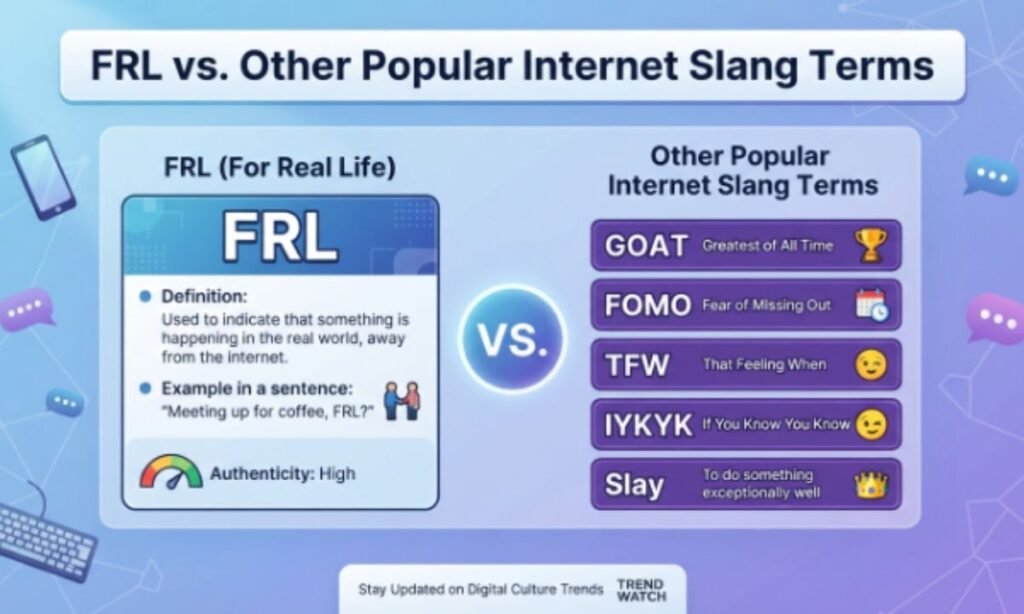
To communicate naturally in group chats, it helps to know how frl fits alongside other common texting acronyms.
- FRL and NGL (Not Gonna Lie): Often paired together to share an honest opinion (“NGL, that test was brutal frl”).
- FRL and ONG (On God): Both terms emphasize truthfulness, though ong carries a stronger, almost oath-like level of conviction (“I didn’t take your keys, ong frl”).
- FRL and No Cap: “No cap” means “no lie.” Pairing them reinforces that a statement is 100% authentic (“That was the wildest game ever, no cap frl”).
- FRL and TBH (To Be Honest): Used to introduce a sincere thought (“TBH I don’t really like that song frl”).
- FRL and ISTG (I Swear To God): Used when frustration or extreme emotion accompanies an honest claim (“ISTG I missed my bus again frl”).
How to Respond When Someone Says “FRL”
Knowing what to reply when someone says frl depends on how they used it in the conversation.
If They Used FRL to Agree With You
If a friend replies with “frl” after you share an opinion, they are validating your point. You don’t need a lengthy response.
- “Right?!”
- “Glad I’m not the only one.”
- “100%.”
If They Asked “FRL?” as a Question
If someone responds with “frl?”, they are looking for confirmation that what you said actually happened.
- “Yeah, I’m totally serious.”
- “I wish I was lying, but yeah!”
- “100% true story.”
If They Used FRL to Share Big News or Vent
When someone tells you a surprising fact and tags it with “frl,” acknowledge their emotion.
- “That’s crazy!”
- “No way, I can’t believe that.”
- “I feel you, that sucks frl.”
Formatting & Capitalization: “frl” vs. “FRL”
Does capitalization change the meaning of frl in chat? Technically no, but modern texting culture treats uppercase and lowercase styling slightly differently:
- Lowercase (frl): This is the standard, most common way to type the abbreviation among teens and young adults. It feels natural, casual, and effortless.
- Uppercase (FRL): Usually appears if auto-correct capitalizes the letters, or if the sender wants to show extreme enthusiasm, anger, or emphasis.
Common Slang Variations
You will frequently see frl combined with other short words in casual texting:
- frl tho: Short for “for real though.” Used to bring seriousness back to a conversation after a joke (“That was funny, but frl tho, we need to leave”).
- frl bro: Used when chatting casually with friends (“I’m so tired frl bro”).
- frl rn: Short for “for real right now.” Emphasizes an immediate feeling or situation (“I’m so hungry frl rn”).
- frl lol: Blends seriousness with humor, showing you mean what you said but find the situation funny (“I fell up the stairs frl lol”).
Mastering FRL in Everyday Texting
Modern internet shorthand moves fast, but the frl text meaning remains one of the simplest to master. Whenever you see frl on Snapchat, TikTok, or in your text messages, just read it in your head as “for real.”
Whether you use it to show a friend you’ve got their back, express disbelief at wild news, or clarify that you aren’t joking, frl is an efficient, natural way to keep your digital conversations honest and expressive.
Frequently Asked Questions
What does FRL mean in text messaging?
FRL stands for “For Real” in modern text messaging and online chat slang. It is used to emphasize that a statement is truthful, express strong agreement, or show shock during a conversation.
What is the difference between FR, FRL, and FRFR?
All three mean “for real,” but FR is the standard casual version, FRL adds the phonetic “L” sound for emphasis, and FRFR stands for “for real, for real” to show maximum seriousness with zero exaggeration.
What does “frl?” mean with a question mark?
When typed with a question mark, “frl?” translates to “Are you serious?” or “Is that actually true?” It signals surprise or skepticism and asks the other person to confirm what they just said.
How do you respond when someone texts “FRL”?
If they are agreeing with you, reply with simple validation like “100%” or “Right?!” If they asked “frl?” as a question, confirm your statement by replying “Yeah, totally serious” or “No lie.”
What does FRL mean on Snapchat and TikTok?
On Snapchat and TikTok, FRL means “For Real” and is used in comment sections, video captions, and snap overlays. Creators and viewers use it to highlight relatable moments, agree with hot takes, or emphasize genuine reactions.
Is FRL an official abbreviation or slang?
FRL is informal internet slang that developed naturally in digital culture rather than an official dictionary acronym. It is perfect for group chats and social media, but it should be avoided in professional or academic writing.
