

You’re walking to your car on a gray March morning, half lost in thought, when a streak of bright blue lands on a fence post. You stop without deciding to. For a second, something in your chest loosens, and the bluebird meaning you half remember from songs and greeting cards suddenly feels personal.
People search for this because the bird shows up everywhere. It appears in an old song, in devotional blog posts, in Native American stories, in Chinese myth, and in conversations after a hard week. The trouble is that each source says something slightly different, and some of the claims online are confident without being accurate.
This guide sorts it out. You’ll get the short answer, the origin of the “bluebird of happiness,” what different cultures believed, what the Bible does and doesn’t say, and what a sighting in your own yard most likely signals.
Bluebird meaning centers on happiness, hope, and calm reassurance. The bird symbolizes renewal because it returns in early spring, and its vivid blue reads as peaceful. Most traditions treat a sighting as a gentle sign of steadier feelings rather than a prediction. The Bible never names the bird.
What Does a Bluebird Symbolize?
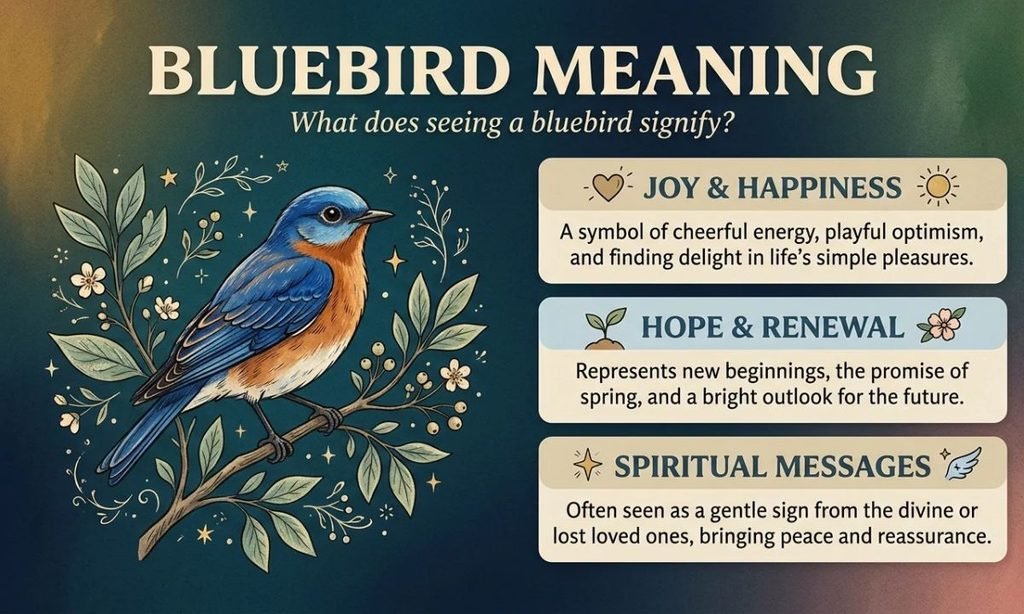
Across nearly every culture that has paid attention to the bird, a bluebird stands for hope, renewal, and quiet joy. Blue birds often signify calm, and the strongest pattern is emotional rather than predictive. A sighting rarely forecasts anything about your life. It marks a small shift in how you feel.
The longer answer comes from two sides: the stories people tell and the physics of the feathers. Both matter. The stories explain why the symbol stuck, and the science explains why the bird looks so striking in the first place.
In this article I’ll flag the places where the evidence gets thin, because a few popular claims, especially the biblical ones, don’t hold up when you check them.
Where Does the “Bluebird of Happiness” Come From?
Most English speakers know the idea from Maurice Maeterlinck’s 1908 play The Blue Bird. Two children travel across the world hunting for the bird that brings happiness. The twist is why it stuck: what they wanted turned out to be closer to home than they thought.
A 1934 song, “Bluebird of Happiness,” carried the phrase into everyday American speech. If you’ve ever heard someone say a person “has a bluebird on their shoulder,” that’s the lineage.
Maeterlinck didn’t invent the feeling, though. He borrowed everyday beliefs about a flash of blue showing up after a long, grey winter. Those stories and dreams were already circulating, and the bird became their shorthand.
The mood behind the phrase is hope and calm. Plenty of people feel a quiet sense of calm and a small wave of reassurance when a bluebird lands nearby. I’ve had it happen mid-walk, and the gentle feeling that follows is real even if the meaning is up for debate.
Why Does This Bird Feel So Meaningful?
Part of the answer is plain aesthetics. A male eastern bluebird on a brown fence post looks almost unreal, and aesthetic appreciation is where most people start, long before symbolism enters the picture. That vibrant color gives many of us a small jolt of the brilliance of life.
The Blue Isn’t Pigment
Here’s a detail I like: true blue is rare in nature, and bluebirds don’t carry blue pigment. Microscopic structures in the feathers scatter and bend light, so the plumage shifts in tone as your angle changes. This is why the bird looks brighter in sunlight and duller in shade.
That quality does something to the way we read it. Something can stand out visually and still feel soft, which is why people stare in curiosity instead of looking away.
Blue as a Calming Color
Blue feels open and quiet, like sky or water, so it signals calmness before you’ve consciously thought about it. Blue color symbolism covers the rest: sky, water, distance, and peace. Add the bird’s habit of showing up in early spring, when the air feels lighter and daily routines start loosening, and the timing reinforces the mood.
The Song
Then there’s the voice. The bluebird’s song is soft and melodic, nothing like a jay’s racket. Listeners often remember it longer than the color, and many hear it as a melodic expression of calm.
What Does It Mean When You See a Blue Bird?
The bluebird meaning in a personal sighting comes down to a moment of clarity and emotional steadiness. It is rarely dramatic. Across cultures, blue bird symbolism has stayed surprisingly consistent, and most readings treat the sighting as reassurance rather than a message.
The same logic keeps the blue bird spiritual meaning grounded. Most interpretations focus on how someone already feels instead of predicting something new. In practice, that amounts to clearer thinking and steadier emotions. It’s seldom a life-changing occurrence.
Here’s how that tends to play out in ordinary American life:
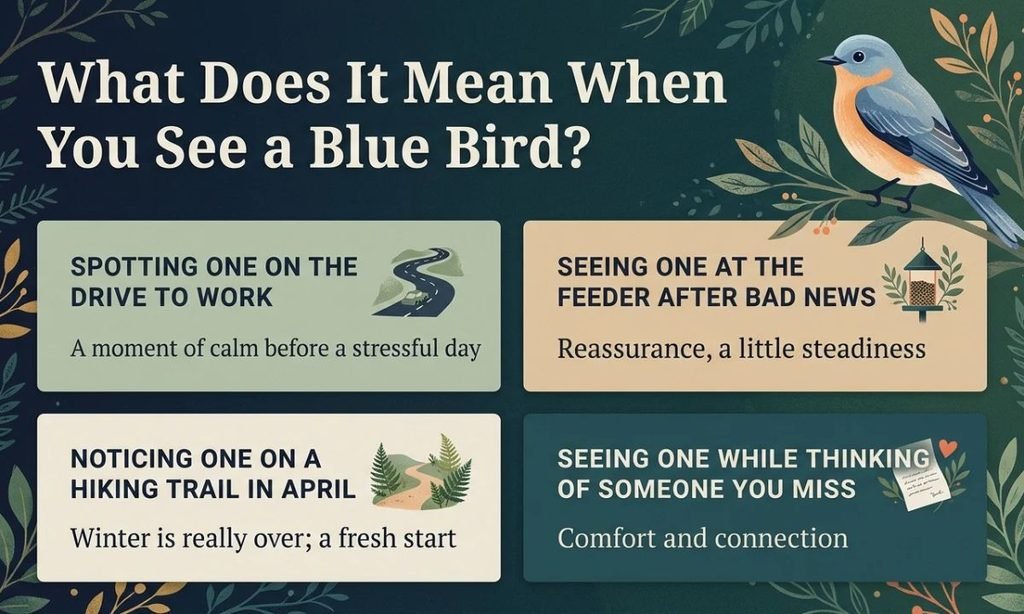
| Situation | What people usually read into it |
| Spotting one on the drive to work | A moment of calm before a stressful day |
| Seeing one at the feeder after bad news | Reassurance, a little steadiness |
| Noticing one on a hiking trail in April | Winter is really over; a fresh start |
| Seeing one while thinking of someone you miss | Comfort and connection |
None of these is a prediction. They’re all about attention, which is the thread that runs through every other section below.
Is Seeing a Blue Bird a Sign of Good Luck?
A blue bird sighting is generally considered a quiet positive sign rather than extreme luck. Nothing changes overnight. People tend to say they feel calmer afterward, and that small shift is the part they remember most.
Blue birds are usually noticed during quiet moments, such as early in the day or when things have slowed down. Because of that, the association is with gentle shifts instead of sudden change. If you’re hoping a bluebird means a lottery win, you’ll be disappointed.
It’s less about luck in the traditional sense and more about a calming everyday moment that feels slightly easier than the one before it. If you want a rule of thumb, treat it as a nudge, not a promise.
What Do Blue Birds Mean in Love and Relationships?
When people ask about blue birds in relationships, I notice they usually have something personal on their mind already. The link has a practical basis. Many blue bird species form strong pair bonds, share parenting, and return to the same nesting areas each year.
That points to steadiness rather than intensity. Patience, long-term connection, and consistency are the traits people read into a pair perched close together on a branch, a picture of calm connection and companionship.
A few common scenarios show how it works in real life:
- After an argument. Some people spot a bluebird during the quiet period that follows. These are calm, observant birds that perch and wait rather than react, so the association is with slowing down instead of pushing the conversation further.
- While thinking about someone you care about. The bird’s habit of staying near familiar spaces fits that thought.
- During routine time together. Seeing one on an ordinary Saturday reinforces how a stable connection actually works: through small, repeated habits.
The bird doesn’t predict outcomes. It reflects patience, consistency, and paying attention to what already exists between people.
Bluebird Meaning Across Cultures
Different traditions have read the bird in different ways, though the themes overlap more than you’d expect. Here’s a quick comparison before the details.
| Tradition | Core associations | Key detail |
| Native American | Spring, seasonal change, natural cycles, hope | Details vary by nation (Navajo, Iroquois, Plains, Southwest) |
| Chinese | Messages, harmony, divine connection | The qingniao serve Xi Wangmu |
| European folklore | Patience, luck, better times | German household luck; Russian tale of endurance |
Bluebird Meaning in Native American Traditions
Long before Maeterlinck’s play, Native American traditions tied the bluebird to spring. Its arrival meant winter was loosening its grip, and for communities that lived by the seasons, that kind of change was worth noticing. Many accounts call the bird a bringer of good news, a messenger of hope, and an emblem of the return of spring.
Those meanings came from watching nature closely instead of building abstract ideas around it. Among the Navajo, the bird is often linked with sunrise and warmth. Iroquois traditions describe its soft calls as part of the move from winter into spring, which tied it to planting cycles and renewal rather than luck alone.
The pattern repeats across Plains and Southwest groups. Because the birds return at predictable times each year, people treated them as quiet markers of change. They appear in ceremony, storytelling, and everyday life without feeling forced, and the symbolism grew out of repeated experience.
Details differ between nations, so I’m wary of anyone who offers one single “Native American meaning.” What the accounts share is positivity and bright future symbolism. The bluebird’s meaning here works more like a seasonal forecast than a prophecy.
Chinese Tradition: The Blue-Winged Messenger
In Chinese tradition, blue birds symbolize messages, harmony, and divine connection. In mythology, the qingniao serve Xi Wangmu, the Queen Mother of the West. Early texts like the Shan Hai Jing describe them carrying messages between realms.
One caution: the name is usually rendered “blue-green bird,” so this isn’t a North American bluebird, and the link is symbolic rather than literal. Still, the job description matches. Carry word between worlds and bring good news.
The idea stayed consistent in later poetry and painting. Court and literary settings usually show these birds as messengers, not emotional symbols, and the ideas of blessing and order stuck with them.
European Folklore
Across Europe, blue birds are tied to patience, luck, and the arrival of better times. This idea developed mostly through storytelling rather than ritual. In German seasonal folklore, small blue songbirds were linked with household luck and the end of winter. In farming communities especially, their return meant stable weather and the start of regular work.
Russian tradition gives a clearer example in nineteenth-century retellings of the folktale translated as “The Blue Bird” (Sinjaja ptitsa). Those stories describe long journeys before the bird appears. That tied it to patience and endurance instead of sudden fortune, a kind of good fortune that arrives late.
As tales like these spread across Europe, they shaped how blue birds were understood in later cultural symbolism.
Bluebird Meaning in the Bible
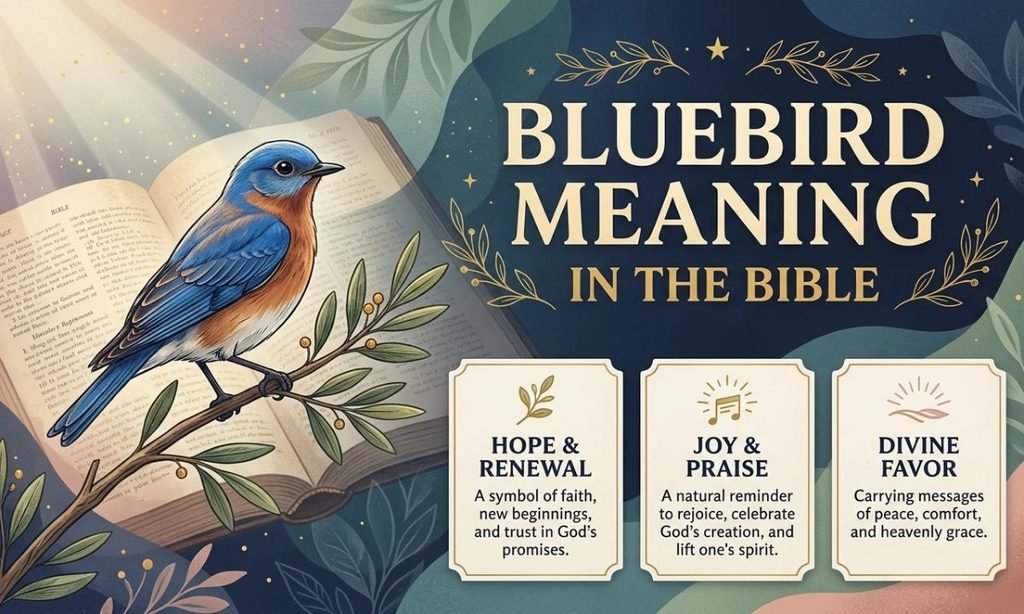
This is the section where I slow down. Search for the bluebird meaning in Bible and you’ll find article after article with confident claims. But the Bible never mentions a bluebird. The species is native to North America, so it was never part of the world the writers of scripture knew.
What you’re reading is biblical interpretation: writers taking established themes and applying them to a bird they love. As a devotional exercise, that’s fair. Just don’t mistake “bluebird in the Bible” for a verse reference.
What Scripture Actually Says About Birds
The groundwork is real, though. In Matthew 6:26, Jesus points to the birds of the air as proof that God cares for creation. That unwavering care for small creatures is the thread these writers pull. In many readings, birds symbolize divine communication, and the bird that actually shows up in scripture is the dove, at Jesus’ baptism and in Noah’s story.
The Christian Reading
Within Christianity, believers who adopt the bluebird often treat it as a symbol of the Holy Spirit, borrowing from the dove. I’d call that a stretch rather than a tradition, though it’s common online. The bird’s vibrant hue gets tied to hope, comfort, and guidance.
Its return in spring gets tied to resurrection and new beginnings. Resurrection symbolism is probably the strongest of these links, because the bluebird shows up right as the ground thaws. Other biblical themes follow: spiritual journeys, protection, and heaven, since blue is the color of the sky.
Promise, Grace, and the Covenant
Writers who love this bird lean on the purity of the sky. Vast skies become a picture of God’s plan, and a bird soaring across them stands for endless possibilities. That’s a spiritual metaphor, and a decent one.
The closest scriptural anchor is the covenant with God after the flood, when a sign appears in the sky along with a promise. A blue bird overhead becomes a poignant reminder of God’s promises, and devotional posts usually pair it with God’s promise and protection.
That’s where faith and joy symbolism enters. The word that keeps appearing is trusting: trusting God’s plan, and leaning on the unwavering faithfulness behind it. Readers talk about faith, faithfulness, and purity, and they count a sighting among their blessings. Many find solace and spiritual hope in it, and some call the bird a symbol of joy and divine presence.
Grace is the other thread. Paul’s instruction to rejoice in the Lord always (Philippians 4:4) is the verse most often paired with the bird, and God’s goodness and grace is the theme underneath. Writers call the bluebird a unique messenger of spiritual reassurance, one of those beautiful creatures that point to divine provision.
A sighting becomes a divine nudge, aimed at people facing adversity and life’s challenges. The promise attached is divine presence and protection: not a smoother road, but company on it.
Is the Bluebird a Messenger?
Messenger is the role that ties nearly every tradition together. Bluebird as a messenger shows up in Native American, Chinese, and Christian readings alike. Each time, the bird is a direct link to the divine, a courier of divine communication rather than the source.
People call it spiritual guidance in feathers. I’ve seen the phrase “spiritual signs and signals” stretched to cover anything from a bird on the windowsill to a song heard at the right moment.
The inner voice angle is the one I find most grounded. Inner voice guidance simply means the bird gives you a reason to stop and listen to yourself. That’s what soul and spirit symbolism boils down to. The bird doesn’t speak, but it quiets enough noise that your own voice gets through. Spirits lift, and a flat morning can feel invigorated.
Spiritual narratives around the bird keep returning to that connection, and I think the inspirational meaning is why the symbol survives in so many cultures. If nothing else, it brings a shift in mood.
What Is the Spiritual Meaning of a Bluebird Sighting?
In spiritual readings, spotting a bluebird comes down to a gentle nudge. The bluebird’s spiritual meaning usually involves three moves:
- Let go of burdens.
- Find light in uncertainty.
- Cultivate inner peace.
Even a small nudge can change how a day feels. Readers describe it as a call for spiritual progress, a prompt to reconnect with their true selves. The soul’s journey doesn’t need a dramatic sign, and the beauty of transformation lies in how ordinary the trigger is.
Gratitude tends to follow, then a kind of enlightenment in the small, practical sense of seeing the day more clearly. Blessings, happiness, and joy show up quietly. It’s spiritual meaning without the fireworks, and it still counts when life’s challenges are loud.
The Hidden Meanings Are Smaller Than They Sound
The hidden meanings are less mystical than they sound. The bluebird works as a profound symbol precisely because it’s small. Most of what people draw from it comes down to small moments: a flash of blue at the feeder while life’s chaos is loud, and suddenly there’s some tranquility, a little serenity, a sense of safety.
Writers who read the bird spiritually pull out a few repeating ideas:
- Hope and renewal symbolism sits up front.
- Inner joy symbolism comes next.
- Spiritual growth and symbolism follows, tied to resilience and a way to reconnect with purpose.
- Many people find the bird nudges them toward the brighter aspects of life, a modest kind of satisfaction that holds through challenges.
Taken together, it shapes an understanding of joy and happiness as something you notice along the journey, not something you arrive at.
In devotional writing, the bluebird is also a symbol of spiritual awakening, one that guides and nurtures the soul. It’s one of God’s creations, and nature gets credit for the tender care many people feel they’ve lost. Harmony and solace are the usual words. The emotional landscapes it touches differ from person to person, but the deepest desires are the same: safety, belonging, a bit of peace. That’s the human experience in a feeder-sized frame.
Are Blue Birds a Sign of Death?
Almost never. Blue birds are not considered a sign of death in folklore, memorial writing, or modern belief, even though the idea can sound unsettling at first. They have a positive reputation, even when someone notices one during a difficult time. The meaning tends to reflect how that person is already feeling.
That’s partly why the bird comes up so gently in conversations about grief. People mention seeing one near anniversaries, hospital visits, or quiet mornings after loss. They read these moments as comforting rather than symbolic, which is why the blue bird meaning death question gets a soft, grounded answer instead of a fearful one.
The bird isn’t treated as an omen. It’s remembered as a calm presence that helps people steady themselves during emotional moments.
What Does It Mean When a Blue Bird Visits Your Yard?
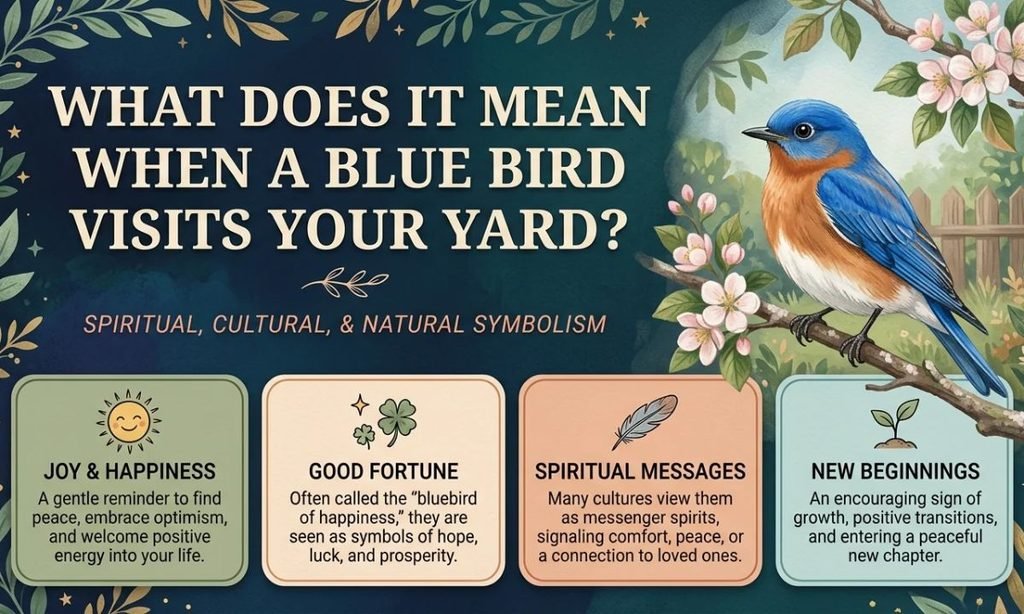
A blue bird visiting your yard usually reflects a natural pause and a moment of quiet awareness. There’s often a simple reason, too. These birds like open space where they can spot insects easily, so lawns, fences, and quiet gardens draw them in.
You’ll often see one pause on a rail or low branch, watching the ground before dropping down to feed. They also use nest boxes and old tree holes, which is why they come back to familiar places each season. If you put up a birdhouse in your backyard, you make an everyday visit more likely.
So what does it mean when a blue bird visits you? The meaning people describe stays calm and practical, and the answer usually comes back to attention, not prediction. The moment interrupts routine in a quiet way. Most people read it simply: slow down, notice what’s happening around you, and stay open to what’s already taking shape.
The Science and the Middle Ground
Some people look at the bluebird through science, and honestly, that makes sense. The color comes from light scattering through the feathers, not pigment. The bird is usually just feeding, resting, or passing through like any other small songbird. That view is clear, practical, and complete on its own.
At the same time, plenty of people still read something more into it, especially during emotional stretches of life. That perspective is just as real in its own way.
How I Read a Bluebird
Having sorted the sources, here’s where I land. The Bible doesn’t mention the bird, but the themes readers attach to it are old: joy, hope, and divine promise. The bluebird carries a promise of happiness only if you bring that frame yourself. Taken that way, it’s a testament to how people hunt for meaning in ordinary things, and a reminder that themes of joy and hope don’t need a verse number.
The layers are there if you want them: the science of the feathers, the lessons from Maeterlinck’s play, the spiritual insight of old traditions, and a deeper connection to the natural world. One message runs through all of them, a message of love and joy.
If you enjoy figuring out what everyday terms really mean, our plain-language breakdown of APKPure meaning follows the same approach: where a term comes from and how people actually use it.
Most of the time, the bluebird meaning sits somewhere in the middle. You notice the bird, pause for a second, and then keep going. Whether you see biology, comfort, or both, the moment stays simple, calm, and easy to carry with you.
My own takeaway is simple: seek beauty in everyday life, including your own. If a bright blue bird turns up on your fence this spring, stop for a second. That’s the whole practice.
FAQs
What does a bluebird symbolize?
A bluebird symbolizes happiness, hope, renewal, and calm reassurance. Its early-spring return and vivid blue color are the main reasons it became a sign of fresh starts.
What does it mean when you see a bluebird?
Most people read it as a moment of clarity and emotional steadiness. It’s usually seen as a gentle sign of calm, not a prediction about your life.
Is seeing a bluebird good luck?
It’s considered a quiet positive sign rather than big luck. Many people say it leaves them feeling calmer, which is the part they remember most.
What is the “bluebird of happiness”?
The phrase comes from Maurice Maeterlinck’s 1908 play The Blue Bird. In it, two children search the world for happiness and find it at home. A 1934 song helped carry the phrase into everyday speech.
Is the bluebird mentioned in the Bible?
No, the Bible never names a bluebird. The species is native to North America, so biblical meanings are modern interpretations drawn from themes like God’s care, hope, and promise.
What is the spiritual meaning of a bluebird?
Spiritually, a bluebird is seen as a gentle nudge to let go of burdens, find light in uncertainty, and cultivate inner peace. Most readings focus on joy, renewal, and gratitude.
What does a bluebird mean in Native American culture?
Many Native American traditions link the bluebird to spring, seasonal change, and good news. Details vary by nation, such as sunrise and warmth for the Navajo and seasonal shifts for the Iroquois.
What does a bluebird symbolize in Chinese culture?
In Chinese tradition, blue birds symbolize messages, harmony, and divine connection. The qingniao in the Shan Hai Jing serve as messengers for Xi Wangmu, the Queen Mother of the West.
Is a bluebird a sign of death?
Almost never. Folklore, memorial writing, and modern belief give the bluebird a positive reputation, and many people find its presence comforting during grief.
What does it mean when a bluebird visits your yard?
Usually it’s a natural pause and a moment of quiet awareness. Practically, bluebirds are drawn to open space, insects, nest boxes, and old tree holes.
What does a bluebird mean in love and relationships?
Bluebirds symbolize steadiness, patience, and long-term connection. Many species form strong pair bonds, share parenting, and return to the same nesting areas each year.
Why are bluebirds blue?
Their blue comes from tiny feather structures that scatter light, not from pigment. That’s why the color looks brighter in sunlight and duller in shade.
Is a bluebird a messenger from God or a spirit?
Many traditions treat the bluebird as a messenger or a link to the divine. Most readings see it as prompting you to pause and listen to your own inner voice, not as a literal message.
