

You are scrolling through your messages and there it is: a lone “NYN” with no explanation. If you have wondered what does NYN mean in text, you are in good company, because this one trips up plenty of people. The short version is that it most likely stands for “No, You’re Not.”
NYN is not a classic acronym like LOL or BRB, so people search for it after seeing it in a group chat, a Snapchat reply, or a TikTok comment. Three letters with no context are easy to misread. The meaning shifts with the tone, the people, and the platform.
This guide covers what the letters stand for, how people use them, and where you are most likely to see them. You will also get realistic examples, reply ideas, and a few tips for not embarrassing yourself with it.
Quick answer: NYN most likely stands for “No, You’re Not.” People use it as a quick reply to disagree with a statement, tease a friend, or reassure someone who is being too hard on themselves. It is informal slang, not a standard acronym, so the meaning depends on the conversation and who sent it.
What NYN Stands For

The letters break down simply. N is for No, Y is for You’re, and the last N is for Not. Together they form “No, You’re Not.”
People use this slang expansion to reject a claim, correct someone, or joke with a friend. Say someone announces they are the fastest runner in the group, or the best singer. A friend answers with NYN, possibly as a joke.
Here is the honest part. This is a niche interpretation. No dictionary treats it as a standard abbreviation, and I have never seen a verified origin for it. If anyone tells you they know exactly who coined it and when, I would be skeptical.
When clarity matters, write the phrase out in full. “No, you’re not” takes a few extra seconds and removes all the guesswork.
Quick Definition of NYN
Think of NYN as a texting abbreviation built for casual conversations. It is shorthand for telling someone they are wrong about a statement, and that statement is usually about themselves.
Picture a simple exchange. Person A says they are terrible at this game. Person B replies “NYN” because A is actually pretty good. B responds to the statement directly, with no extra words.
You will mostly find it in text messages, online chats, social media platforms, and gaming communities. It is a spoken-aloud-in-your-head kind of reply, quick and a bit blunt.
The Simple Meaning Behind the Letters
At its core, NYN is a short way of telling someone they are mistaken. You might use it to disagree politely, to encourage a friend, or to reassure someone who is beating themselves up.
Spelled out, it can mean “you’re better than you think,” “that’s not true,” or just “I disagree.” Sometimes it is a plain move to correct a statement. The topic is usually how a person talks about themselves.
The real appeal is speed. People like to respond quickly, and a shorthand version beats full sentences. It replaces a whole sentence in moments when typing a paragraph would feel like overkill.
Why People Use NYN
There are a few reasons people reach for NYN instead of typing the full phrase. Most are practical, with a little social instinct mixed in. In my own chats, the shortcut wins nearly every time.
It Saves Time
It is three letters. Instead of typing “No, you’re not,” people write NYN, which is quicker than an entire sentence. That is abbreviation efficiency, the same reason anyone cares about typing speed on a phone.
It Keeps Conversations Moving
Online conversations move fast, and quick replies keep a thread alive. Abbreviations help people respond instantly, so the chat never stalls waiting for a long answer.
It Shows Support
Often NYN is a supportive tone in disguise. When someone is too hard on themselves and types “I’m ugly,” NYN pushes back on that self-criticism. I have seen people use it this way many times, and being kind in two seconds is a real use of encouragement.
It Belongs to Internet Culture
NYN sits in the same family as LOL, BRB, IMO, TBH, and IDK. Internet users shorten words and phrases constantly, and those shortened phrases turn into a slang category of their own. NYN fits that habit, even if it is one of the less common ones.
Where NYN Is Used
Everywhere NYN shows up is informal, and almost all of it is online. You will see it across many platforms, in several kinds of online conversation, and in some communities more than others. Here is the breakdown as I have run into it.
Text Messages
Friends use it in casual chats. Say someone texts, “I’m so boring,” and the reply comes back, “NYN. Everyone loves hanging out with you.” That is friendly usage and quick reassurance. Text messaging suits it because nobody expects polish.
Social Media
On Instagram, TikTok, Snapchat, Facebook, and X (formerly Twitter), abbreviations save time and space. Platform language leans short, especially in a comment or reply. Someone posts, “I’m probably the worst artist here,” and a follower writes, “NYN, your work is amazing.” Three letters plus a compliment does the job.
Online Gaming
Gamers type fast while playing, so short forms are everywhere. A player says they keep messing up, and a teammate answers, “NYN, you’re helping the team a lot.” That one line carries both encouragement and support. It keeps the game moving.
Group Chats
Group chats get busy, and quick abbreviations keep conversations flowing. Someone writes, “Nobody wants me on the project,” and a group member replies, “NYN. We definitely do.” In a crowded thread, speed matters as much as the message.
How NYN Gets Used in Text Messages
NYN works as a quick response to a statement. The examples below are illustrative. They show how the abbreviation could work if the sender means “No, You’re Not,” but they do not prove that everyone types it that way. The meaning is conditional on the people and the subject.
When Someone Brags
A person drops a confident claim like “Nobody can beat me at this game,” and a friend answers NYN. It is a challenge, and the friend may be teasing someone a little overconfident. People who brag casually usually expect to be called out.
When Friends Joke Around
Friends disagree for fun all the time. If A says, “I’m the most popular person in school,” and B replies NYN, both people get the joke. Without that shared understanding, the same reply can land very differently.
When Someone Makes a Claim
Say A types, “I’m always right,” and B writes NYN. B is rejecting a statement A made about themselves. Here the letters work as a simple disagreement marker.
When Someone Challenges a Friend
NYN also appears in playful arguments and friendly debates. A says, “You know I’m better at football than you,” and B writes, “NYN, bro.” That reply invites the debate to continue, and the back-and-forth is the fun part.
NYN Meaning on Snapchat
On Snapchat, NYN can show up in a private message or a group chat as a quick reply. If the sender means “No, You’re Not,” they are disagreeing with a claim or playfully rejecting it. Say A writes, “I’m the best dancer in our group 😂,” and B answers NYN.
Snapchat has no fixed meaning for it, though. It is not a standard abbreviation on the platform. If the conversation does not make things clear, ask what the sender intended.
NYN Meaning on TikTok
TikTok users run into unfamiliar abbreviations in comments, captions, and direct messages all the time. A creator or commenter might use NYN as a short disagreement. Picture A saying, “This is the best outfit ever,” and B replying NYN. If B means a similar disagreement, they are rejecting the statement.
There is no universal TikTok meaning, though. It could be an inside joke, a typo, or the shorthand of one particular group. The exact meaning only shows up in the conversation, so avoid assuming.
NYN Meaning in Gaming Chats
Gaming chats run on short replies and competitive banter. Player A might say, “Nobody in this lobby can beat me,” and Player B answers NYN. The point is that Player A is not unbeatable.
Here is another. Player A says, “I’m carrying this whole team,” and Player B writes, “NYN, we all helped.” B is reminding everyone that the team contributed.
Gaming communities love inventing their own shorthand. A specific game or group may use the same letters for something else entirely. If the setting does not support “No, You’re Not,” ask for clarification.
Real-Life Examples of NYN in Text
Examples show natural usage better than definitions do. These are illustrative conversations, not quotes from real people, and they do not prove that everyone uses the abbreviation this way. Start with the supportive side.
Supportive Examples
Confidence boost: Sarah says she is bad at public speaking. Mike answers, “NYN. Your presentation was excellent.” Mike disagrees and offers encouragement.
School conversation: A student says they are going to fail the test. A friend replies, “NYN. You studied all week.” The friend thinks the student is being too negative, so this is reassurance aimed at negative self-talk.
Social media comment: A user posts, “Nobody likes my content.” A follower replies, “NYN. Your videos are awesome.” That is a follower offering reassurance to a content creator.
Gaming chat: A player says, “I’m the weakest person on this team.” A teammate responds, “NYN. You’re carrying us.” The teammate strongly disagrees, and the disagreement doubles as encouragement.
Relationship chat: One person writes, “I’m annoying.” Their partner answers, “NYN. You’re one of my favorite people.” It is affectionate, and three letters carry real warmth.
Teasing and Banter Examples
These ten show the playful side, where NYN is more of a friendly jab.
- Gaming: A: “I’m the best player in this lobby.” B: “NYN 😂” (B disagrees with the claim.)
- Singing: A: “I should be a famous singer.” B: “NYN 😭” (B may be teasing, or disagreeing outright.)
- School: A: “I’m definitely the smartest person in class.” B: “NYN, bro.” (B says A is not.)
- Sports: A: “Nobody runs faster than me.” B: “NYN.” (A straight disagreement.)
- Joking with a friend: A: “I’m the funniest person you know.” B: “NYN 💀” (B playfully rejects the statement.)
- Fashion: A: “My outfit is better than everyone’s.” B: “NYN 😂” (Friendly teasing, possibly.)
- Cooking: A: “I’m the best cook in my family.” B: “NYN, remember the burnt pizza?” (The joke has a reason behind it.)
- Competition: A: “I’ve already won this challenge.” B: “NYN, it’s not over yet.” (B says A has not won yet.)
- Being right: A: “I’m always right.” B: “NYN. Nobody is always right.” (B backs the disagreement with a point.)
- Friendly banter: A: “Admit it, I’m your favorite friend.” B: “NYN 😂” (B playfully denies it.)
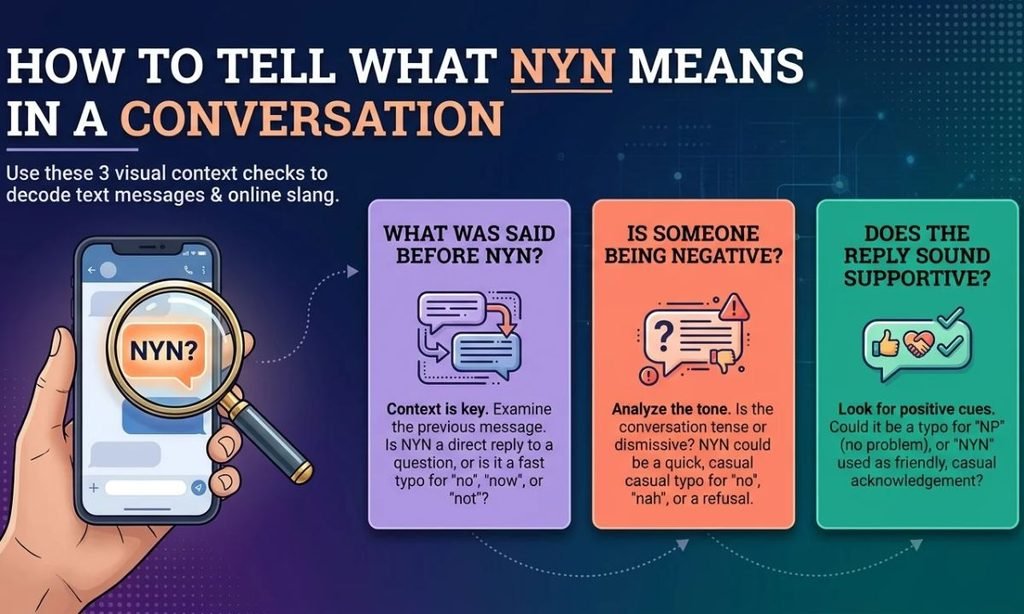
How to Tell What NYN Means in a Conversation

When the meaning is unclear, a few questions will usually settle it. Read the conversation around the message and look for contextual clues.
What Was Said Before NYN?
Look at the statement that came right before. If the previous message was “I’m terrible at basketball,” the reply NYN clearly means “No, you’re not.” The conversational flow gives it away.
Is Someone Being Negative?
If a person is criticizing themselves and gets NYN back, it is probably reassurance. Negative sentiment followed by that reply points to a supportive use. Self-criticism is the strongest cue.
Does the Reply Sound Supportive?
Tone matters. A warm, positive tone suggests the encouraging reading. Even tools built for sentiment analysis rely on the same signals, and they point to the same conclusion when the mood is friendly.
A playful tone with emojis like 😂 or 💀 usually signals teasing instead. Together, these three checks answer what does NYN mean in text for almost any real conversation.
How to Reply When Someone Says NYN
Your reply depends on tone. If your friend is joking, joke back. If they seem serious, ask why. There is no single script, only options that match the mood.
Funny Replies
If a friend uses NYN to tease you, you might say:
- “Yes I am 😂”
- “Keep telling yourself that.”
- “You just can’t admit it.”
- “Let’s agree to disagree.”
- “Prove me wrong!”
These playful comebacks suit banter between people who know each other well.
Casual Replies
To keep things relaxed and neutral, try:
- “Why do you say that?”
- “Maybe, maybe not.”
- “Fair enough.”
- “What makes you think so?”
If You Don’t Understand NYN
Send a simple question: “What do you mean by NYN?” It is often the best choice, because the abbreviation is not widely standardized. Asking beats guessing and gets you the sender’s intended meaning.
Is NYN Rude or Offensive?
Not automatically. Among friends, it is harmless teasing, like replying NYN when someone jokingly claims to be the best gamer in the group. The tone depends on the situation.
In a serious conversation, it can feel dismissive. If someone shares something personal and gets NYN back, they may feel you are not taking them seriously. Before sending it, ask yourself whether the other person will understand the abbreviation and whether the mood is playful.
To disagree politely, you can say “I don’t think that’s true” or “I see it differently.” Those phrases are clearer and cause less confusion than three letters that might read as brusque.
Is NYN Positive or Negative?
It depends on who is using it. Many people use NYN to encourage someone or to challenge a negative self-belief, and in that case it is positive. Others use it to tease or reject a boast, and then it is a playful or mildly negative jab.
That split is why the two common readings, reassurance and banter, can both be correct. The surrounding conversation decides which one you are looking at.
NYN vs NTM, NVM, IDK, and Other Abbreviations
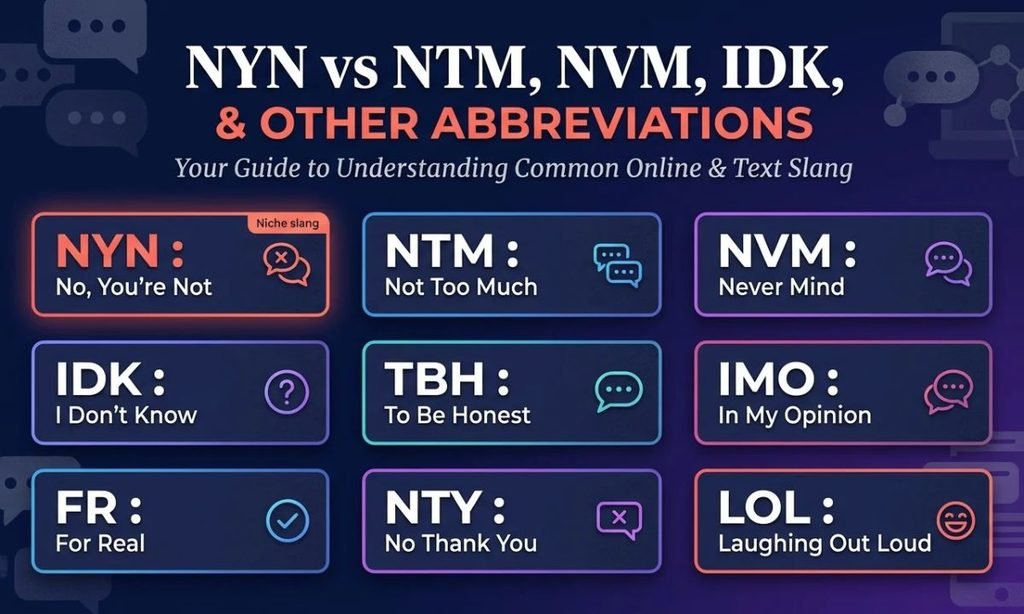
Short abbreviations get mixed up easily, so a side-by-side comparison helps. These are not interchangeable. The key difference is that NYN responds to a statement by rejecting it.
| Abbreviation | Meaning | Common use |
| NYN | May mean “No, You’re Not” in niche slang | Disagreeing with a statement |
| NVM | Never Mind | Taking back a question or dismissing a point |
| IDK | I Don’t Know | Saying you do not know |
| TBH | To Be Honest | Sharing an honest opinion |
| IMO | In My Opinion | Giving a personal view |
| FR | For Real | Showing seriousness or agreement |
| NTY | No Thank You | Politely refusing an offer |
| LOL | Laughing Out Loud | Showing amusement |
NTM looks similar in shape, but it belongs to a different group of abbreviations. FR leans toward agreement, while NYN is about disagreeing. NYN is also less established than the familiar ones on this list, so do not treat it as a stand-in for any of them.
Can NYN Have Other Meanings?
Yes. Niche groups, organizations, and online communities can all use the letters differently. This is why I would never claim one answer fits everywhere. IIf you want the technical label, the situation resembles polysemy, where one form carries more than one meaning.
“No, You’re Not” is the most widely understood reading in casual conversations I have seen. Still, a community can define its own, and then the common reading stops applying.
Some sources that list NYN come from user-submitted slang references. That is a useful clue about how established it really is: it exists, but it is not backed by the kind of wide recognition that something like LOL has.
Is NYN Popular Today?
Not very. NYN does not match the reach of LOL, OMG, BRB, IDK, or TBH, and it is not universally recognized. Some people understand it immediately. Others need a quick explanation.
Recognition depends on age groups, online communities, and messaging habits. Slang popularity can also shift, so an obscure term can spread quickly or fade out. For now, treat NYN as a niche piece of online slang culture.
When to Use NYN (and When Not To)
Use it when you want to disagree with a negative statement or offer reassurance. This is guidance based on how people actually respond, not a rulebook.
Good Situations
The best fits are negative self-statements like “I’m ugly,” “I’m bad at this,” “Nobody likes me,” “I’m not smart,” or “I’m boring.” Say someone tells you they are terrible at cooking, and you reply, “NYN. That dinner was delicious.” That is appropriate usage with a clear target.
Casual Conversations
NYN works best with family, friends, and online friends. It also fits social media interactions and gaming chats. Informal communication is its home turf.
Informal Settings Only
Keep NYN out of business emails, professional reports, academic writing, and formal workplace communication. A classic workplace mistake would be replying “NYN” to a manager who said they were not great at a presentation. The reply may be meant kindly, but it can read as abrupt or confusing.
In professional settings, write the full phrase. The mismatch between formal and informal register makes you look careless, and NYN belongs strictly to casual use. It is informal slang, and in a work context it may come across as dismissive.
Common Mistakes About NYN Meaning
People misread NYN because it is uncommon and depends so heavily on context. Here are the mix-ups I see most.
Thinking It’s a Typo
Some readers assume the sender typed it by accident. That is a reasonable guess if you do not know the abbreviation, and it is often the first reaction. Ask what it means. A quick question beats a wrong reply.
Confusing It With Other Slang
People sometimes mix NYN up with other abbreviations, especially short three-letter slang like TSS, which has its own separate meaning in texting. The confusion usually fades once you read the surrounding conversation. Look at what came before, and the meaning tends to become clear.
Assuming It Has One Universal Meaning
Slang changes across communities. “No, You’re Not” is the most common texting reading, but variation exists, and community-specific slang can contradict it. Specific groups may use their own meaning.
Five Quick Mistakes to Avoid
- Assuming one universal meaning. There is no single definition across all texting communities.
- Assuming everyone knows it. Many people do not, so writing “No, you’re not” in full is clearer.
- Thinking it is always an insult. It can be playful teasing or serious disagreement, and tone matters.
- Letting the platform decide the meaning. Seeing NYN on TikTok, Snapchat, or Discord does not fix a definition. Read the surrounding messages.
- Guessing when it is unclear. It could be a typo, personal shorthand, or a community-specific term. Ask the sender.
Pro Tips for Using NYN Correctly
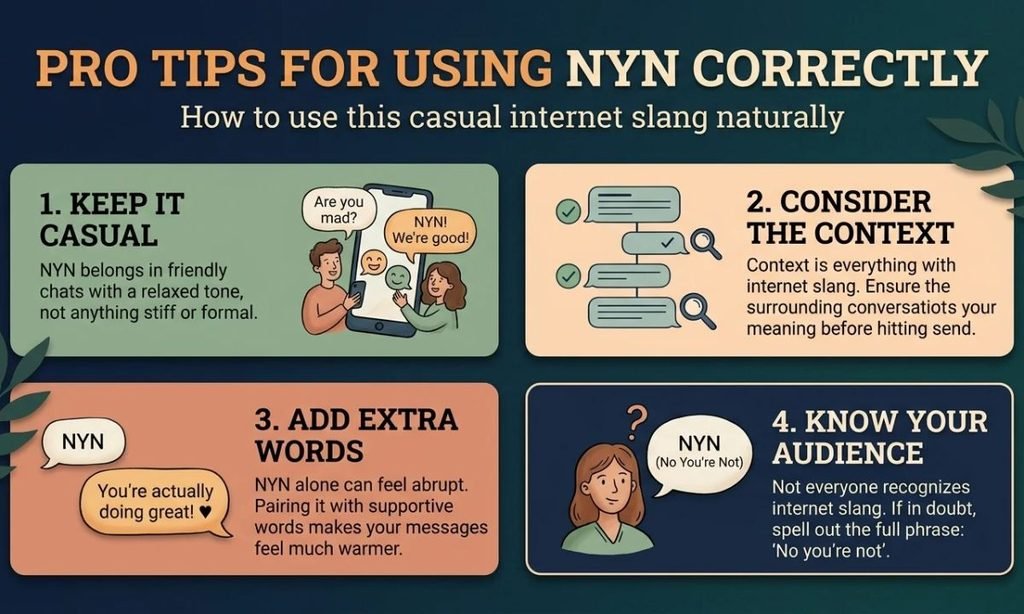
These are the habits that have served me well.
- Keep it casual. NYN belongs in friendly chats with a relaxed tone, not anything stiff.
- Consider the context. Context is everything with internet slang. Make sure the conversation supports the meaning you intend before you hit send.
- Add extra words when needed. NYN alone can feel abrupt. A line like “NYN. You’re actually doing great” feels much warmer.
- Know your audience. Not everyone recognizes it. If someone is unfamiliar with internet slang, write the full phrase.
What to Take Away
So, what does NYN mean in text? Most of the time it means “No, You’re Not,” and people use it to disagree, to reassure a friend, or to tease someone who just bragged. It is quick, casual, and best kept among people who will get it.
It also has limits. Nobody can point to a confirmed origin, plenty of people have never seen it, and a few groups may use it differently. If a message is still unclear after you read the surrounding conversation, ask the sender instead of guessing. That habit has saved me more awkward moments than any slang glossary.
FAQs
What does NYN mean in text?
NYN most likely means “No, You’re Not.” People use it to disagree with a statement, usually one a person makes about themselves.
It is informal slang, so the meaning can change with the conversation.
What does NYN stand for?
The letters stand for N (No), Y (You’re), and N (Not). Together they read “No, You’re Not.”
This is a niche interpretation, not a standard abbreviation.
Is NYN a real texting abbreviation?
It exists in some online slang references, but it is not widely recognized like LOL or BRB.
Many people have never seen it, so confirm the meaning if it is unclear.
What does NYN mean on Snapchat?
On Snapchat, it is usually a quick reply that disagrees with a claim or teases a friend.
Snapchat has no fixed official meaning for it, so check the chat around it.
What does NYN mean on TikTok?
On TikTok, it may be a short disagreement in comments or direct messages.
It could also be an inside joke or a typo, so read the surrounding comments.
Is NYN rude or offensive?
Not automatically. Between friends, it is usually harmless teasing or encouragement.
In a serious conversation, it can sound dismissive, so use it carefully.
How do you reply when someone texts NYN?
If they are joking, joke back with something like “Keep telling yourself that.”
If you are unsure, ask “What do you mean by NYN?”
Is NYN the same as NVM or IDK?
No. NVM means “Never Mind” and IDK means “I Don’t Know,” while NYN may mean “No, You’re Not.”
They are different abbreviations with different jobs.
Can NYN have more than one meaning?
Yes. Some groups, gaming communities, or friend circles may use the letters differently.
“No, You’re Not” is the most common reading, but context decides.
Can I use NYN in a work email or professional message?
It is best to avoid it. NYN is informal slang and may come across as abrupt or confusing at work.
Write “No, you’re not” in full, or use a polite phrase like “I see it differently.”
