

You thank a friend for help, and they fire back three letters: “YWA.” Maybe you laughed, maybe you froze. If you’ve ever stared at your phone wondering what does YWA mean in text, you’re in good company.
People search for this one because it looks like a typo or a cousin of “YW,” and it pops up in group chats, comment sections, and DMs with no explanation. The tone is the confusing part. The same three letters can sound sweet, joking, or a little sharp, depending on who sends them and when.
This guide covers what the letters stand for, why that last “A” matters, and where the term likely came from. You’ll also get real examples, safe replies, and a clear sense of when to skip it entirely.
Answer Block: YWA usually means “You’re Welcome Anyway.” It’s informal texting slang, sent as a reply to a thank-you. The word “anyway” hints that the help was overlooked, unneeded, or didn’t work out. Depending on tone and context, it can be friendly, playful, or slightly sarcastic.
YWA Meaning: You’re Welcome Anyway
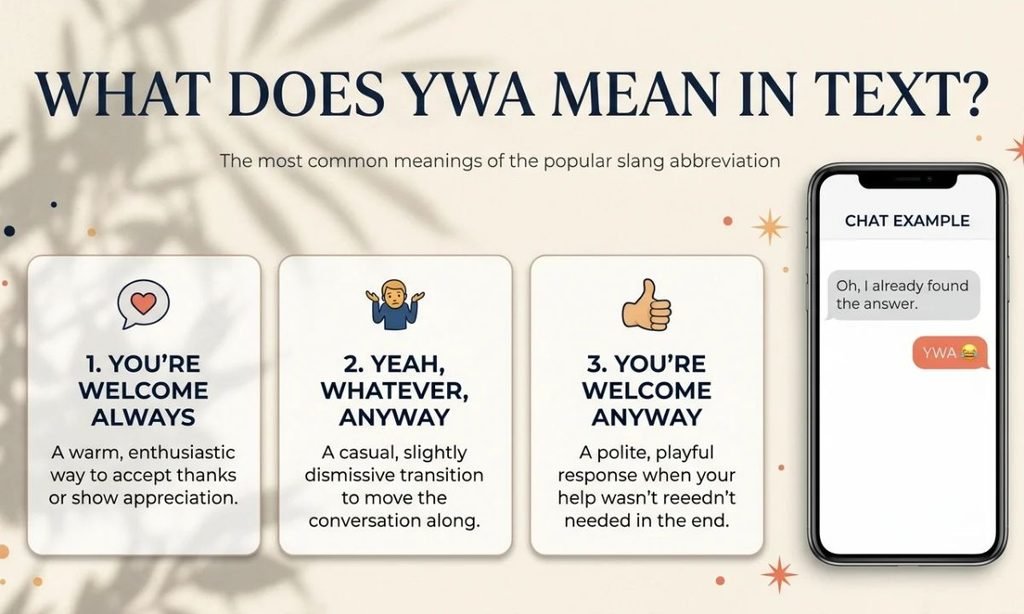
At its core, YWA is a short, casual way to say “you’re welcome” while admitting the outcome was a bit messy, overlooked, or funny. The sender might be hinting that you forgot to thank them, didn’t appreciate the help, or didn’t respond as expected. Or they might just be joking. Which one it is depends on the conversation.
What the Letters Stand For
The breakdown is simple. Y is “You’re,” W is “Welcome,” and A is “Anyway.” Three letters stand in for three everyday words, which is why it works so well in quick chats.
It’s an abbreviation used mainly in informal digital communication, where short phrases win. Written this way, it feels personal, direct, and a little self-aware. It suits friends, classmates, and relatives who share a relaxed style.
Why the “Anyway” Matters
That extra word changes the whole feel. “Anyway” points to an outcome that didn’t go as planned: a favor that backfired, advice that didn’t help, or an effort that wasn’t needed after all.
Say a friend writes “thanks for the tip” after you already solved their problem for them. Answering YWA tells them you helped regardless. It carries a no-hard-feelings vibe. You’re teasing a little, because the help deserved more appreciation than it got.
Here’s another case:
Friend: “Oh, I already found the answer.”
You: “YWA 😂”
What you’re really saying is that you tried to help, so you’re welcome anyway. Between the right people, that’s playful and harmless. Between the wrong ones, it can be a touch sarcastic. The effort is the point of the joke, and the tone decides how it lands.
Does YWA Always Mean “You’re Welcome Anyway”?
Not necessarily. Internet slang has no universal dictionary, and the same acronym can mean different things in different communities, industries, and chats. I’ve seen the same three letters land differently in different group chats, so I treat the YWA meaning as flexible.
If it follows your “thank you,” “You’re Welcome Anyway” is a reasonable reading. If it shows up in an unrelated conversation, don’t assume that meaning. Check the clues:
- What was said right before it?
- Was someone thanking another person?
- Was there a favor or helpful action?
- Are emojis involved?
- Does the sender usually use slang?
If someone sends just “YWA” with no context, scroll up. The intended meaning is usually sitting a line or two above.
What Does YWA Mean in Casual Texting Situations?
In an ordinary text message, YWA works as a quick acknowledgment when someone receives help. Here’s a basic one:
Person 1: “Thanks for sending me the notes.”
Person 2: “YWA!”
You’d read that as “you’re welcome anyway,” with a slightly humorous tone. Nobody is angry. The sender is having a bit of fun.
Here’s a trickier exchange:
A: “I didn’t need the information, but thanks.”
B: “YWA lol.”
B is joking about the whole thing. The effort wasn’t particularly useful, but it was offered anyway. And here’s a plain one:
A: “Thanks for reminding me about the meeting.”
B: “YWA.”
All three read as “you’re welcome anyway.” Still, don’t assume everyone sends or reads it the same way. Not every person uses it identically.
Where Did YWA Come From?
Nobody has documented the origin of YWA, and I’d be wary of any site that gives you a confident date or a named inventor. The most plausible story is a simple shortening of the full phrase, built the same way as YW. It likely spread through early SMS language culture, when character limits pushed people toward creative shortcuts, and later moved onto smartphones and apps.
That’s a reasonable guess, not a record. YWA never had a single viral moment I can point to. It seems to have become a staple of digital conversation quietly, one chat at a time. People of all ages use it now, though younger users lean on it most, and in 2026 it keeps showing up in chats, comments, and captions.
How Tone Changes the Meaning of YWA
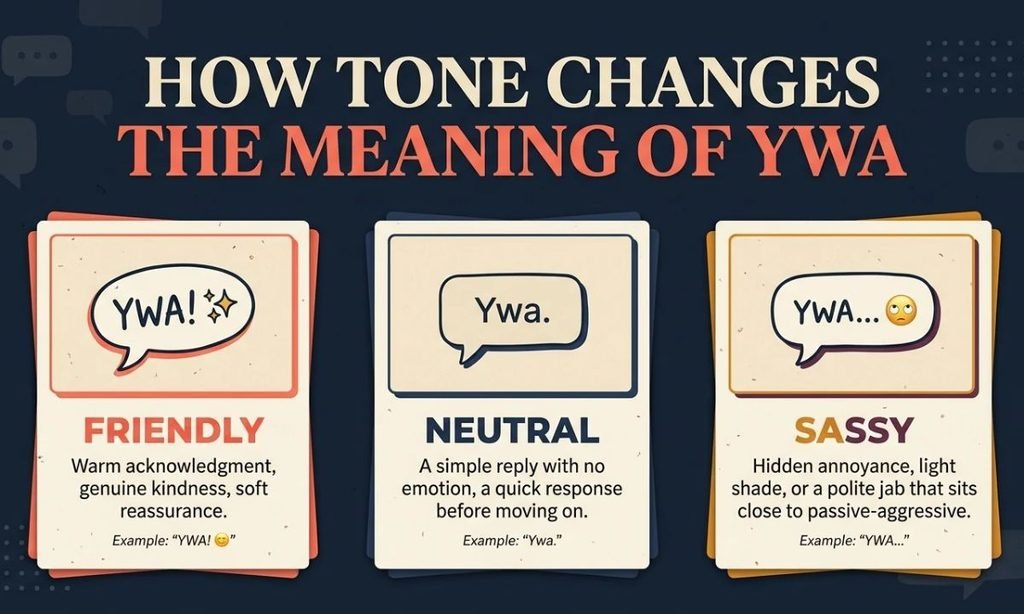
The same three letters can read as warm or cold. Understanding tone matters more than memorizing the acronym, because tone is where most of the meaning lives.
Here’s what I see most often:
- Friendly: warm acknowledgment, genuine kindness, soft reassurance.
- Neutral: a simple reply with no emotion, a quick response before moving on.
- Sassy: hidden annoyance, light shade, or a polite jab that sits close to passive-aggressive.
The feelings behind it vary too. Kindness says “no big deal.” Indifference says “whatever.” Frustration says “I tried, but it didn’t help much.” Warmth says “glad I could be here for you.” I’ve seen every one of those in a single week, from the same people.
Some lists claim a dozen different tones, from sweet and caring to playfully sarcastic. I wouldn’t count them, but the range is real. It also shows a bit of mild self-deprecation, since the sender is poking fun at their own effort.
Is YWA Rude?
Not by default. Whether YWA is rude depends heavily on context. Between close friends it’s often funny, a way to tease someone who forgot to say thanks.
Friend: “I finally found my charger.”
You: “After I spent 20 minutes looking for it. YWA 😭”
That reads as humor, not anger. But if the conversation is already tense, YWA can come across as passive-aggressive, as if the sender feels you didn’t appreciate their effort.
Punctuation and emojis shift the feeling fast:
| Message | Usual feel |
| “YWA 😊” | Friendly |
| “YWA.” | Colder, more serious |
| “YWA 🙄” | Sarcastic, annoyed, even angry |
Compare “thanks for nothing” followed by “YWA bestie.” The second message is the joke, and the first is the jab. The abbreviation doesn’t set the emotion. The surrounding conversation does.
How to Tell If YWA Is Sarcastic
Tone is the hardest part of online communication, because text doesn’t show emotion clearly. A few signs point toward sarcasm.
- The conversation is already tense. If two people are arguing, YWA reads less like a joke and more like a complaint.
- Certain emojis appear. 😂, 😭, 🙄, or 😅 can each change the attitude.
- The sender stresses their effort. “I literally spent an hour helping you. YWA.” has more edge than “YWA 😊.”
- The help wasn’t acknowledged. The word “anyway” can highlight feeling overlooked.
None of these signs is absolute. The safest approach is to weigh the whole conversation rather than judging three letters alone.
Where You’ll See YWA
YWA lives in digital spaces built for quick chats and punchy replies. Mostly it’s one-liners, fast and light. The meaning stays the same across apps. Only the culture around it changes.
Messaging Apps and Social Platforms
On iMessage and WhatsApp it turns up in group chats and friend circles. In Instagram DMs and comment replies it’s common between friends. Snapchat streaks, where fast replies are the norm, are another home, and so are TikTok comments under funny or relatable videos.
On Twitter and X it works as a one-word reply under a post. On Facebook it appears in group threads, and on YouTube in comment replies. Creators and fans use it publicly too, in comment sections after thank-you messages, under viral posts, and in captions when a creator acknowledges helpful but unsuccessful suggestions or content that only partly helped.
YWA Meaning on Snapchat
Snapchat runs on short slang because chats are fast and informal. Someone sending YWA is probably joking around rather than trying to sound formal.
You: “Thanks for the screenshot!”
Friend: “YWA 😂”
That’s the classic case of replying “you’re welcome anyway” right after a thank-you. Snapchat leans on emojis, disappearing messages, and inside jokes, so consider the person’s usual texting style before deciding whether it’s sarcastic. Yes, it fits casual Snapchat chats, especially with someone you know well.
YWA Meaning on Instagram
On Instagram, YWA shows up in DMs, comments, and other private conversations. If a friend sends a useful post and you reply, “Thanks, this actually helped!”, their “YWA!” is straightforward.
It gets more interesting if you didn’t thank them properly or changed the subject after they helped. Then YWA can be a joking reminder that they did help. Instagram slang gets used creatively, not by a strict dictionary definition.
YWA Meaning on TikTok
TikTok has a constantly changing slang culture, and users shorten phrases in comments and messages all the time. When the abbreviation follows a favor, “You’re Welcome Anyway” is the natural reading.
User: “Can someone explain this trend?”
Friend: “I sent you the explanation yesterday.”
User: “Ohhh, I didn’t see it.”
Friend: “YWA 😂”
The friend is being humorous. Their earlier help was overlooked, so they say you’re welcome anyway.
More Examples of YWA in Texting
Seeing slang in use is the easiest way to learn it. Here are five more, each with the sender’s tone.
Friendly
A: “Thanks for helping me with my homework!”
B: “YWA 😊”
Playful
A: “I figured it out myself.”
B: “YWA 😂”
B is joking because they had already tried to help.
Slightly sarcastic
A: “I didn’t really ask for help.”
B: “YWA.”
This one can sound annoyed.
Between friends
A: “Thanks for bringing snacks!”
B: “YWA lol.”
After being ignored
A: “Sorry, I didn’t see your message earlier.”
B: “YWA 😭”
Here the help went unnoticed, and B is humorously saying so.
Two more everyday ones. A friend texts, “Thanks for trying to fix my WiFi, even though it didn’t work.” You reply, “YWA, wish I could’ve done more.” Another says, “Thanks for the advice, didn’t work out but I appreciate it,” and you answer, “YWA bestie, we’ll figure it out next time.” Both are warm, light, and stress-free.
YWA vs. Similar Acronyms
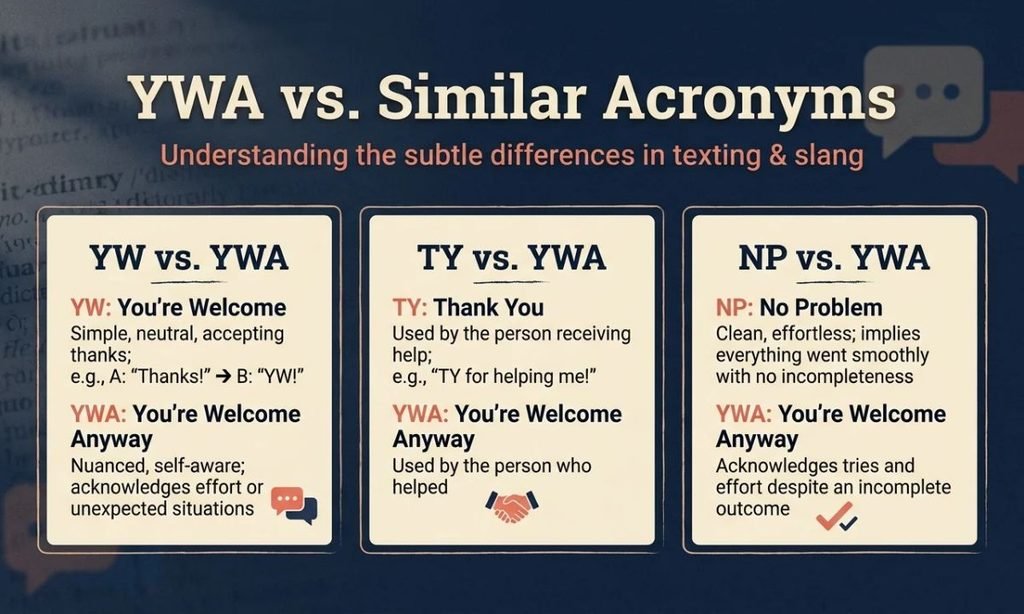
These abbreviations look alike but do different jobs.
YWA vs. YW. YW means “You’re Welcome.” It’s simple, neutral, and mostly about accepting thanks.
A: “Thanks!”
B: “YW!”
The extra A in YWA changes things. It adds context, and you’re left wondering why they said “anyway.” The difference is small on screen but easy to feel. YWA gives a more nuanced, self-aware tone that looks back at the effort.
YWA vs. TY. TY commonly means “Thank You.” Both can appear in one conversation:
A: “TY for helping me!”
B: “YWA!”
TY comes from the person receiving help, and YWA from the person who helped. That makes it easy to remember.
YWA vs. NP. NP means “No Problem.” It’s cleaner and carries no hint of an incomplete outcome.
Other look-alikes cause mix-ups. IKR means “I Know Right” and expresses agreement. TBH means “To Be Honest” and signals an opinion. YWIA means “You’re Welcome In Advance,” which looks ahead, while YWA responds to being thanked. Confusing them can send the wrong vibe in an important conversation.
| Slang | Meaning | Typical use |
| YWA | You’re Welcome Anyway | Casual, sometimes playful |
| YW | You’re Welcome | Casual and simple |
| TY | Thank You | Showing appreciation |
| THX | Thanks | Informal gratitude |
| NP | No Problem | Responding to thanks |
All five handle thanks, but their tones differ.
Why People Use YWA Instead of the Full Phrase
Convenience is the biggest reason. Texting is fast, and people like abbreviations that carry an idea in a few characters. Instead of typing “you’re welcome anyway,” they send YWA.
It also makes a message feel more casual. “You’re welcome anyway.” sounds stiff next to “YWA 😂,” which sounds like the way friends talk online. Over time, short forms become part of a texting style, and people who chat constantly use them without thinking.
When to Use YWA
YWA fits informal conversations: close friends, family, classmates, casual online friends, and people who regularly use texting slang. I use it mostly in one-on-one texts or relaxed group chats. When a friend thanks me after a failed favor, YWA is exactly right. It avoids awkward silence and keeps the mood light.
It also suits a low-stakes chat, a reply to a thank-you meme, or a thread where someone is already joking. It works best with a warm tone, an emoji or “lol,” and at most one short follow-up line.
A few quick checks help:
- Is the mood good or lighthearted?
- Is this a familiar contact rather than a stranger?
- Is there any real emotion or serious feeling underneath?
If the last answer is yes, a longer reply with some warmth will probably land better. When unsure, read the room before you type.
When YWA Sends the Wrong Message
On the surface it’s harmless, but YWA is informal slang, and in formal or professional settings it can come across as cold, lazy, or even rude. I wouldn’t send it to a boss, manager, client, or coworker, and certainly not in a formal work email. If a manager thanks you for finishing an important task, a plain “You’re welcome” is clearer and more professional.
It also fails when someone shares deep emotional pain, offers sincere thanks, or is receiving bad news. After a serious mistake, it can sound like you’re brushing off accountability. To someone who’s clearly upset, it can read as passive-aggressive, careless, or dismissive. In a first conversation, it makes you seem distant. When someone is truly thanking you for significant support, an abbreviation that can sound sarcastic only invites confusion.
A single misfire can leave someone feeling unheard or unappreciated. In those moments, say “You’re welcome!” or “Happy to help!” The point of slang is to make communication easier, not to cause misunderstandings. When in doubt, go with the longer version.
Alternatives to YWA: Better Replies for Every Situation
Sometimes another phrase fits the mood, setting, or relationship better. Here are options grouped by situation.
Friendly and upbeat
- “No worries at all”
- “Happy I could try”
- “Anytime, seriously”
- “Glad I was there”
- “Don’t even mention it”
- “Always here for you”
Easygoing
- “Haha no stress”
- “All good bestie”
- “Lol no problem”
- “We tried lol”
- “Np, next time”
- “It’s whatever”
Supportive follow-ups
- “Hope it works out”
- “Let me know if you need more”
- “We’ll figure it out”
- “I’m still rooting for you”
- “Keep me posted either way”
- “I’ve got you next time”
Pulling back but staying polite
- “Did my best”
- “That’s all I had”
- “Sorry I couldn’t do more”
- “I wish I could help more”
- “That was on me, sorry”
- “Next time I’ll do better”
Work-safe
- “Happy to assist regardless”
- “Thank you for your patience”
- “I appreciate your understanding”
- “Let me know how else I can help”
- “Always glad to support the team”
- “Please feel free to reach out again”
Specific moments call for specific words. If a friend is upset, try “I’m really sorry I couldn’t do more.” After a failed favor, “I’ve got you next time for sure” shows care. When someone is genuinely grateful, “It honestly meant a lot to help” works. In a professional chat, “Happy to assist regardless” is safe. When emotions run high, “I hear you and I’m still here” helps, and after bad news, “Take your time, no rush at all” is kind. For joking with a close friend, “Lol anytime bestie” does the job.
A quick shortcut is fine for a joke, but a thoughtful reply shows the other person you care how they feel.
How to Reply When Someone Says YWA
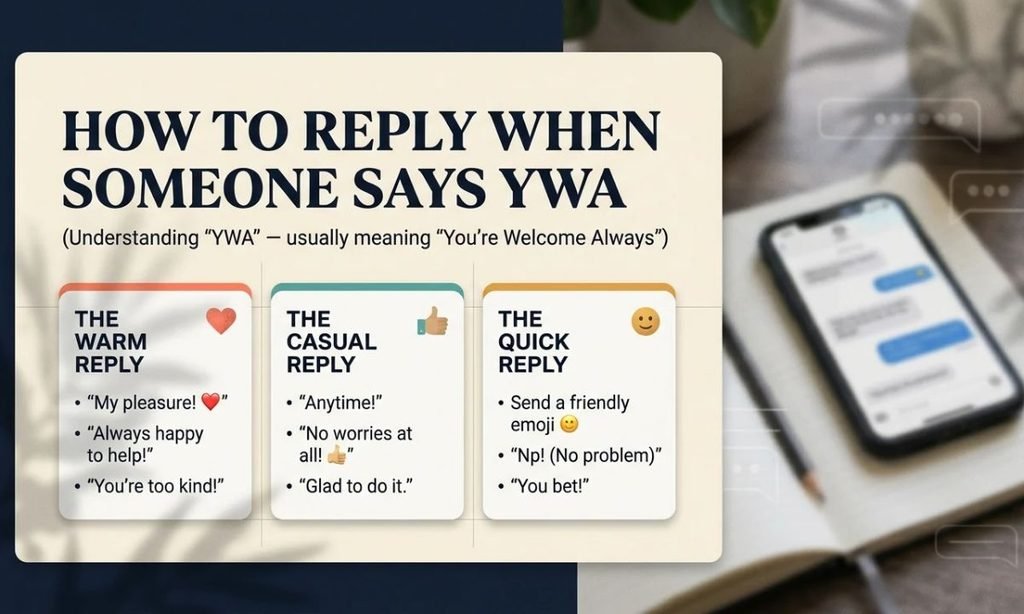
Match the tone you were given. If they’re clearly joking, answer playfully:
- “Haha, I appreciate you 😂”
- “I know, I know!”
- “You’re the best.”
- “My bad 😭”
- “Thanks again!”
If it sounds sarcastic, a simple “Haha, I really do appreciate it!” keeps things from turning awkward. You don’t need to explain yourself. In casual texting, you follow the mood of the conversation. If it’s a friend being friendly, “I appreciate it” or a simple emoji works fine.
Common Mistakes with YWA
The same few errors keep coming up:
- Sending it in a serious or emotional conversation, where it reads as cold.
- Using it with a boss or coworker.
- Dropping it with no context or follow-up when a warmer response was needed.
- Overusing it until it feels lazy and meaningless.
- Using it sarcastically, which can hurt more than the sender intends.
Remember the person on the other end. A brushed-off thank-you can sting, and sharp messages can be hurtful.
Does It Matter Who Sends It? Popularity and Sender Questions
People often ask what YWA means from a girl or from a guy. The answer is the same for both. It usually means “You’re Welcome Anyway” after a favor or thank-you, and the specific tone depends on the conversation, not the sender’s gender.
Is it popular in 2026? It seems to be growing in texting and social media conversations, though I can’t give you numbers. Is it a positive or rude reply? It can be polite, playful, or slightly rude, depending on how the message is written. People mostly use it online to joke with friends, or when someone forgets to say thanks.
YWA in the Wider World of Texting Slang
YWA belongs to a big family of texting abbreviations: short coded expressions that help people communicate faster. LOL, BRB, and OMG are among the oldest and most widely recognized, and NGL is a newer one. If you’ve also wondered about the PH meaning in text, it’s another short term that depends heavily on context. They feel natural, and plenty of younger people treat them like a second language.
Online slang keeps changing. Terms like lowkey, no cap, and slay often start in niche communities, such as gaming or stan culture, and Black Twitter, before they go mainstream. What was popular last year can feel outdated now. TikTok and Discord push new trends quickly, and Reddit and Twitter have their own distinct slang cultures.
Digital shorthand like tbh, imo, and idk has become standard vocabulary for many people. It lets you type faster and sound less formal, and it can carry tone and emotion that plain words sometimes miss. The risk is misreading someone’s message.
Gen Z slang is bold, fast-moving, and tied to identity, humor, and energy. A lot of it comes from Black culture, LGBTQ+ communities, and internet subcultures. Older Gen Z members sometimes struggle to keep up, and using a phrase wrongly or too late can make you seem out of touch.
Chat response phrases such as “Got it,” “sounds good,” “for sure,” “lmk,” and “hmu” keep conversations flowing, and “I hear you” is a classic go-to. Timing and word choice set the tone, and the right phrase changes how someone feels.
Real exchanges teach more than definitions. A simple “lol same” builds connection, and back-and-forth chats show how one wrong word can flip a meaning. The same slang, whether YWA or NGL, lands differently in different situations, and real examples are the best way to sharpen your digital communication skills.
Final Thoughts on What YWA Means
YWA is a three-letter abbreviation you’ll meet in casual conversations, usually after someone helps and the help gets overlooked, turns out unnecessary, or is humorously underappreciated. It can be friendly, teasing, or slightly sarcastic. Check the surrounding messages, the emojis, and the punctuation to see what the sender meant.
Once you accept that context matters, it’s easy to read and easy to use. Keep it for friends and relaxed chats, and reach for a full sentence when the moment is serious or professional.
FAQs
What does YWA mean in text?
YWA usually means “You’re Welcome Anyway.” It’s informal texting slang sent as a reply to a thank-you. The “anyway” hints the help was overlooked, unneeded, or didn’t fully work out.
What does YWA stand for?
Y stands for “You’re,” W for “Welcome,” and A for “Anyway.” It’s a three-letter shortcut used mainly in casual chats. Friends, classmates, and family use it most.
Is YWA rude?
Not by default. Between close friends it’s usually a joke or light tease. In a tense conversation, though, it can sound passive-aggressive or sarcastic.
What is the difference between YWA and YW?
YW means “You’re Welcome” and is neutral. YWA adds “Anyway,” which gives it a more playful or self-aware tone. The extra word suggests the effort wasn’t fully appreciated or didn’t pan out.
How do I reply when someone texts YWA?
Match their tone. If they’re joking, try “Haha, I appreciate you” or “My bad.” If it feels sarcastic, “Haha, I really do appreciate it!” keeps things light.
How can you tell if YWA is sarcastic?
Check the mood of the conversation and the emojis. A tense chat, a 🙄 emoji, or a cold “YWA.” with a period often signals sarcasm. A 😊 or 😂 usually means it’s friendly.
What does YWA mean from a girl or a guy?
It means the same thing no matter who sends it. The tone depends on the conversation, not the sender’s gender. Read the earlier messages for clues.
Can I use YWA on Snapchat, Instagram, or TikTok?
Yes. It fits casual chats on all three, especially with friends. The meaning stays the same across apps, though each platform has its own slang culture.
Is it okay to use YWA at work?
It’s best to avoid it with a boss, client, or coworker. Professional settings call for full sentences like “You’re welcome” or “Happy to help.” Slang can come across as cold or careless.
What does YWIA mean, and is it the same as YWA?
No. YWIA means “You’re Welcome In Advance” and looks ahead to a favor. YWA is a response to someone who has already thanked you.
Where did YWA come from?
Its origin isn’t documented, so any confident date or inventor is a guess. It’s most likely a simple shortening of the full phrase, like YW. It probably spread through early SMS and later moved onto apps.
What can I say instead of YWA?
Try “No worries at all,” “Anytime, seriously,” or “I’ve got you next time.” For work chats, “Happy to assist regardless” is a safe pick. Choose the reply that fits your relationship and the mood.
