

You scroll past a photo of a guy with a sharp jawline, and the top comment says “bro has been mewing for years.” Then your friend texts “can’t talk, I’m mewing” and you have no idea whether it’s a joke, a diet, or a workout. Here is the short version of the mewing meaning: it’s a slang term built on a real tongue posture technique, and most people online use it as a joke.
People search for this word because it has two lives. One is a facial posture method that claims to reshape your jaw. The other is an internet gag about looking better or staying silent. You’ll see it in TikTok comments, Instagram Reels, YouTube Shorts and gaming chats, usually with no explanation attached.
This article covers what the word means in both senses, where it came from, how people use it, and why it spread so fast. It also looks at the technique itself, what the science says, and what orthodontists suggest if you want a stronger jawline.
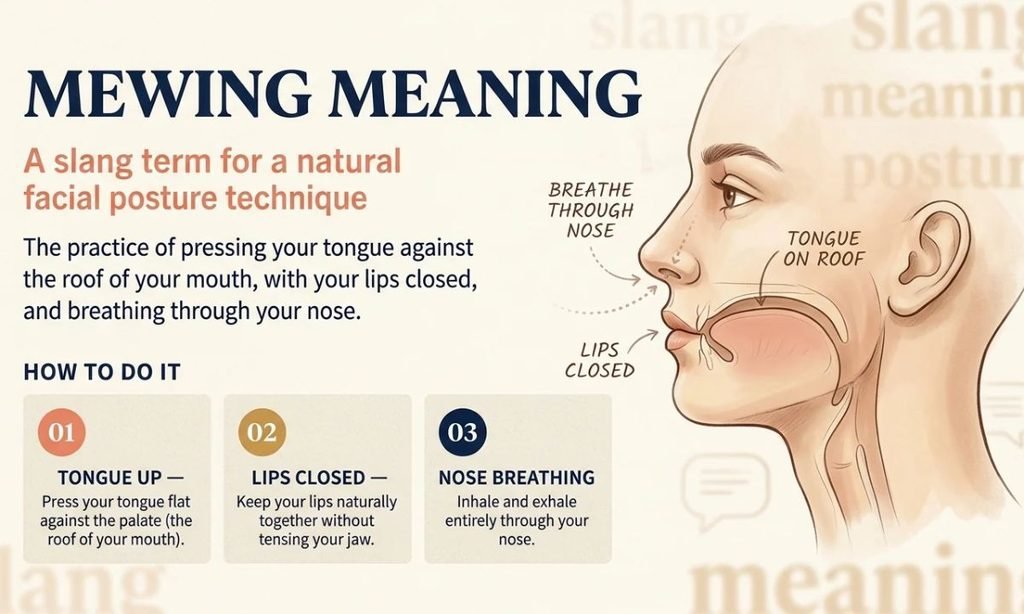
Mewing meaning in plain words: Mewing is slang for pressing your tongue against the roof of your mouth, lips closed and breathing through your nose, to supposedly sharpen your jawline. Online, it also works as a joke about improving your looks or staying silent because you’re “busy mewing.” It started as a real posture technique.
What Does Mewing Mean in Slang?
Search “what does mewing mean slang” and you’ll find a pile of one-line dictionary answers. In everyday internet use, mewing is a viral term for someone improving their facial appearance, jawline first, or jokingly staying quiet while they do it. That’s the meaning you’ll find in most comment sections.
The phrase works as a compliment, an excuse, or a punchline. Someone writes “Bro is mewing” under a photo with a strong jawline. A friend replies “Keep mewing.” Another person dodges a question with “I’m mewing.” It’s the same word with three different moods, and the reader fills in the rest.
Because it’s informal slang, it belongs in casual spaces. It’s an inside joke more than a formal term, and people who haven’t seen it online may have no clue what you mean.
Mewing as a Serious Term
Used seriously, the word points to a method. People practicing it treat it as an all-day habit rather than a workout. It also sits inside the looksmaxxing crowd, where a craze can turn into a personal project overnight.
Group chats show a lighter side. Someone spots a friend slouching with their mouth open and types “mew,” the way a relative might say “sit up straight.”
Where Did the Word Mewing Come From?
The word comes from Dr. John Mew, a British orthodontist, and his son Dr. Mike Mew. Dr. John Mew developed the technique in the 1970s, and it became a key part of his orthotropics practice. Orthotropics is the idea that tongue posture shapes how a face grows. Dr. Mike Mew later promoted it online.
So the slang came from a real technique. It was a facial posture method first and a joke second, and nobody argues about that part of the story.
How a family name became a verb is less clear. Some people trace it to forum and YouTube discussions from years before TikTok. Others credit TikTok, where it exploded. Be wary of anyone who names one exact day with total confidence.
How the Meaning Shifted
The word originally referred to tongue posture. Today it also carries humorous meanings that don’t need the technique at all. Staying silent, for example, was never part of the original method. That meaning developed later as internet humor.
The Idea Behind the Technique
The belief is simple. Proper tongue placement exerts gentle, continuous pressure on the upper jaw, called the maxilla, which could influence bone structure and overall facial form. Dr. John Mew wanted a method that improved facial aesthetics through oral posture alone.
Why Professionals Pushed Back
In late 2024, the council also struck Dr. Mike Mew off the register. It found that his treatment recommendations for a young patient were inappropriate and misleading. He has publicly disputed the decision. Dr. John Mew died in 2025.
Where Is Mewing Used Online?
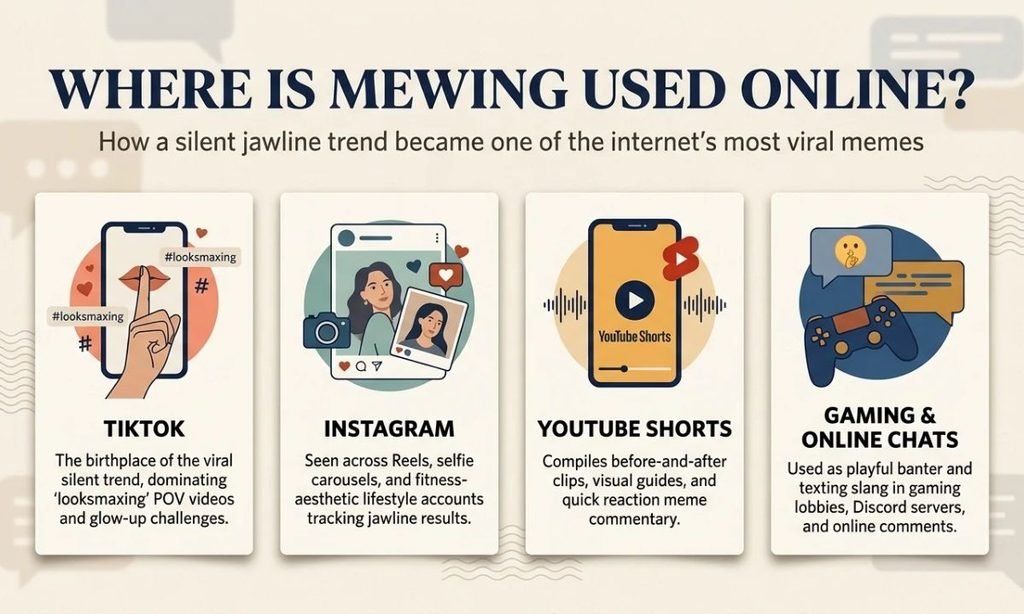
Mostly anywhere people post short videos and argue in comments. The usage shifts a little by platform, but these places share one trait: a busy comment section.
TikTok
TikTok turned mewing into a global trend. Creators post jawline transformation videos, glow-up content, before-and-after photos and funny mewing memes. Many of them carry the emoji combination 🤫🧏, which stands for staying quiet while mewing. You can read it as “I’m mewing” without a single word.
On TikTok, slang like this usually reads as a quick gag. A single comment with those emojis helped make the trend feel universal.
Instagram users leave comments like “Bro has been mewing for years,” “The mewing worked,” or “Ultimate mewing results.” These usually compliment someone’s appearance. The “years of mewing” angle is the giveaway, since it implies slow, patient effort behind a good facial profile.
YouTube Shorts
Short-form creators on YouTube Shorts use mewing jokes often. The content is predictable: fitness videos, self-improvement clips, transformation videos and comedy sketches. The joke lands in about three seconds, which suits the format.
Gaming and Online Chats
Gamers sometimes use it as a playful excuse in voice chat: “Can’t talk right now, I’m mewing.” That’s the “not talking” version of the joke, and nobody in the lobby takes it literally.
Why Did Mewing Go Viral?
Several things pushed the slang into the mainstream, and the first is the simplest.
It’s funny. The idea that someone is so committed to a better jawline that they refuse to speak is absurd, and that absurdity is the joke. A little laughter does most of the work.
It fits self-improvement culture. Modern internet culture is full of fitness trends, looksmaxxing, glow-ups and confidence advice. Mewing became part of that movement, which treats your face as a project. It slotted into the trend vocabulary easily.
It’s easy to turn into a meme. “I’m mewing” is a short phrase that fits countless situations. Simple ideas travel fast, and this one is easy to reuse.
Social media did the rest. Once influencers started using the term, millions of users copied it, and copied usage is how slang spreads. Short-form video platforms reward quick jokes, visual trends and transformation videos, and mewing fit all three.
The community kept it going. Once enough people used the word, it became part of everyday internet language. Internet users also love turning serious topics into jokes, and mewing was perfect meme material.
How Do People Use Mewing in a Sentence?
Examples beat definitions, so here is how the word shows up online.
- “Bro’s jawline is insane. The mewing paid off.” This is praise for someone with a sharp, strong jawline.
- A friend asks, “Why are you so quiet today?” and you answer, “I’m mewing.” It’s a humorous excuse for not talking. Plenty of people say “Sorry, I’m mewing” when they don’t want to answer, or when talking would “interrupt” their jawline routine.
- “He didn’t get a haircut. He just started mewing.” As a TikTok comment, it jokes that an improved appearance came from mewing.
- “Everyone else is talking. I’m mewing.” On an Instagram Reel, it’s a meme suggesting you stay silent and focus on self-improvement.
The word also works as a verb. “I don’t argue anymore. I just mew.” Commenting on a glow-up works too: “His jawline got sharper. He’s definitely been mewing,” or “The mewing transformation is crazy.” The main uses are talking about appearance, making jokes and creating memes.
Mewing vs. Looksmaxxing, Rizz, and Other Slang
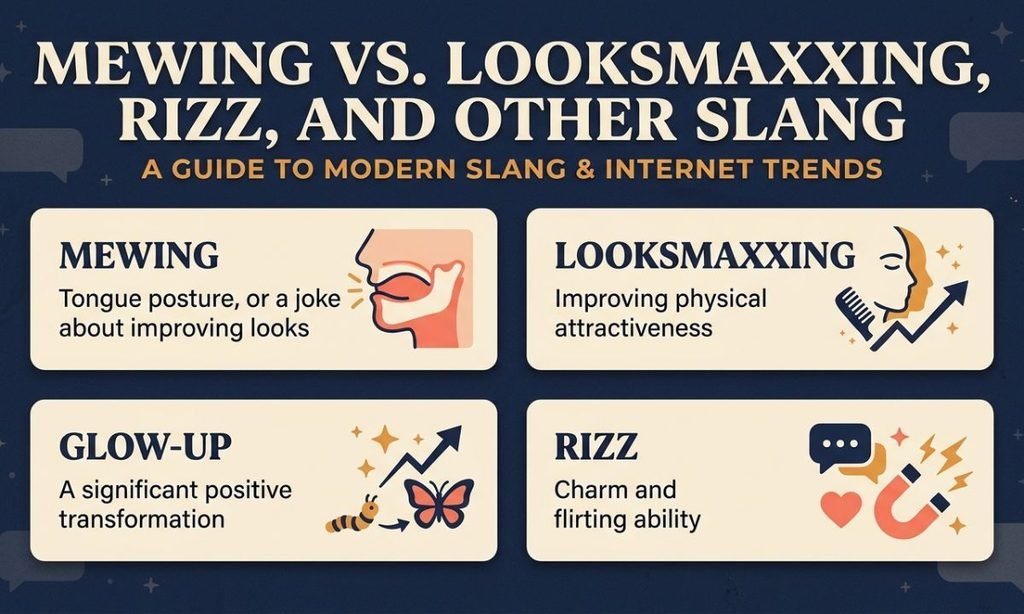
Mewing sits next to several other slang words, and people mix them up. This table shows how they differ.
| Term | Meaning | Main focus |
| Mewing | Tongue posture, or a joke about improving looks | Jawline and facial appearance |
| Looksmaxxing | Improving physical attractiveness | Overall appearance |
| Glow-up | A significant positive transformation | Lifestyle and looks |
| Rizz | Charm and flirting ability | Social attraction |
| Mogging | Looking better than someone else | Appearance comparison |
The key difference is scope. Mewing zeroes in on facial aesthetics and jawline jokes. The other terms cover broader parts of attractiveness, such as style, confidence and charm. If attraction slang is what you’re after, the huzz meaning in text is another one that trips people up.
Common Myths About Mewing
Misunderstandings travel with the slang, so here are the common ones.
Myth: it’s only a meme. Not exactly. The word began with a real technique before it became a joke.
Myth: everyone uses it seriously. Most people use it humorously today. A lot of comments are jokes, not serious discussions.
Myth: mewing automatically changes your face. This is the biggest one. Online users exaggerate results for comedic effect, and many viral posts are memes, not scientific claims. As far as I know, the evidence that tongue posture reshapes an adult face is weak, and many dentists dispute it. Read “before” and “after” photos with that in mind.
Myth: mewing means staying silent. Originally, it didn’t. That meaning came later as internet humor.
So is mewing a real thing? Yes, as a posture technique. The slang piled extra layers on top of it, and the claims you see online are usually exaggerated on purpose.
When Should You Use the Word Mewing?
Casually, and with people who share the reference. A few tips from watching how it lands:
- Understand the context first. Sometimes people mean the actual technique, and other times they mean the meme, so pay attention to the conversation.
- Keep it casual. It’s informal slang. Text messages, social media comments, memes and friendly conversations are the right places.
- Don’t overuse it. Like any trend, heavy repetition makes it feel forced and stops it from being funny.
- Know your audience. Not everyone understands it. Avoid professional emails, business meetings and academic writing. Telling your boss “I’m mewing right now” gets confusion, not laughter.
- Recognize the joke. Most “mewing” comments are exaggeration, and the literal meaning is rarely the point.
What Is the Real Mewing Technique?
Now for the serious side of the mewing meaning. As a technique, mewing means resting your whole tongue against the roof of your mouth, with lips closed and breathing through your nose. It’s meant to be an all-day habit that changes how your face develops. It’s a form of tongue posture, and the people who do it want a sharper jawline without surgery.
The method aims at an aesthetically pleasing jawline by teaching correct tongue posture, facial posture and mouth posture. It’s designed to improve how the face sits at rest. Supporters promote it as a way to get a stronger profile, counteract the effects of mouth breathing and avoid surgery. It involves a variety of exercises, mostly built around constant positioning of the tongue.
How to Mew Step by Step, According to Followers
This is how people who believe in the practice describe it.
- Set your head and neck. Stand or sit tall, lengthen the back of your neck, and keep your chin up without tilting it. Gently close your lips so they’re sealed, not tight.
- Raise your whole tongue to the upper palate. Put the tip of your tongue on the gum line behind your front teeth, without touching the teeth themselves.
- Add a tiny suction hold. Lightly press the tongue to the palate until it feels stuck up there, with no discomfort. Keep your jaw relaxed and breathe calmly through your nose.
- Build up slowly. Beginners start with short holds. Progress means longer intervals, several times a day, until the position becomes your normal resting posture.
What Are the Claimed Benefits of Mewing?
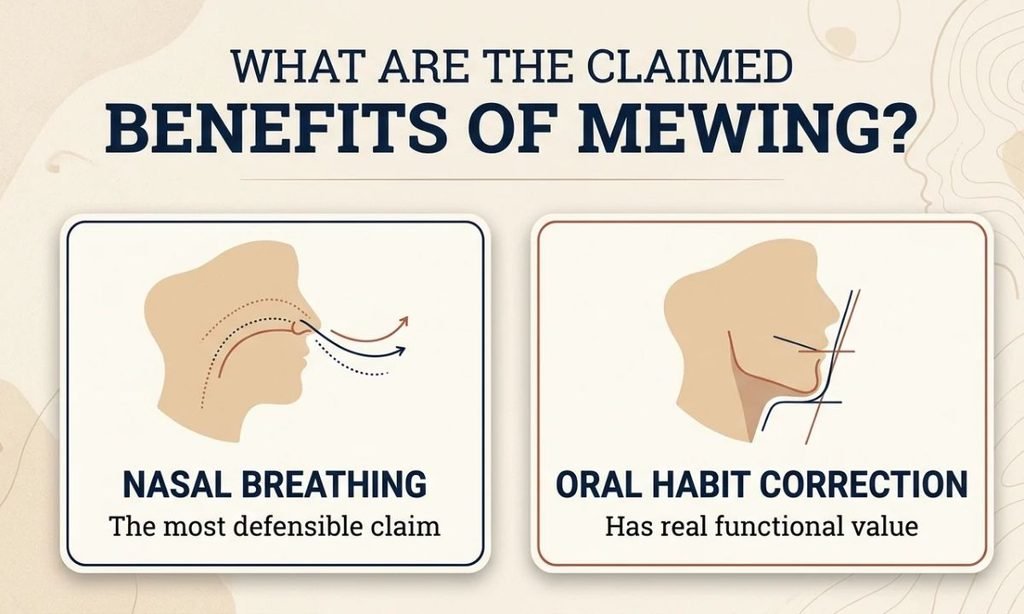
The reported benefits are a mixed bag, so take them with a grain of salt.
Nasal breathing is the most defensible claim. Mewing encourages consistent nose breathing, which supports airway function and may ease dry mouth. It also promotes better head and neck alignment, though that usually comes from general posture awareness rather than tongue posture alone.
Oral habit correction has real functional value. Mewing can reduce mouth breathing and tongue thrust. That’s a genuine potential benefit, but the effect is on habits, not bone.
The look is where claims balloon. Holding the position creates mild muscle engagement under the chin, which may give slight firmness and a subtle visual improvement. It isn’t reshaping of the jaw.
Facial development is a different matter. Upper jaw growth matters most while bones are still developing, and that’s the territory of orthodontic development. In adults, dramatic structural change is unlikely without medical intervention. There’s little to no scientific evidence behind the bigger claims, and not enough to call mewing a treatment. Until someone shows otherwise, it stays unverified.
Does Mewing Really Work?
Maybe, to a certain extent, but the research is limited. As of 2026, there’s no high-quality evidence that mewing alone can cause major facial changes in adults. As a face-shaping strategy, it isn’t something to bet on with current data.
Before-and-after photos can look convincing, but many don’t tell the whole story. Lighting, weight loss, posture and natural maturation do the heavy lifting, and all four influence the images. Almost all the success stories are anecdotal.
There may be real cases of dedicated mewers developing stronger facial structures over time. Still, nobody can separate mewing from everything else going on, so the transformative power people describe isn’t established.
How Orthodontists See Tongue Posture
Tongue posture does matter in orthodontics, just not the way influencers suggest. An orthodontist checks tongue position and oral habits as part of a full diagnosis, because a poor habit can contribute to bite problems and to relapse after treatment. It’s very important for long-term stability.
Force is the catch. Facial changes usually need constant orthodontic force for most of the day, often around 22 hours. Functional appliances, expanders, braces and clear aligners are built to apply controlled forces over time. That’s steady, continuous pressure, and a customized plan keeps it on target.
Conscious tongue positioning can’t compete. Holding a perfect position is hard when you talk, swallow and eat. Orthodontic appliances are the more reliable way to correct the jaw and bite, and they affect them in ways a tongue habit can’t.
Common Mewing Mistakes and Safety Concerns
Several mistakes come up again and again, and the community that supports the practice lists them too:
- Pushing the tongue against your teeth, which can cause tooth movement or soreness
- Clenching your jaw to hold the position
- Pressing hard on the palate, which brings fatigue and headaches
- Keeping only the tip of the tongue up while the back drops
- Breathing through your mouth while trying to mew, which works against the purpose
Mewing is considered relatively harmless as long as you avoid excessive clenching. In extreme cases, when done incorrectly, people have reported misaligned teeth, temporomandibular joint (TMJ) pain and loose teeth. Whether it’s safe depends mostly on how hard you press.
What Are Better Ways to Get a Stronger Jawline?
If you want significant, permanent facial changes, you’re much better off consulting a professional orthodontist than relying on an unverified technique. That’s the path most clinicians point to for jawline enhancement. These options are more effective and industry-backed, and they put health and safety first.
Functional Appliances for Growing Patients
These suit children and early teens who are still growing. Timed with growth spurts, they guide jaw development by gently encouraging the lower jaw forward and helping both jaws develop in better harmony. The gains in jaw projection and facial balance are meaningful, and they aren’t possible once natural growth has finished.
Palatal Expansion
Used for younger patients, palatal expansion can widen a narrow upper jaw and improve facial symmetry when the jaw has shifted functionally. It also helps with a narrow palate, crossbite and airway issues.
Braces and Clear Aligners
Both are highly effective at repositioning teeth and normalizing the bite, which can fix the misalignment behind facial imbalance. In some cases that helps side-profile harmony and gives a mild to moderate gain in jawline definition, especially when recession or imbalance comes from the teeth. The effect is subtle because they don’t change jawbone size. Traditional braces and discreet clear aligners like Invisalign both work for jaw alignment.
Orthognathic Surgery
Jaw surgery is performed by an oral and maxillofacial surgeon, combined with orthodontic treatment. The upper or lower jaw is moved forward or back, or widened. It’s the top choice for severe jaw misalignment, a recessed chin, or functional problems with chewing and breathing. Among surgical options, it delivers the most structural jawline enhancement.
How to Choose an Orthodontist
Mewing remains a popular topic in the orthodontic world, but scientifically backed evidence is thin, and guaranteed results come from treatment, not tongue habits.
Pick an orthodontist who walks you through your options. The first step is an appointment with an experienced provider who assesses your needs and builds a treatment plan. Proper treatment is the best way to boost your confidence, improve your chewing and speech, relieve jaw discomfort and fix your teeth and looks. If you’ve been putting off that step, now is a good time to book a consultation.
The Takeaway on Mewing Meaning
The mewing meaning comes down to a word that started as a facial posture technique and turned into one of the most recognizable memes of modern internet culture. It’s everywhere now, from TikTok comments to gaming chats and viral videos. When someone says “I’m mewing,” they’re almost certainly joking.
If you’re curious about the real technique, treat it as a posture habit with limited evidence, and go easy on the pressure. If you want lasting changes to your jaw or bite, talk to an orthodontist. And if you just want to understand the comment section, you now know exactly what people mean.
FAQs
What does mewing mean?
Mewing is slang for pressing your tongue against the roof of your mouth, lips closed and breathing through your nose, to supposedly sharpen your jawline. Online, it’s also a joke about improving your looks or staying silent.
What does “I’m mewing” mean in a text or comment?
It’s usually a playful excuse for not talking or answering a question. People also use it as a joke about working on their jawline, so it’s rarely meant literally.
Who invented mewing?
Mewing is named after British orthodontist Dr. John Mew, who developed the technique in the 1970s as part of orthotropics. His son, Dr. Mike Mew, later promoted it online.
Is mewing real or just a meme?
It’s both. Mewing began as a real tongue posture technique and later turned into an internet joke. Most people online use the word humorously today.
How do you mew correctly?
Sit or stand tall, close your lips gently, and rest your whole tongue against the roof of your mouth. Keep the tip just behind your front teeth, your jaw relaxed, and breathe through your nose.
Does mewing actually work?
The research is limited, and there’s no high-quality evidence that mewing alone can cause major facial changes in adults. Many before-and-after photos are shaped by lighting, posture, weight loss, and natural maturation.
Can mewing change your jawline?
Probably not in any dramatic way. It may create mild muscle engagement under the chin, but it doesn’t reshape the jawbone. Real structural change in adults usually needs orthodontic or surgical treatment.
Is mewing safe?
Mewing is generally considered fairly harmless if you avoid hard pressure and clenching. Doing it wrong has been linked to sore teeth, jaw (TMJ) pain, headaches, and shifting teeth.
What are common mewing mistakes?
The most common ones are pushing the tongue against your teeth, clenching your jaw, and pressing too hard on the palate. Keeping only the tongue tip up or breathing through your mouth also defeats the purpose.
What does the mewing emoji 🤫🧏 mean?
The combination of the shushing face and the deaf person emoji stands for staying quiet while mewing. It’s a wordless way to say “I’m mewing,” especially in TikTok comments.
What’s the difference between mewing and looksmaxxing?
Mewing focuses on the jawline and facial appearance. Looksmaxxing is a broader term for improving overall physical attractiveness, including style, grooming, and fitness.
Can I say “mewing” at work or in professional emails?
It’s best to skip it. Mewing is informal slang that many people won’t recognize, so it can cause confusion in business or academic settings.
What’s a better way to get a stronger jawline than mewing?
An orthodontist can recommend options based on your age and needs, such as functional appliances, palatal expansion, braces, or clear aligners. Orthognathic (jaw) surgery is the most effective choice for severe structural issues.
Did mewing get the Mews in trouble with dental authorities?
Yes. The UK’s General Dental Council revoked Dr. John Mew’s dental licence in 2017, and the British Orthodontic Society dropped Dr. Mike Mew in 2019. Both still stand by their views.
