

The first time I heard “snafu” was in a Monday meeting. A manager sighed and said the product launch had turned into a snafu. Everyone nodded. I nodded too, without a clue what it meant. This guide is what I wish I’d had that day, a plain explanation of snafu meaning in slang, where the word came from, and how to use it without embarrassing yourself.
Quick answer: Snafu is slang for a messy, confusing situation that has become so common it feels normal. It comes from the World War II-era acronym “Situation Normal: All Fouled Up.” People use it casually to shrug at everyday chaos, like a crashed app, a delayed flight, or a botched schedule.
Snafu Meaning in Slang: The Core Definition
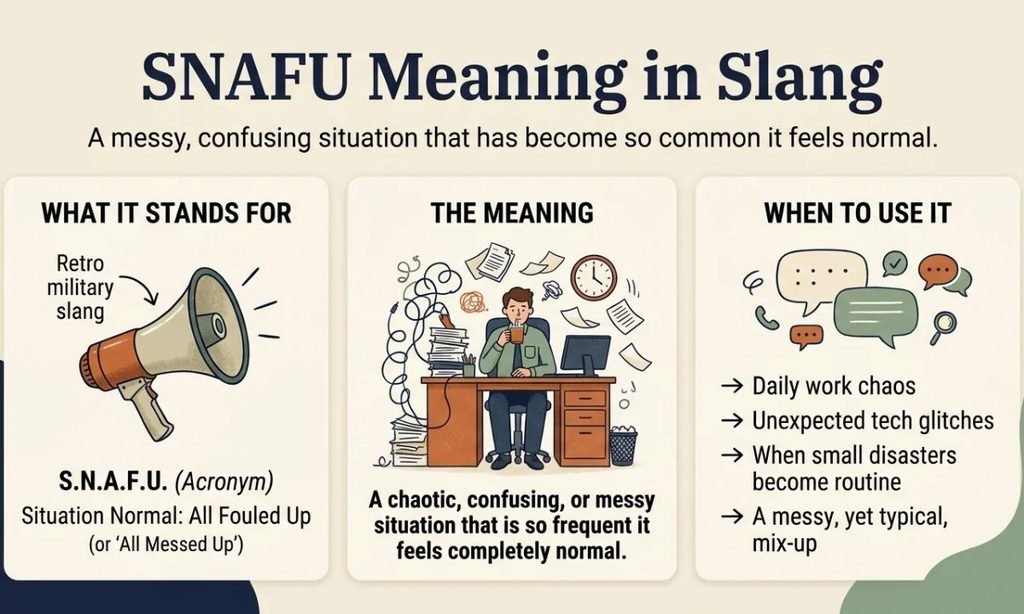
SNAFU is an acronym for “Situation Normal: All Fouled Up.” That’s the cleaned-up version. The original military phrase used a much stronger word in place of “fouled,” and some people still write it with an asterisk. Most folks today stick with the polite form.
The word describes a disorganized setup where problems pile up, confusion never really clears, mistakes keep multiplying, and chaos has quietly become the baseline. In plain terms, it’s a messy, badly handled situation. It’s also a slightly crude word, and it’s brutally honest about how often things go sideways. That honesty is probably why it has lasted.
The Clean Definition
Here’s the safe version I use when someone asks: a snafu is a chaotic, messed-up situation, the kind that happens so often it feels ordinary. That definition works in polite company, and it’s accurate.
Why the Word “Normal” Matters
The word “normal” is what gives snafu its bite. A snafu isn’t a one-off disaster. It’s a mess you almost saw coming.
Here’s a real example. When the office network crashed for the third time in a week, my coworker didn’t swear or storm off. She just said, “Total snafu.” Later that month her vacation plans fell apart after a flight cancellation, and she used the word again. Frustration, humor, and sarcasm all fit inside those five letters.
The Simple Version
Strip it down and a snafu is a typical problem people have come to expect. Something went wrong, nobody is shocked, and the mess is usually the same kind of mess as last time. If you’ve ever botched a plan and just shrugged, you’ve lived through one.
Where SNAFU Comes From: Origin and Background
Snafu dates back to World War II, when it was American military slang. Soldiers used it to describe chaotic conditions, confusing leadership decisions, and the everyday operational problems that come with running a huge organization. The uncensored phrase carried profanity, and cleaner versions later replaced the final word.
From there, the word traveled. It moved through military culture into workplace language and business conversations, then into movies and TV shows. Eventually it landed in internet slang and meme culture. I think it survived because it still describes modern chaos so well. Software updates, supply chains, and group chats may be new, but the feeling of “of course this went wrong” is not.
So yes, it’s military slang, and yes, it’s still in use today. You’ll hear it in pop culture, online posts, and casual conversation. It isn’t going anywhere.
Where Is SNAFU Used?
You’ll spot this word in more places than you’d guess. Here are the main ones.
Workplace and Office Talk
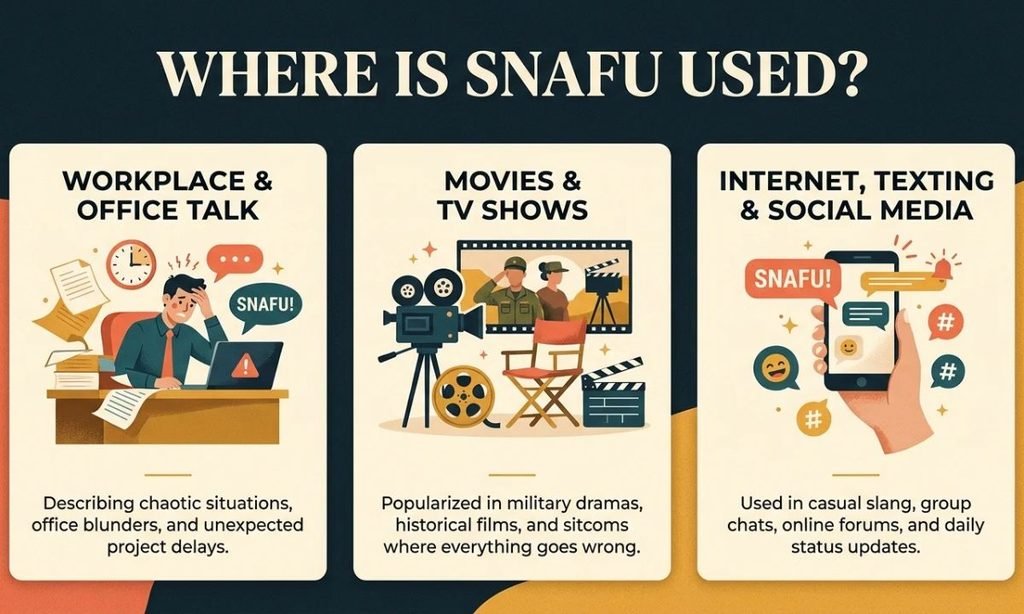
Office talk is where I hear it most. Systems fail, a project stalls because of miscommunication, or a meeting starts without the right files. Someone says “total snafu,” and the room relaxes a little. Naming the mess makes it feel smaller.
Movies and TV Shows
Films and TV lean on the word too, especially in military stories. A mission falls apart, and a character mutters that things went sideways fast. It fits because that’s the world the word came from.
Internet, Texting, and Social Media
In texting, snafu works as shorthand for casual complaints about chaotic situations. It shows up when technology fails, plans fall apart, gaming servers crash, workplace problems pile up, or a group project drifts off course.
Social media users tend to use it sarcastically. You’ll see lines like “Another Monday, another snafu,” “that update was a complete snafu,” or “the tournament registration system is a snafu.” Someone’s internet dying right before a deadline is a classic. The mood matches internet humor in general, where daily life is treated as a running joke.
You’ll see it most on Reddit and Discord. In my experience, it comes from older internet users and anyone raised around military slang, while younger users often reach for newer words. Still, the term has stayed in circulation.
Want more texting shorthand? Check out the NTM meaning in text and the LTR meaning in text guides.
Gaming and Tech
Gamers and tech people use it for an update that breaks everything. Glitches, bugs, and server crashes can wreck a session, and “huge snafu” is the shorthand. A gaming lobby that bugs out again? Snafu.
Other Contexts Where SNAFU Appears
The military meaning dominates, but the word turns up in other areas too:
- Military slang, its home turf
- Internet slang for chaos
- Pop culture references
- Business jargon
- Gaming frustration slang
Across all of them the core idea stays the same: confusion, disorder, or failure. I’ve never seen it used for something that went well.
How SNAFU Is Used in Real Conversations
Spoken or typed, snafu belongs to real situations where something is plainly broken. The usual suspects are workplace disasters, technical failures, school project confusion, travel problems, gaming glitches, and event-planning mistakes.
A conference where the projector, the schedule, and the catering all fail at once is a snafu. So is a customer service system that bounces you between departments, or a server crash that eats a whole afternoon. One road trip of mine turned into a snafu when the GPS died in the middle of nowhere.
What I notice is that the word sounds humorous rather than aggressive. People use it to shrug at a mess, not to start a fight.
Real-Life Examples by Situation
- Work chaos: The email system crashes an hour before a deadline. Everything goes wrong at once, and nobody planned for it.
- Delivery problem: A package goes to the wrong address. It’s a frustrating mix-up, and nobody is clearly to blame.
- School situation: The exam schedule changes at the last minute. It’s confusing and poorly managed, and students end up scrambling.
- Daily life: You plan a trip and forget to book the tickets. It’s a careless mistake with real consequences, and the word fits perfectly.
Examples of SNAFU in Sentences
Here’s how it reads in casual communication, where it behaves as a flexible term:
- “This software update is a complete snafu.”
- “The group project became a snafu overnight.”
- “Airport delays turned the trip into a travel snafu.”
- “Our gaming lobby was bugged again. Snafu.”
- “Today’s meeting was an organizational snafu.”
- “The livestream turned into a technical snafu.”
- “Every holiday shopping season is a snafu.”
- “Their scheduling system is permanently snafu 😂”
Each of these is typical online slang, and each sounds more weary than angry.
Why Do People Use SNAFU?
Mostly because it’s funny, casual, and says a lot in very few syllables. Here’s what makes people reach for it:
- It lets you express frustration without launching into a rant.
- It packs chaos into one word.
- It adds a little humor.
- It sounds casual but still expressive.
- It carries a quiet “what else is new?” that other words don’t.
The mess gets named, and everyone moves on.
Tone and Intent
The tone is sarcastic, frustrated, humorous, informal, and a little cynical. The speaker is annoyed but still trying to laugh. “Another app crash? Classic snafu” is a good example: irritated, but not furious. People are rarely overly angry when they use it.
It also points at the situation, not at a person. Snafu isn’t one of the direct insults people fire at each other, and it doesn’t work well for attacking someone personally. That’s part of why it stays friendly. Is it positive or negative? Negative, but usually in a lighthearted way.
SNAFU vs Similar Terms
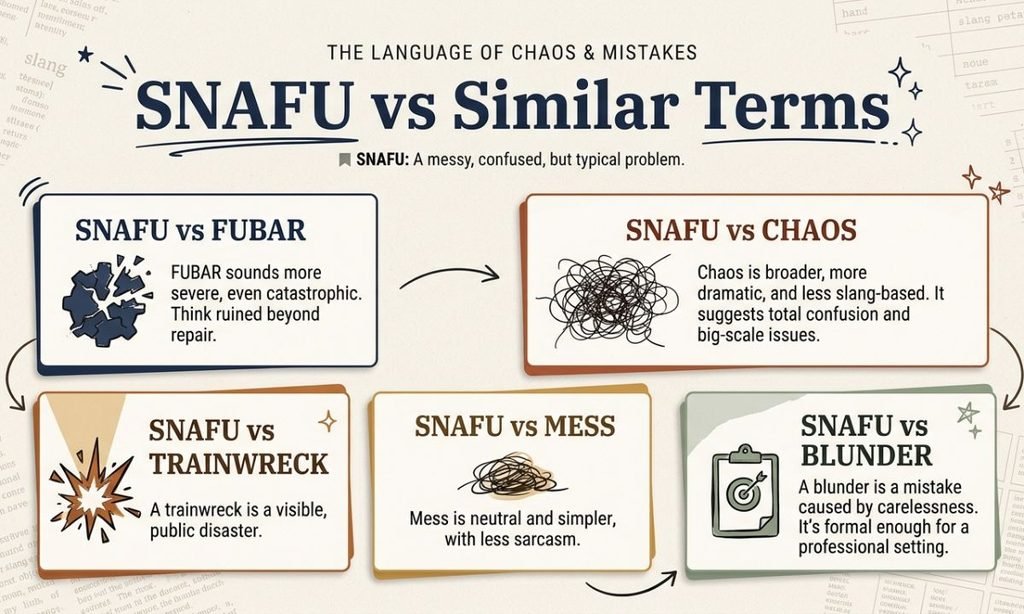
Snafu has plenty of company among slang words for disorder and failure: FUBAR, chaos, dumpster fire, trainwreck, mess, and cluster. Each one points at a slightly different angle. Blunder belongs on the list too, though it’s more formal.
The quick version: a snafu is an expected, everyday mess, while FUBAR is a total disaster.
- SNAFU vs FUBAR: FUBAR sounds more severe, even catastrophic. Think ruined beyond repair.
- SNAFU vs chaos: Chaos is broader, more dramatic, and less slang-based. It suggests total confusion and big-scale issues.
- SNAFU vs trainwreck: A trainwreck is a visible, public disaster.
- SNAFU vs mess: Mess is neutral and simpler, with less sarcasm.
- SNAFU vs blunder: A blunder is a mistake caused by carelessness. It’s formal enough for a professional setting.
What sets snafu apart is the mix of humor, sarcasm, and frustration.
Comparison Table
| Term | Meaning | Typical Use | Key Difference |
| SNAFU | Chaotic, “normal” situation | Slang and workplace humor | Sarcastic, expected mess |
| FUBAR | Completely ruined situation | Military slang | Far more extreme |
| Chaos | Disorder and confusion | General use | Neutral, dramatic tone |
| Trainwreck | Obvious, visible disaster | Informal slang | Dramatic failure |
| Mess | Disorganized situation | Everyday speech | Simpler, less sarcastic |
| Blunder | Mistake from carelessness | Professional settings | Formal, about the error itself |
Is SNAFU a Bad Word?
Not directly, but it comes from a phrase with profanity, so it’s mildly informal. The clean version, with “fouled,” is fine in casual conversation. Online and in everyday speech, most people treat it as humorous slang rather than offensive language.
It can still feel out of place in formal business writing, academic papers, professional presentations, and very polite environments. Remember the hidden swear word, even when you never say it out loud.
When Should You Use SNAFU?
Use it when the situation is predictable, or at least typical, and you want to keep things light. If something goes wrong in a way everyone recognizes, it’s the right word. It suits:
- Minor workplace issues
- Scheduling mistakes
- Tech glitches
- Everyday frustrations
When NOT to Use SNAFU
Skip it anywhere it might sound unprofessional or confusing:
- Job interviews
- Academic essays
- Formal emails and professional reports
- Serious legal communication
- Corporate presentations
- Around sensitive people, since profanity hides inside it
- Serious or tragic situations
Some readers won’t know the military slang background, so simpler language works better in formal settings. “Problem,” “issue,” “confusion,” or “disorganization” will do the job. I once watched someone drop snafu into a client email, and the reply asked what it meant. That’s the kind of detour you want to avoid.
Common Misunderstandings About SNAFU
Most confusion comes from people who aren’t familiar with military slang. These are the usual mix-ups:
- “It just means problem.” It actually means a messy problem that feels normal and expected.
- “It’s modern slang.” Nope. It dates back to World War II and began as military slang.
- “It’s always offensive.” Many people use the clean version casually without a second thought.
- “It refers to people.” It describes situations, not individuals.
- “It’s the same as other military slang.” It’s easy to confuse with terms like FUBAR, but the two aren’t interchangeable.
- “It’s a straight-up angry word.” The tone is usually sarcastic and humorous, and the sarcasm is easy to miss in text.
In practice, snafu describes messy situations with humor and frustration, and there’s very little confusion about what it means once you’ve seen it a few times.
Pro Tips for Using SNAFU Like a Pro
- Keep it casual. It works best in relaxed conversations and for relatable problems, the ones that make people say “been there.”
- Pair it with humor. Something like “Another Monday, another snafu” sounds natural.
- Mind your audience. Not everyone knows its hidden meaning, and some people will be bothered by it.
- Keep it out of formal settings. Swap in “issue” or “problem” when professionalism matters.
- Aim it at situations. Describe the mess, not the person who caused it.
These tips cover most of what I’ve learned the hard way, and they apply to slang in general.
Final Thoughts
SNAFU means a messy, confusing, badly organized situation that feels normal, even expected. It began in World War II and grew into a popular internet expression and a workplace staple for chaos, wrapped in sarcasm and humor. You’ll find it in memes, gaming chats, office conversations, and social media posts, usually when plans collapse, technology fails, or confusion takes over.
Despite its profanity-based roots, it’s lighthearted, informal, and rarely offensive. Real life is messy, unpredictable, and often frustrating, and this word laughs at the chaos instead of fighting it. So the next time something goes wrong and you’re not even surprised, say “well, that’s a snafu” and move on.
FAQs
What does SNAFU mean in slang?
SNAFU stands for “Situation Normal: All Fouled Up.” It describes a messy, confusing situation where something has gone wrong, usually because of poor planning or a simple mistake.
What does SNAFU mean in texting?
In texting, SNAFU means something went wrong or turned chaotic. For example, “Got to the airport and the flight was canceled. Total SNAFU.” It’s usually used in a casual, slightly humorous way.
What does SNAFU actually stand for?
The full phrase is “Situation Normal: All Fouled Up.” The original military version used a stronger word in place of “Fouled,” and the cleaned-up version is the one most people use today.
Where did the word SNAFU come from?
SNAFU began as U.S. military slang during World War II. Soldiers used it to describe the everyday confusion and disorder of military operations, and it later spread into everyday English.
Is SNAFU a bad word or offensive?
No, SNAFU is generally considered mild and acceptable in most settings. The original version contained a profanity, but today the word is used casually in conversation, news, and even workplaces.
How do you use SNAFU in a sentence?
You can use it as a noun for a mistake or mix-up. For example, “There was a scheduling SNAFU, so the meeting started late.” You can also say “What a SNAFU!” when things go sideways.
What does SNAFU mean on social media?
On platforms like TikTok, Instagram, X, and Reddit, SNAFU is used to call out a mishap, glitch, or awkward mix-up. People often pair it with a short story or a meme about something that went wrong.
Is SNAFU the same as FUBAR?
Not exactly. Both describe things going wrong, but SNAFU suggests a messy, disorganized situation, while FUBAR means something is completely broken or beyond repair. FUBAR is the more severe of the two.
What are some synonyms for SNAFU?
Common alternatives include mix-up, blunder, mess, screw-up, fiasco, and foul-up. Which one fits best depends on how serious the mistake is and how casual the conversation is.
Is SNAFU an acronym or an abbreviation?
SNAFU is an acronym, meaning each letter stands for a word in the phrase. It’s also pronounced as a single word (“sna-FOO”) rather than letter by letter.
Can you use SNAFU in professional or formal writing?
Yes, in many cases. SNAFU is common in business, journalism, and tech to describe a minor error or operational hiccup. For very formal documents, though, a word like “error” or “mishap” may sound more polished.
What are other military slang acronyms like SNAFU?
Related WWII-era terms include FUBAR (Fouled Up Beyond All Recognition) and TARFU (Things Are Really Fouled Up). Like SNAFU, they were used to describe chaos and have since entered everyday language.
How do you pronounce SNAFU?
SNAFU is pronounced “sna-FOO,” with the stress on the second syllable. It rhymes with “kangaroo” and “shampoo.”
