

You open someone’s profile and spot three letters sitting alone in the bio: DNI. No explanation, no hint. Plenty of people stop mid-scroll right there. The DNI meaning is simple once you know it, but the acronym also has a few other lives outside social media, and mixing them up can get awkward fast.
Here’s everything you need, from the slang to the medical order to the government job.
What Does DNI Mean? (Quick Answer)
DNI stands for “Do Not Interact.” It’s internet slang for a boundary. People add it to bios, captions, and posts to ask certain users not to follow, comment on, message, or otherwise engage with them. It’s a request, not a technical block, so it only works if other people choose to respect it.
The Simple Meaning of DNI in Plain Words
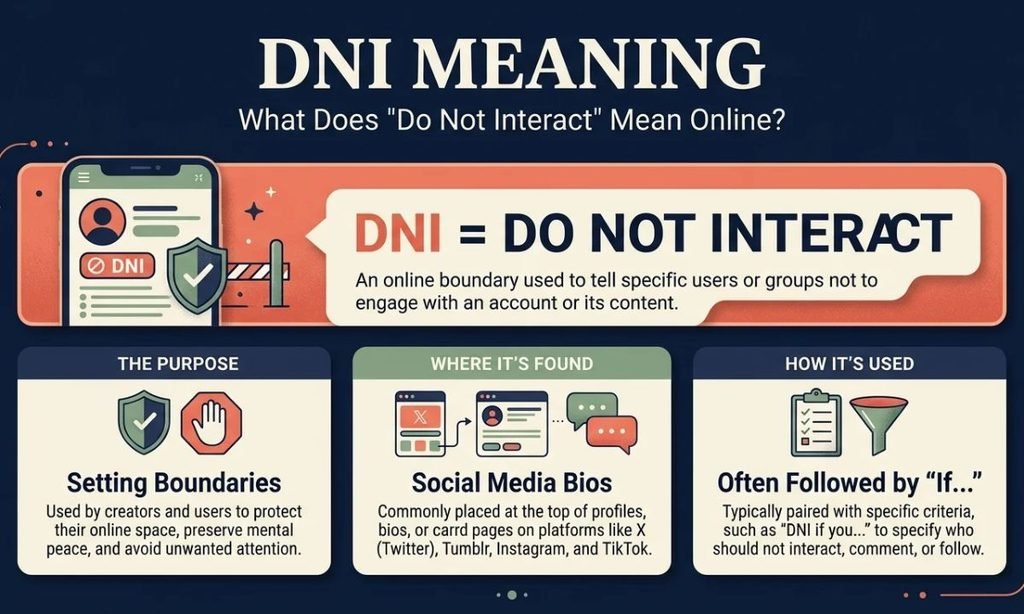
Think of DNI as a sign you hang on the door of your online space. It doesn’t lock anything. It just tells a certain group of people, or anyone who behaves a certain way, to stay away.
Some quick examples:
- “Minors DNI” means anyone under 18 should engage somewhere else.
- “Drama accounts DNI” asks people who stir up drama to keep their distance.
- “NSFW DNI” is aimed at accounts posting adult or explicit content.
- “Rude? DNI” is a quick way to say unkind behavior isn’t welcome.
Each one reads the same way: if this describes you, don’t interact.
The phrase took off on Tumblr, then spread to nearly every major platform. Today it’s part of everyday internet culture, especially among Gen Z users, and it fits the way people now build communities, share emotions, and talk openly about serious topics online.
Where Is DNI Commonly Used?
DNI shows up wherever people manage their own audience or community. The flavor changes from platform to platform, but the instinct behind it never does: people want a say in who lands in their comments and inboxes.
What Does DNI Mean on Twitter (X)?
On X, DNI usually lives in a bio or a pinned post, often as a full list. A typical one might read “DNI if you’re a Nazi, a TERF, or under 18.” Stan accounts and fandom circles post whole lists, and “anti-fans DNI” is a classic.
The longer, more specific lists show up here for two reasons. Bios give you room to write, and the fandom and political spaces on the platform take boundary-setting seriously.
What Does DNI Mean on TikTok?
TikTok keeps things casual and fast. A creator might drop “minors dni 🚫” into a video caption or fire off a one-word reply under a comment. It usually attaches to a single video rather than a whole profile, and you’ll see far fewer of the long bio lists you find on X. Lines like “homophobes DNI” also turn up in TikTok bios.
What Does DNI Mean on Discord?
On Discord, the practical meaning leans toward moderation. Server owners put DNI in the rules channel or in member bios to flag spammers, trolls, or anyone who has stirred up drama before.
These are tight communities, so DNI works less like a personal tag and more like community policy. It’s one way a server keeps its conversations healthy and its welcome channel clear about who belongs.
DNI on Instagram, Tumblr, and Reddit
Instagram users lean on DNI to cut down on unwanted attention and spam. Tumblr is where the habit really took hold. Reddit users adopt it too, usually in profile descriptions. Across every platform, it comes down to control over your own space.
Why Do People Use DNI?
It’s almost never about being unfriendly. Most people are trying to protect their energy.
Avoiding trolls and spam. Haters, spam accounts, and drama seekers wear you down over time. A DNI is a quick filter that saves you the trouble.
Protecting mental space. People who talk about mental health or trauma often want a bit of personal room, and a DNI marks where it starts.
Building safe communities. Fandom admins and private-space owners use lines like “racists DNI” or “bigots DNI” to set a respectful tone from the start.
Controlling the audience. Some pages are meant for specific groups: adults only, anime fans only, gamers only. Pages with adult content or sensitive topics need that line drawn early.
Underneath all of it sits the same trio: comfort, safety, and boundaries.
How the “DNI List” Format Works
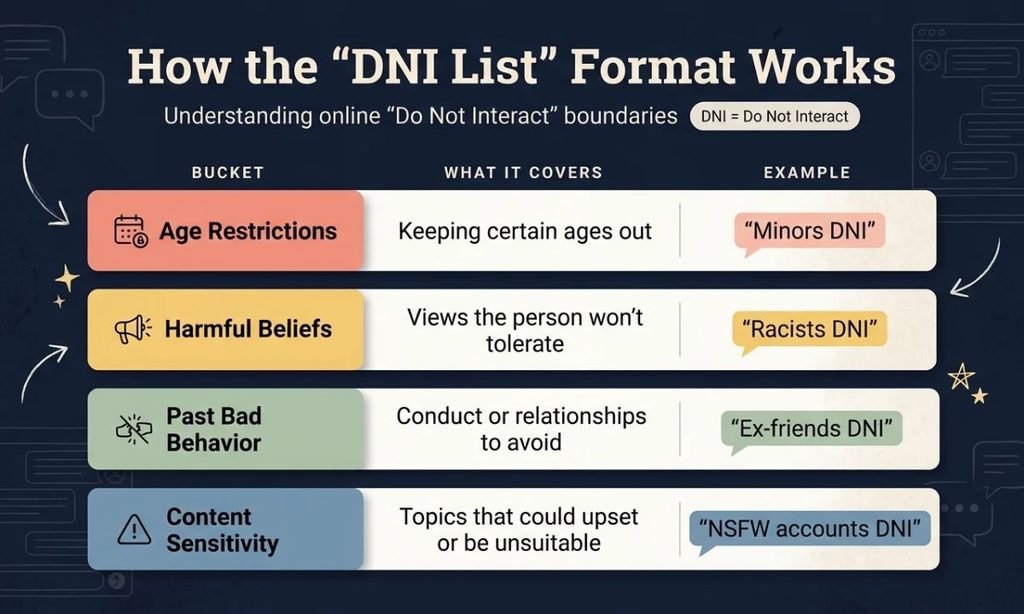
The bare letters rarely appear alone. They’re attached to traits, behaviors, or beliefs the person wants to avoid. You might see “DNI if you’re homophobic, racist, or a minor,” or “DNI: spammers, trolls, ex-friends.”
Most entries fall into four buckets:
| Bucket | What it covers | Example |
| Age restrictions | Keeping certain ages out | “Minors DNI” |
| Harmful beliefs | Views the person won’t tolerate | “Racists DNI” |
| Past bad behavior | Conduct or relationships to avoid | “Ex-friends DNI” |
| Content sensitivity | Topics that could upset or be unsuitable | “NSFW accounts DNI” |
When you’re reading a list, ask which bucket each item belongs to. That tells you what the person is actually trying to protect.
Real-Life DNI Examples With Explanations
Seeing real usage makes the meaning click faster than any definition. Here are common patterns you’ll run into.
In a bio
- “18+ content, minors dni.” This works as an age gate. The account holds adult discussions, so younger users are asked to stay out.
- “Locals DNI.” This is about privacy. The person wants distance between online and offline life, so people from their real-life area aren’t invited in.
- “Anti-shippers DNI.” A fandom favorite, meant to head off arguments and harassment over fictional relationships. People who use a version of this often report a calmer notification feed within days.
In a Discord rule
- “Spammers dni, this isn’t a promo server.” This keeps clutter out.
As a personal boundary
- “Ex-friends dni, I’ve moved on.” A way of closing the door on a relationship without a confrontation.
In a group chat
- Someone asks who’s joining the call, and a friend answers “trolls dni pls.” It’s lighthearted, but it still means it.
Before a heavy post
- “Heavy discussion ahead, dni if this isn’t for you today.” This gives readers an out before a tough topic.
NSFW DNI Meaning
DNI and NSFW (Not Safe For Work) travel together constantly, especially in fandom spaces on X, Tumblr, and AO3. “NSFW, minors dni” is probably the most common pairing out there.
It does two jobs at once. It flags the adult content, and it asks underage followers to stay away before anyone even opens the post. If you want a cleaner, safer feed, “NSFW DNI” on a non-adult account asks explicit-content accounts to keep their distance.
DNI vs. Similar Internet Terms
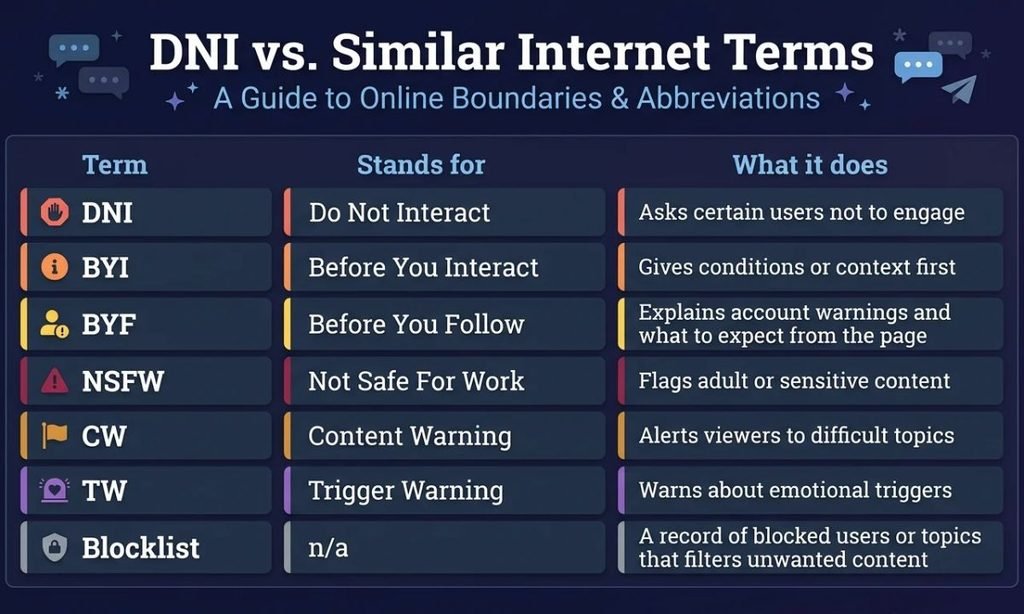
People mix these up constantly. Here’s a side-by-side look.
| Term | Stands for | What it does |
| DNI | Do Not Interact | Asks certain users not to engage |
| BYI | Before You Interact | Gives conditions or context first |
| BYF | Before You Follow | Explains account warnings and what to expect from the page |
| NSFW | Not Safe For Work | Flags adult or sensitive content |
| CW | Content Warning | Alerts viewers to difficult topics |
| TW | Trigger Warning | Warns about emotional triggers |
| Blocklist | n/a | A record of blocked users or topics that filters unwanted content |
The Blocklist is the odd one out. Unlike the others, which are labels or requests, it’s a working filter. Each term has its own purpose, and mixing them up leads to confusion.
DNI vs. BYI: What’s the Difference?
BYI is DNI’s softer cousin. DNI excludes certain people entirely. BYI informs them first by setting conditions or giving context before they engage. Think of a note like “read my pinned post before following.”
The difference is firmness. DNI says stay away. BYI says read this first. Both are boundary tools, just at different strengths.
DNI vs. Blocking, Muting, and Reporting
This is where people get tripped up. DNI is a request. Block, mute, and report are actions. That’s the whole difference: request versus action.
| Tool | What it does | Enforced? |
| DNI | Asks certain people not to engage | No, it relies on the honor system |
| Block | Stops a user from viewing or contacting you | Yes, technically enforced |
| Mute | Hides someone’s posts from your feed, on your end only | Yes, but only for you |
| Report | Flags content to platform moderators | Depends on platform review |
Writing DNI is a stated boundary, not a lock on the door. If someone ignores it, enforcement is up to you, and blocking is the tool that actually does something.
When Should You Use DNI?
Use it when it solves a real problem. A private community, adult-oriented content, regular harassment, or sensitive topics are all fair reasons. If you need an online boundary, say so plainly. Something like “Minors DNI. This account discusses adult topics.” is clear, respectful, and easy to understand.
It’s also a good fit for personal profiles, for moderating a fandom space, and for filtering toxic or unwanted engagement. It helps signal that certain audiences should skip certain content, like keeping minors away from mature posts.
The Mistake to Avoid: The Giant DNI List
Where people go wrong is the massive list. When someone writes “DNI if you like this movie, this game, this food,” the account starts to sound hostile, aggressive, or overly negative.
A bloated list can push people away, create drama instead of preventing it, and leave you with a confusing profile. Short and clear wins every time.
When Not to Use DNI
DNI looks unprofessional in work emails or professional Slack channels. Skip it with teachers, clients, or coworkers, and in any situation that needs a real conversation.
In a formal setting, pick wording that fits the room:
- “Please don’t contact me about this.”
- “I’d prefer not to discuss this topic.”
The intent is the same. The tone just suits the audience.
Is DNI Rude or Respectful?
It depends on the wording and the tone. Tone changes everything.
- “Minors dni, please” is respectful. The courtesy softens it.
- A bare “dni” is neutral, and polite enough in its plainness.
- “If you disagree with me dni” is harsh and can read as dismissive of other views.
DNI lists also draw criticism when they feel exclusionary or performative instead of protective. Adding a reason or a “please” helps the boundary read as a request rather than an attack.
Common Misunderstandings About DNI
Myth 1: DNI works like a blocking feature. It doesn’t. It’s a request and a boundary statement, and anyone can technically ignore it.
Myth 2: Only toxic people use it. The opposite is usually true. Plenty of Gen Z users add one for safety, comfort, and a little peace of mind, and it has become part of normal internet culture.
Different Types of DNI You’ll See Online
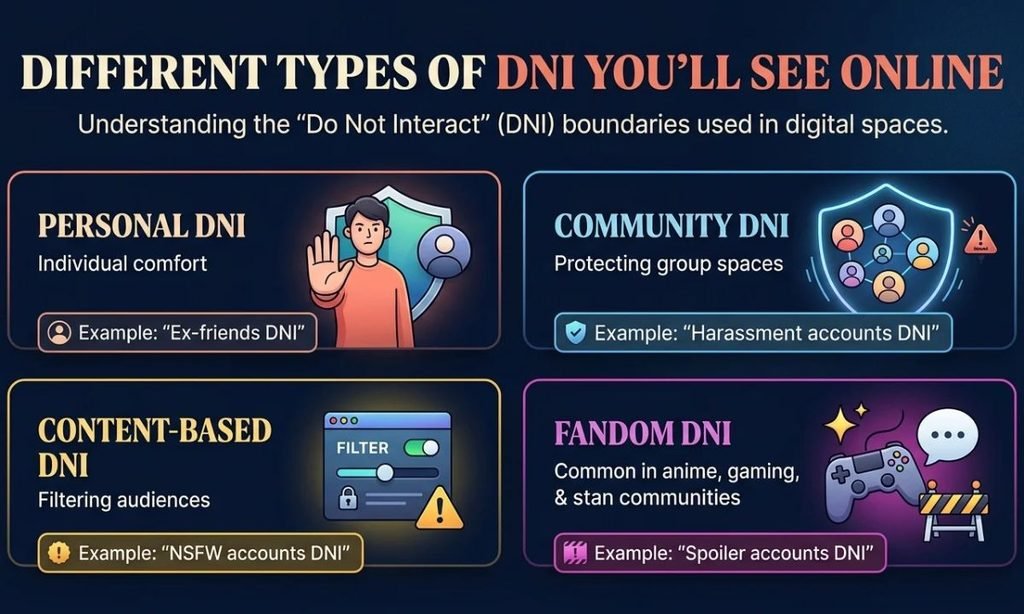
| Type | Purpose | Example |
| Personal DNI | Individual comfort | “Ex-friends DNI” |
| Community DNI | Protecting group spaces | “Harassment accounts DNI” |
| Content-based DNI | Filtering audiences | “NSFW accounts DNI” |
| Fandom DNI | Common in anime, gaming, and stan communities | “Spoiler accounts DNI” |
Is DNI Effective?
Sometimes yes, sometimes no.
It works when:
- People respect boundaries.
- The community is moderated.
- Expectations are clear.
It falls apart when:
- Trolls ignore it.
- The list turns into an extreme one.
- Aggressive wording invites an argument.
Even so, plenty of people feel more comfortable having one posted.
Pro Tips for Using DNI Correctly
- Keep it short. A giant paragraph of rules is something nobody reads.
- Stay respectful. Angry or insulting wording achieves less than a clear boundary.
- Add context for 18+ pages. A short explanation of why helps.
- Don’t expect everyone to obey. For stronger protection, combine your DNI with blocking, muting, and privacy settings.
- Update your rules. Your space changes, so your boundaries should too.
Why DNI Became So Popular
The internet has become more personal. People build communities online, share their feelings, and talk about serious topics out in the open. That makes boundaries matter more than they used to.
DNI caught on because it’s a fast way to say who a space is for. For Gen Z especially, these internet boundaries are now a normal part of online life. It’s one of many terms that started in fandom and social media spaces and went mainstream. If you like decoding online slang, our guide to larping meaning covers another term you’ll see across the same platforms.
Can DNI Be Controversial?
Yes. Critics say it creates division, builds echo chambers, and makes social media feel less open. Supporters argue that it protects mental health, reduces harassment, and helps people feel safer online. Both views have merit, and the truth probably sits somewhere in between.
Other Meanings of DNI Beyond Social Media
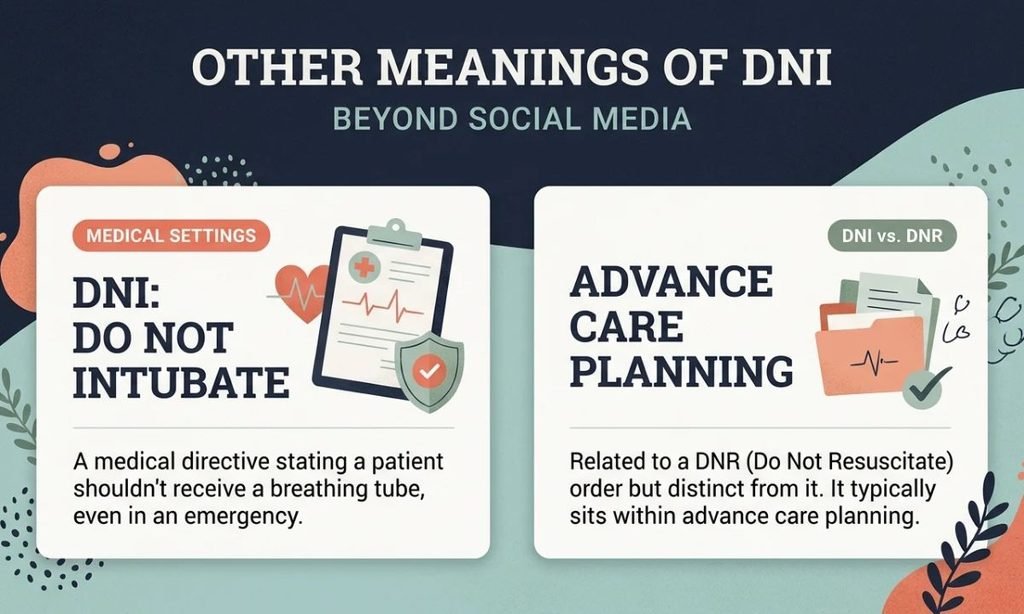
Do Not Interact is the dominant meaning online, but the acronym shows up in a few unrelated fields too. Context decides everything. Outside social media, DNI can mean Do Not Intubate, Director of National Intelligence, or Documento Nacional de Identidad.
DNI Meaning in Medical Settings
In healthcare, DNI means Do Not Intubate. It’s a medical directive saying a patient shouldn’t receive a breathing tube, even in an emergency.
It’s related to a DNR (Do Not Resuscitate) order but distinct from it, and it typically sits within advance care planning.
What Does DNI Mean in Government?
In the U.S. government, DNI stands for Director of National Intelligence, the cabinet-level official who oversees the intelligence community. You can find more about the role on the official Office of the Director of National Intelligence website. Tulsi Gabbard held the role until she resigned in June 2026, and Jay Clayton was sworn in as the ninth Senate-confirmed DNI in August 2026. If you spot DNI in a political headline, this is almost certainly what it refers to.
DNI Meaning in Spanish: The National Identity Card
In Spain and several Latin American countries, DNI stands for Documento Nacional de Identidad, a national ID card. It’s the everyday identification document used for banking, buying event tickets, and more, much like a driver’s license or passport in the U.S.
What Does DNI Mean at Costco?
This one is murkier. Some shopper forums use DNI informally to describe a warehouse’s restocking pattern, but it’s not an official term, and there’s no verifiable company-wide definition. If you see it in a shopping thread, treat it as community slang, not a policy term.
What Does DNI Mean in the Winter Olympics?
Nothing official. Olympic results use codes like DNS (Did Not Start), DNF (Did Not Finish), DNQ (Did Not Qualify), and DSQ (Disqualified). If you’ve seen DNI in that context, it’s likely a mix-up with one of these.
Quick Reference: All the DNI Meanings
| Context | DNI stands for |
| Social media, texting | Do Not Interact |
| Medicine | Do Not Intubate |
| U.S. government | Director of National Intelligence |
| Spain and Latin America | Documento Nacional de Identidad |
| Costco shopper forums | Informal slang, not an official term |
| Winter Olympics | Not an official code |
Final Thoughts on the DNI Meaning
The DNI meaning in text comes down to one idea: Do Not Interact. Underneath, it stands for safety, privacy, and community management. It’s a small tool for setting online boundaries quickly, whether you’re keeping minors away from mature content, filtering toxic behavior, or protecting a community space from unwanted noise.
Keep it respectful, keep it clear, and use it for comfort rather than conflict. Remember it’s a request, not a lock, so pair it with blocking or moderation when you need real enforcement.
And if you meet the acronym outside a social media bio, check the context first. Medicine, government, and national ID systems all use it too.
FAQs
What does DNI mean in texting?
DNI stands for “Do Not Interact.” It’s internet slang people use in bios, captions, and posts to ask certain users not to follow, comment, or message them.
What does “minors DNI” mean?
It means anyone under 18 shouldn’t engage with that account. People usually add it when their page includes adult topics or content.
What does DNI mean on TikTok?
On TikTok, DNI is a quick boundary tag, often added to a caption or comment. It usually applies to a single video, like “minors dni,” rather than a whole profile.
What does DNI mean on Twitter (X)?
On X, DNI usually appears in a bio or pinned post, often as a list of people the user doesn’t want engaging with them. These lists tend to be longer and more specific than on other platforms.
What does DNI mean on Discord?
Discord servers use DNI in rules channels or member bios to flag spammers, trolls, or past troublemakers. It works more like a moderation guideline than a personal statement.
Is DNI the same as blocking someone?
No. DNI is a voluntary request that relies on others respecting it, while blocking is a technical action that actually limits contact. For real enforcement, use both.
Is DNI rude?
Not necessarily. A short, polite line like “minors dni, please” is respectful, while hostile wording like “if you disagree with me dni” can come across as harsh.
What does NSFW DNI mean?
It’s a request for explicit-content accounts to stay away, or a warning that a post contains adult material and minors shouldn’t engage. “NSFW, minors dni” is the most common combination.
What is the difference between DNI and BYI?
DNI tells certain people to stay away entirely. BYI (“Before You Interact”) is softer: it asks people to read your conditions or context first, like a pinned post, before engaging.
What does DNI mean in medical terms?
In healthcare, DNI means “Do Not Intubate.” It’s a directive saying a patient shouldn’t receive a breathing tube, even in an emergency, and it’s separate from a DNR order.
What does DNI mean in government?
In the U.S., DNI stands for Director of National Intelligence, the cabinet-level official who oversees the intelligence community. Jay Clayton was sworn in as DNI in August 2026.
What does DNI mean in Spanish?
In Spain and Latin America, DNI means “Documento Nacional de Identidad,” the national ID card. It’s used for banking, travel, and everyday identification, much like a U.S. driver’s license.
What does DNI mean at Costco?
There’s no official Costco definition. Some shopper forums use it informally for restocking patterns, so treat it as community slang, not company policy.
What does DNI mean in the Winter Olympics?
It has no official meaning there. Olympic results use codes like DNS, DNF, DNQ, and DSQ, so DNI is most likely a mix-up with one of those.
When should you use DNI in your bio?
Use it when you have a real reason, like adult content, a private community, or ongoing harassment. Keep it short, polite, and specific so it reads as a boundary rather than hostility.
Can you use DNI in a professional setting?
It’s best avoided in work emails, school messages, or client chats. Try plain wording like “I’d prefer not to discuss this topic” instead.
