

If you’ve ever stared at a sentence with one of these — and wondered whether it belongs there, you’re not alone. The dash is one of the most misunderstood punctuation marks in English. People confuse it with a hyphen, misuse it in emails, and often avoid it altogether because they’re not sure what it actually means.
Here’s the good news: once you understand dash meaning and how this small mark works, you’ll start using it with confidence. It’s not complicated once someone breaks it down in plain English, which is exactly what we’re going to do here.
By the end of this guide, you’ll know what a dash is, how it differs from a hyphen, how to use it correctly in a sentence, and when it makes your writing stronger instead of messier.
What Is the Meaning of Dash?
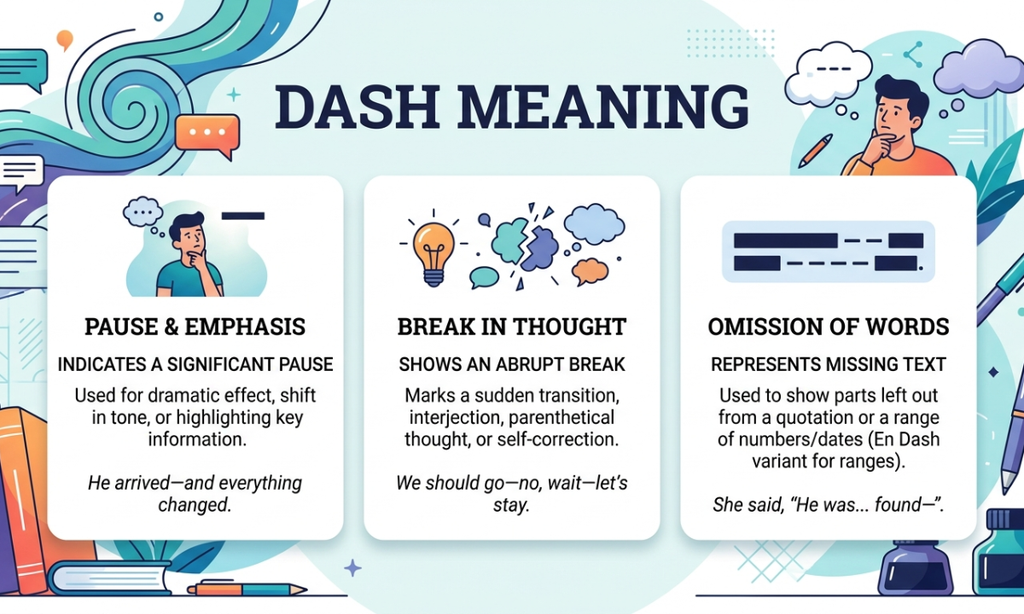
So, what does dash mean exactly? In grammar, a dash is a punctuation mark used to show a break in thought, add emphasis, set off extra information, or connect ranges of numbers. It looks like a horizontal line, and depending on the type, it can be short or long.
The definition of dash isn’t limited to one single use. That’s actually part of what makes it confusing. A dash can:
- Interrupt a sentence to add a side comment
- Replace commas, parentheses, or colons for stronger emphasis
- Show a sudden change in tone or direction
- Connect a range, like dates or numbers
Think of the dash as punctuation’s way of saying, “wait, let me add something important here.” It draws attention to whatever comes after it, which is why writers love using it for emphasis.
If you look up dash dictionary meaning in most standard English dictionaries, you’ll find something along these lines: a punctuation mark (—) used to indicate a pause, break, or omission, or to set apart a phrase within a sentence. That’s the core definition, but real-world usage is a lot more flexible than a textbook entry suggests.
Dash Definition: Breaking It Down Simply
Let’s simplify the dash definition even further, because dictionaries can sometimes make things sound more complicated than they need to be.
A dash is:
- A punctuation mark
- Represented by a horizontal line
- Used to separate or emphasize parts of a sentence
- Different from a hyphen, even though they look similar
That last point trips up a lot of people, so it’s worth repeating: a dash is not the same as a hyphen. They serve different jobs, even though your keyboard doesn’t always make a clear visual distinction between them.
Dash as a Noun
Grammatically speaking, dash is a noun when referring to the punctuation mark itself. For example: “She added a dash at the end of the sentence for effect.” Here, “dash” names the punctuation mark, which makes it function as a noun in that sentence.
Dash can also function as a verb in everyday English, unrelated to punctuation, as in “He had to dash to catch the bus.” But when we’re talking about grammar and writing, we’re focused on the noun form: the punctuation symbol.
Types of Dashes: Em Dash vs. En Dash vs. Hyphen
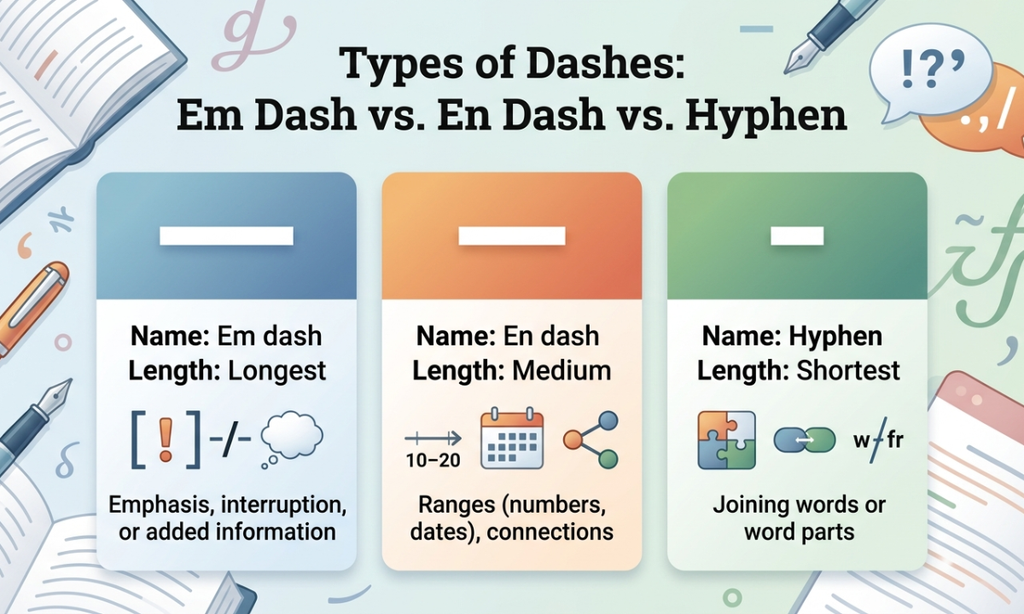
This is where a lot of the confusion around dash meaning really comes from. English actually has more than one type of dash, and each one has its own specific job. For a detailed explanation of punctuation and grammar terms, you can also refer to this Merriam-Webster grammar guide
| Symbol | Name | Length | Common Use |
| — | Em dash | Longest | Emphasis, interruption, or added information |
| – | En dash | Medium | Ranges (numbers, dates), connections |
| – | Hyphen | Shortest | Joining words or word parts |
The Em Dash (—)
The em dash is the one most people picture when they think of “a dash.” It’s the longest of the three, and it’s used to create emphasis or insert a break in a sentence.
Example: “I was going to leave early — but then something came up.”
Notice how the em dash creates a dramatic pause. You could replace it with a comma or parentheses, but the em dash gives the sentence more punch.
The En Dash (–)
The en dash is shorter than the em dash but longer than a hyphen. It’s mainly used to show a range or connection between things.
Example: “The meeting is scheduled for 2–4 PM.”
Example: “Read pages 10–15 for homework.”
You’ll also see the en dash used to connect two related words that aren’t quite compound words, like “the New York–London flight.”
The Hyphen (-)
Technically, a hyphen isn’t a dash at all, even though people use the terms interchangeably in casual conversation. A hyphen connects words or parts of words, like “well-known” or “mother-in-law.”
Understanding dash meaning really depends on knowing this distinction, because mixing these up can actually change the meaning of your sentence.
Dash Meaning in Grammar
In formal grammar, the dash is considered a versatile punctuation mark that can take the place of commas, colons, semicolons, or parentheses, depending on the tone you want to create.
Here’s a quick breakdown of what a dash can replace and why a writer might choose it instead:
- Instead of a comma: for stronger emphasis on the added phrase
- Instead of parentheses: to make the extra information feel more integrated into the sentence
- Instead of a colon: to introduce a list or explanation with a punchier feel
For example, compare these three versions of the same sentence:
- With commas: “She brought everything she needed, snacks, water, and a map, for the trip.”
- With parentheses: “She brought everything she needed (snacks, water, and a map) for the trip.”
- With a dash: “She brought everything she needed — snacks, water, and a map — for the trip.”
All three are grammatically correct, but the dash version feels more direct and confident. That’s the real power behind dash meaning in grammar: it’s not just about following rules, it’s about controlling tone.
Dash Definition for Kids (Simple Explanation)
If you’re explaining dash meaning to a younger student, keep it simple. A dash is a punctuation mark that looks like a short line. Writers use it to add extra information to a sentence or to show a pause, kind of like taking a breath before saying something important.
A kid-friendly example: “My dog — the one with brown spots — loves to play fetch.”
That little phrase between the dashes gives more detail about the dog without needing a whole new sentence.
How to Use a Dash Correctly
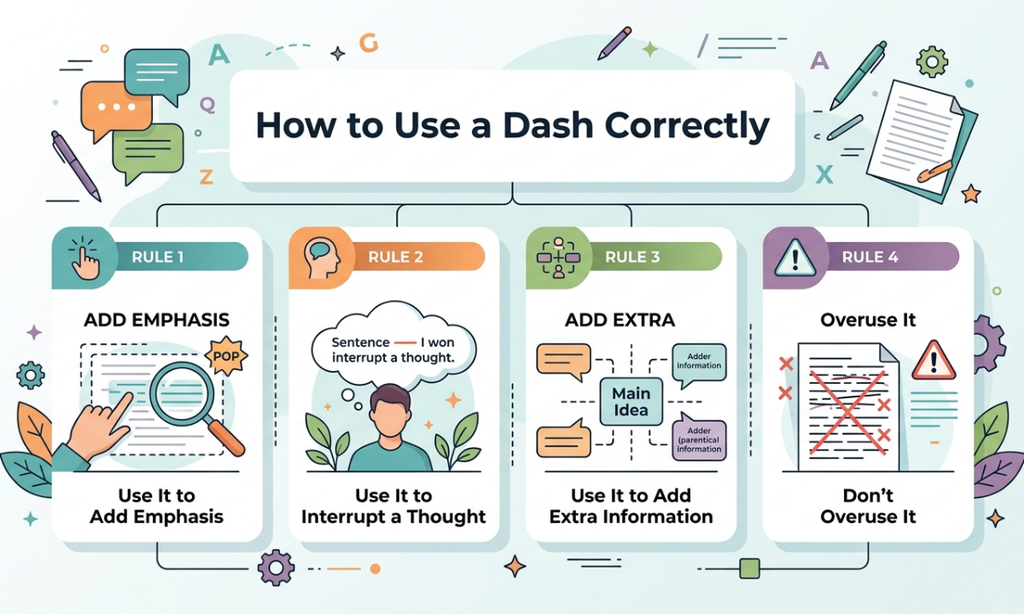
Knowing the definition is one thing. Actually using a dash with confidence is another. Here’s how to use a dash in your own writing without overdoing it.
Rule 1: Use It to Add Emphasis
When you want to highlight something important, a dash works better than a comma.
Example: “There’s only one thing I’m sure of — I’m not giving up.”
Rule 2: Use It to Interrupt a Thought
Dashes are great for showing a sudden shift or interruption, especially in dialogue.
Example: “I was about to explain, but — wait, do you hear that?”
Rule 3: Use It to Add Extra Information
You can insert a phrase between two dashes to add detail without disrupting the main sentence.
Example: “The recipe — which took hours to perfect — turned out amazing.”
Rule 4: Don’t Overuse It
This is where a lot of writers get it wrong. Dashes are powerful, but using them in every other sentence makes your writing feel choppy and unpolished. Save them for moments that genuinely need emphasis.
Dash in a Sentence: Real Examples
Seeing dash meaning in action makes everything click faster than just reading definitions. Here are several examples showing different uses:
For emphasis:
“He had one goal — to win.”
For interruption:
“I thought about calling her — actually, I still might.”
For added information:
“My sister — who lives in Texas — is visiting next week.”
For a range:
“The store is open Monday–Friday, 9 AM–6 PM.”
In texting or casual writing:
“omw — be there in 10”
That last example shows how dash meaning has expanded into digital communication. In texts and casual messages, people often use a dash the same way they’d use “by the way” or a quick pause, without worrying about formal grammar rules. If you’re interested in common texting expressions, you can also read our guide on what does PDA mean in text.
What Does a Dash Symbol Look Like?
If you’re wondering what a dash symbol actually looks like on a keyboard or screen, here’s the simple answer: it’s a horizontal line, longer than a hyphen. On most keyboards, you won’t find a dedicated dash key. Instead, word processors like Microsoft Word or Google Docs often auto-format two hyphens into an em dash when you’re typing.
Here’s how to find it manually if you need to:
- On Windows: Hold Alt and type 0151 for an em dash, or 0150 for an en dash
- On Mac: Press Option + Shift + Hyphen for an em dash, or Option + Hyphen for an en dash
- In Google Docs: Type two hyphens between words, and it usually auto-corrects to an em dash
So when someone asks, “what is a dash called” in a technical sense, the answer depends on which type they mean — em dash, en dash, or the more casual catch-all term “dash.”
Dash vs. Hyphen: Quick Comparison
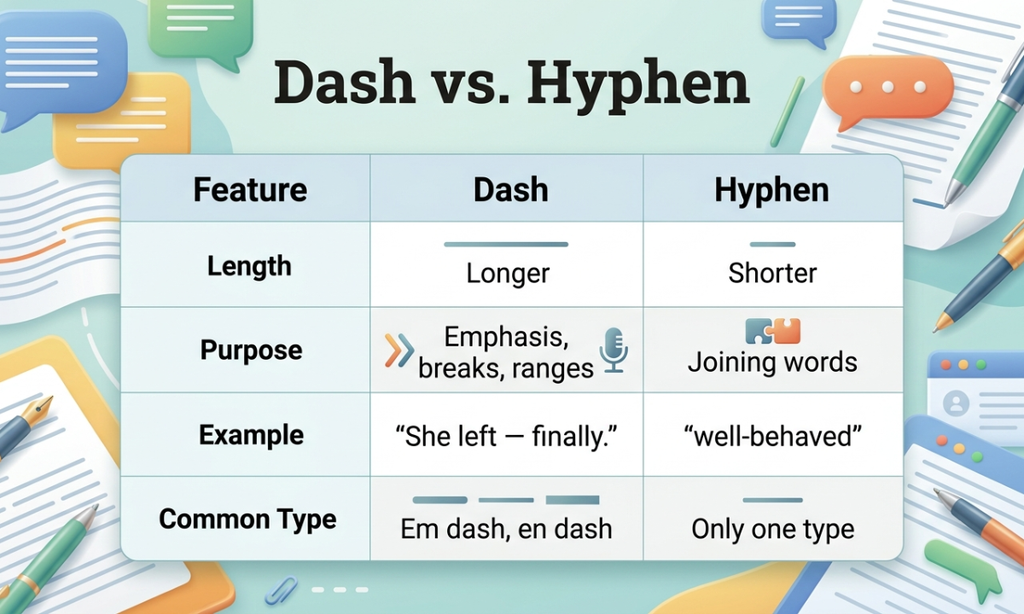
Since this comparison causes so much confusion, here’s a simple table to keep things straight.
| Feature | Dash | Hyphen |
| Length | Longer | Shorter |
| Purpose | Emphasis, breaks, ranges | Joining words |
| Example | “She left — finally.” | “well-behaved” |
| Common Type | Em dash, en dash | Only one type |
If you remember nothing else from this guide, remember this: a hyphen joins, a dash separates or emphasizes. That one distinction clears up most of the confusion around dash meaning for good.
Why Understanding Dash Meaning Actually Matters
You might be thinking, does any of this really matter outside of an English class? Actually, yes. Whether you’re writing a work email, a college essay, a text message, or a novel, punctuation shapes how your reader interprets tone and pacing.
A dash can make your writing feel more conversational and confident. Used well, it mimics the natural pause we make when speaking, which makes your writing feel more human and less robotic. Used poorly, it can make your sentences feel disjointed or overly dramatic.
Professional editors and writing teachers pay close attention to dash usage because it reveals how comfortable a writer is with sentence structure. Mastering it puts you a step ahead, whether you’re writing for school, work, or your own blog.
Final Thoughts on Dash Meaning
At its core, dash meaning comes down to one idea: it’s a flexible punctuation mark that adds emphasis, shows interruption, or connects ideas and ranges. Once you understand the difference between an em dash, en dash, and hyphen, using this punctuation mark becomes second nature.
Start small. Next time you’re writing an email or a text, look for a spot where you’d naturally pause or want to emphasize something, and try using a dash instead of a comma. You’ll be surprised how much stronger your sentence feels.
Punctuation doesn’t have to be intimidating. With a little practice, the dash becomes one of the most useful tools in your writing toolkit.
FAQs
What does dash mean in a sentence?
A dash marks a pause, interruption, or added emphasis within a sentence. It often sets off extra information without breaking the main flow of thought. For example: “She finally arrived — an hour late.”
What is the difference between a dash and a hyphen?
A hyphen joins words or parts of words, like “well-known.” A dash is longer and used to separate ideas, add emphasis, or show a pause, like “She left — finally.”
What is an em dash used for?
An em dash (—) is the longest type of dash, used for emphasis, interruptions, or inserting extra detail into a sentence. It’s the most common dash people mean when they simply say “dash.”
What is an en dash used for?
An en dash (–) is shorter than an em dash and mainly connects ranges, like dates, times, or numbers. A common example is “Monday–Friday” or “2–4 PM.”
How do you type a dash on a keyboard?
On Windows, hold Alt and type 0151 for an em dash. On Mac, press Option + Shift + Hyphen. Many word processors also auto-convert two hyphens into a dash while typing.
Can you start a sentence with a dash?
Starting a sentence with a dash isn’t standard in formal writing, since dashes typically connect or interrupt existing sentence parts. It’s more common in casual or stylistic writing, like dialogue or texting.
What is a dash called in grammar?
In grammar, it’s simply called a dash, with two main types: the em dash and the en dash. Each has a distinct length and a specific job within a sentence.
Is a dash the same as a minus sign?
No, a dash and a minus sign look similar but serve different purposes. A minus sign is used in math to show subtraction, while a dash is a punctuation mark used in writing.
