

You’re scrolling through a group chat and someone drops a line like “he’s not my friend, he’s an opp.” No context, no explanation, just the word sitting there like you’re supposed to already know what it means.
If you’ve landed here trying to figure out the Opps meaning in text message conversations, you’re not alone. This word shows up constantly in texting, on social media, and in everyday slang among younger generations, and it can throw off anyone who didn’t grow up around it.
The short version: “opp” is short for “opposition” or “opposing person.” It’s slang for an enemy, rival, or someone who’s against you. But the full picture is a lot more interesting, and knowing how to read the tone behind it will save you from some awkward misunderstandings.
This guide covers everything you need — the real definition, where the word came from, how people use it in real texts, and how to tell when it’s serious versus when it’s just a joke between friends.
What Does Opp Mean in Text?
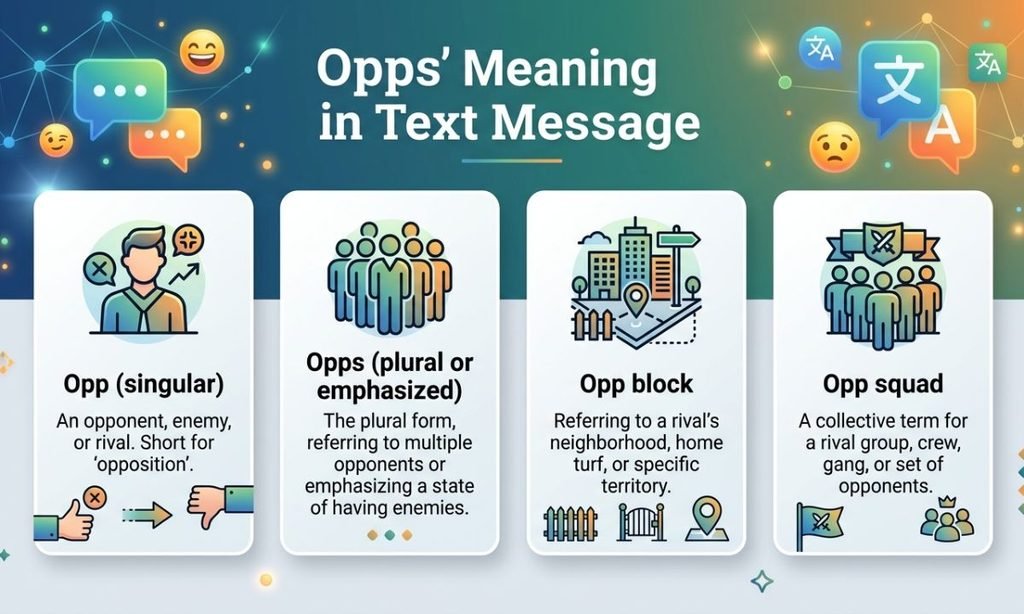
At its core, when someone asks what does opp mean in text, the answer is simple: an “opp” is an opponent, rival, or enemy. It’s someone the sender considers to be against them in some way, whether that’s a personal beef, a group rivalry, or something more serious.
The word is almost always used as a noun, and it’s typically directed at a specific person or group. You’ll see it written in a few different ways depending on who’s texting:
- Opp (singular)
- Opps (plural or emphasized)
- Opp block (referring to a rival’s neighborhood or territory)
- Opp squad (a rival group or crew)
So if you’re wondering what does opp mean on text specifically, in most cases it’s shorthand for “this person is not on my side, and might even be working against me.”
For broader slang definitions and usage notes, you can also check Merriam-Webster’s dictionary resources.
Where the Word Comes From
“Opp” isn’t a brand-new invention. It’s rooted in hip-hop and drill music culture, particularly Chicago drill music from the early 2010s, where “opposition” was shortened into “opp” to describe rival gang members or people from a conflicting neighborhood. Artists used the term constantly in lyrics, and from there it spread into everyday slang through social media, especially platforms like Twitter, Instagram, and TikTok.
Over time, the word softened for a lot of younger users. What started as a term tied to real street rivalries eventually became a catch-all word for anyone you don’t like, anyone competing with you, or even someone who’s just being annoying. That shift matters a lot when you’re trying to understand tone, which we’ll get into shortly.
Opp Meaning in Text: The Full Breakdown
Let’s slow down and really unpack the opp meaning in text beyond the one-line definition. There isn’t just one way to use this word — context changes everything.
1. The Serious Meaning
In its original and most literal sense, an opp is a real enemy. This could mean:
- A rival from a conflicting group, crew, or gang
- Someone involved in an actual ongoing conflict or beef
- A person the sender genuinely does not trust or get along with
In this context, calling someone an opp is not playful. It signals real tension, and depending on who’s using the word and where, it can carry serious weight.
2. The Casual, Everyday Meaning
Most of the time, especially among teens and young adults texting friends, “opp” has been watered down into something far less intense. People use it to describe:
- A friend who’s playfully being difficult
- Someone who beat them in a game or competition
- A sibling who ate their leftovers
- A coworker who took credit for something small
In this version, calling someone an opp is closer to calling them a “hater” or saying “you’re on my bad side right now” — but usually with a smile behind it.
If you’re interested in another popular texting abbreviation, you can also read our guide to FML meaning in slang to see how another short expression changes meaning depending on context.
3. The Joking, Ironic Meaning
There’s also a fully sarcastic use where “opp” is a joke between close friends. Someone might text “you’re such an opp for not saving me a slice of pizza” as a lighthearted jab, not a real accusation of anything.
This is the version that trips people up most. If you take every “opp” text at face value, you’ll misread half the messages you get from anyone under 30.
How to Tell If Someone Means It Seriously
Since the word swings between “real enemy” and “inside joke,” tone matters more than the word itself. Here’s a quick way to gauge it.
| Signal | Likely Meaning |
| Sent with laughing emojis (😂, 💀) | Playful, not serious |
| Used about a close friend or sibling | Almost always joking |
| Paired with slang like “smh” or “lol” | Casual, low stakes |
| Sent in a serious or tense conversation | Could be genuine |
| Referring to someone unknown to the group | Possibly a real rivalry |
| Repeated with anger or all caps | Take it seriously |
If you’re ever unsure, the safest move is to just ask. Something like “wait are you actually mad or joking” clears things up fast and avoids reading too much into a text.
Opps Meaning in Different Contexts
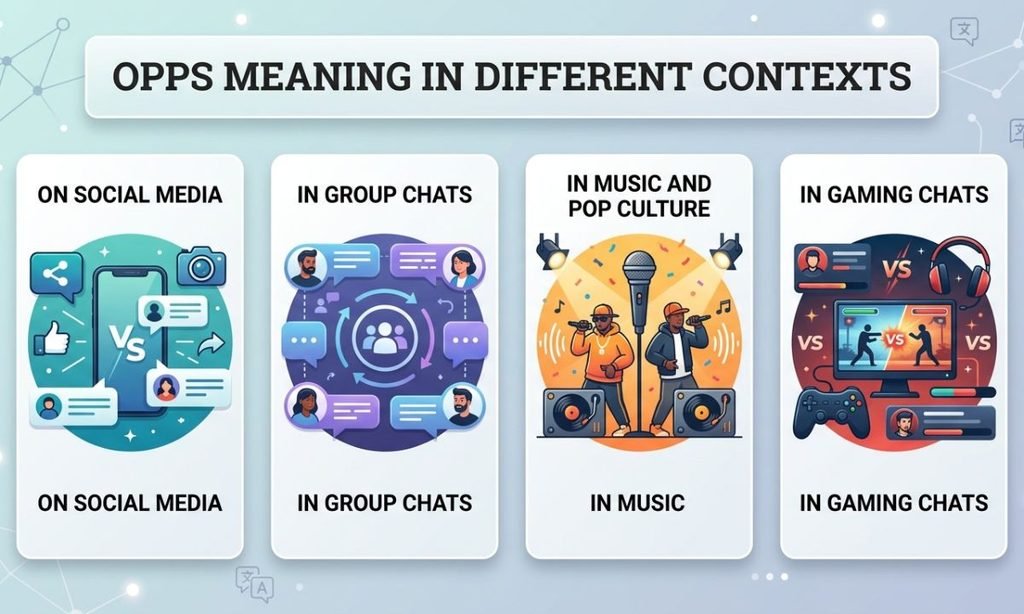
The word doesn’t stay locked into one meaning across every platform or age group. Here’s how it tends to shift depending on where you see it.
On Social Media
On Instagram or TikTok, “opps” often shows up in captions or comments as a badge of confidence — “ignoring the opps today” or “opps in my comments as usual.” It’s less about a specific person and more about a general vibe of “haters gonna hate.”
In Group Chats
This is where the casual, joking version thrives. Friend groups love turning “opp” into an inside joke, assigning it to whoever loses a game, forgets to bring snacks, or shows up late.
In Music and Pop Culture
In drill, trap, and hip-hop lyrics, the term usually keeps its original, more serious meaning tied to real rivalries. This is also where a lot of younger users first pick up the word before adapting it for everyday texting.
In Gaming Chats
Gamers frequently use “opp” to describe the other team or a specific rival player, similar to how “opponent” would traditionally be used, just shorter and more casual.
Real Text Message Examples
Seeing the word in action makes the meaning click faster than any definition alone. Here are a few realistic examples covering different tones.
Casual and joking:
“bro ate the last slice without asking, ur such an opp 💀”
Competitive, low stakes:
“not you beating me in the game again… certified opp behavior”
Genuine tension:
“don’t trust him, he’s been acting like an opp lately”
Social media caption style:
“opps mad, opps still mad, moving on with my day”
Notice how the punctuation, emojis, and overall message length give away the tone way more than the word “opp” by itself.
Opp vs. Similar Slang Terms
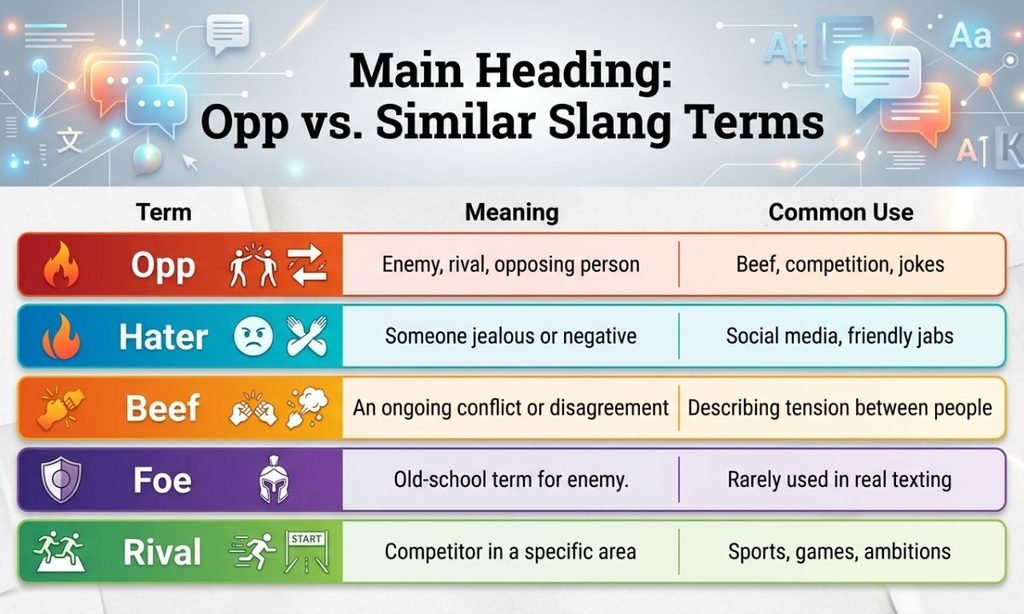
To fully understand what does opp mean in text, it helps to compare it against similar slang people mix it up with.
| Term | Meaning | Common Use | Tone |
| Opp | Enemy, rival, opposing person | Beef, competition, jokes | Ranges from serious to playful |
| Hater | Someone jealous or negative | Social media, friendly jabs | Usually casual |
| Beef | An ongoing conflict or disagreement | Describing tension between people | Can be serious or exaggerated |
| Foe | Old-school term for enemy | Rarely used in real texting | Mostly ironic today |
| Rival | Competitor in a specific area | Sports, games, ambitions | Neutral to competitive |
The biggest difference between “opp” and words like “hater” is that opp implies a more direct, personal conflict, while “hater” is broader and often aimed at random critics rather than one specific person.
Why This Slang Caught On
Language moves fast in group chats, and short, punchy words tend to survive longest. “Opp” checks every box: it’s one syllable, it’s flexible enough to fit serious and silly situations, and it came from music that millions of people already listened to and quoted daily.
It also fills a gap that older slang didn’t quite cover. “Enemy” sounds dramatic for a text about someone stealing your fries. “Hater” doesn’t capture direct one-on-one conflict the same way. “Opp” sits right in the middle, which is exactly why it stuck.
Should You Use “Opp” Yourself?
If you’re thinking about using the word in your own texts, a few quick pointers will help you sound natural instead of forced:
- Keep it light unless you actually mean it seriously — the word reads as a joke by default in most friend groups.
- Pair it with emojis or casual slang if you want the playful version to come through clearly.
- Avoid using it about people you don’t know well, since the tone can land wrong without context.
- Skip it in formal or professional messages entirely — it has zero place outside casual texting.
Slang like this works best when it fits naturally into how you already talk. Forcing it into a conversation usually stands out more than it blends in.
Quick Recap
Here’s the short version if you’re skimming:
- Opp is short for “opposition” — a rival, enemy, or someone against you.
- The word came from drill and hip-hop culture before spreading into everyday texting.
- It can be dead serious or completely joking, depending on tone and context.
- Emojis, punctuation, and who it’s aimed at usually reveal the real meaning.
- It’s most common in group chats, social media captions, gaming, and music lyrics.
Once you know the range this word covers, you’ll never second-guess a text again. The opps meaning in text message conversations really comes down to reading the room — the word itself is just doing half the work.
FAQs
What does opp mean in text?
An “opp” is slang for an enemy, rival, or someone who’s against you. It comes from the word “opposition” and can range from a real conflict to a lighthearted joke, depending on tone. Emojis and context usually reveal which one it is.
What does opps mean in texting?
“Opps” is just the plural or emphasized version of “opp,” referring to rivals or people someone considers against them. In everyday texting, it’s most often used casually among friends rather than to describe a serious enemy.
Is calling someone an opp an insult?
It can be, but it depends heavily on tone and relationship. Among close friends, it’s usually a playful jab about something small, like losing a game. Between strangers or in a tense conversation, it can be a genuine insult.
Where did the term “opp” come from?
The word originated in drill and hip-hop music, particularly Chicago drill culture in the early 2010s, as slang for rival gang members. It later spread through social media into everyday texting among younger generations.
How do I know if someone is joking when they call me an opp?
Look for laughing emojis, casual slang, or a friendly context — these usually signal a joke. If the message is short, angry, or repeated without humor, the person likely means it seriously.
What’s the difference between an opp and a hater?
An opp usually refers to a specific person involved in direct conflict or rivalry, while a hater is a broader term for someone who’s negative or jealous, often without a personal connection. Opp implies a more one-on-one dynamic.
Can “opp” be used in a friendly way?
Yes, it’s extremely common as a joke between friends, such as teasing someone for beating you at a game or eating your food. In this context, it carries no real hostility at all.
