

You’re scrolling through your messages, minding your own business, when a friend drops “DTM” into the conversation. No context. No explanation. Just three letters sitting there like you’re supposed to know exactly what they mean.
If you’ve ever paused mid-scroll trying to figure out what does DTM mean in text, you’re not alone. This abbreviation shows up constantly in group chats, Snapchat streaks, and comment sections, and it can mean a few different things depending on who’s typing it and where you’re seeing it.
By the end of this guide, you’ll know every common DTM meaning in text, how to use it naturally, and how to avoid an awkward mix-up when someone sends it your way.
What Does DTM Stand For?
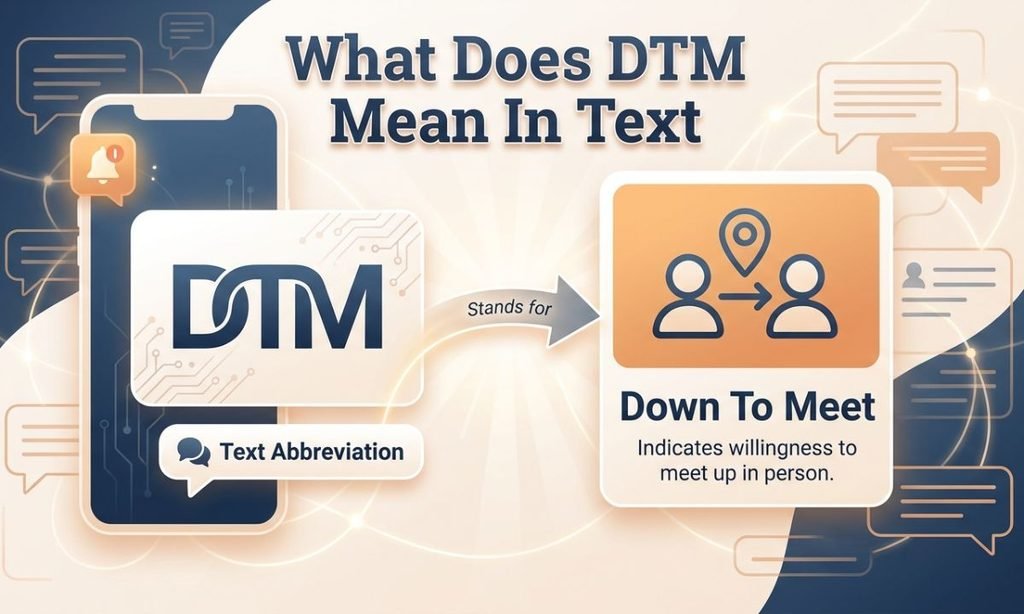
The most common DTM meaning is “Down To Meet.” People use it when they’re agreeing to hang out, link up, or make plans in person.
Here’s a quick example:
Sarah: We’re all going to the game Friday, you in? Jake: Yeah I’m DTM 🙌
In that context, Jake is simply saying he’s available and willing to meet up. It’s casual, friendly, and doesn’t carry any deeper meaning beyond “count me in.”
That said, this isn’t the only DTM text meaning floating around. Slang terms rarely stay locked to one definition, especially once they start trending across different apps and age groups. For additional context on how texting abbreviations can vary by conversation, you can also read our guide to HBS meaning in chat.
Every Common DTM Meaning In Text
Depending on the conversation, DTM in text can shift meaning slightly. Here’s a breakdown of the versions you’re most likely to run into.
| Meaning | What It Means | Common Use | Tone |
| Down To Meet | Willing or open to meeting up in person | Making plans with friends | Casual, friendly |
| Don’t Trust Me | A joking way to admit you’re unreliable | Self-deprecating humor | Playful, sarcastic |
| Dead To Me | Someone or something you’re done with | Venting about a person or situation | Blunt, sometimes dramatic |
| Down To Mingle | Open to meeting new people, often flirtatious | Dating apps, party plans | Flirty |
Most of the time, when someone asks what does DTM mean in texting, they’re referring to “Down To Meet.” It’s by far the most widely used version, especially among teens and young adults coordinating plans over text or social media.
Still, context clues matter a lot here. If your friend just spent an entire message ranting about their roommate and then adds “DTM,” they almost certainly mean “Dead To Me,” not an invitation to hang out.
For another reference on DTM’s common texting and social-media meanings, see Slang.net’s DTM definition.
How to Tell Which DTM Meaning Is Being Used
You don’t need a secret decoder ring to figure this out. A little context does most of the work for you. Ask yourself:
- Is the conversation about making plans? It’s probably “Down To Meet.”
- Is someone venting or annoyed? It’s likely “Dead To Me.”
- Is the tone joking or self-aware? It could be “Don’t Trust Me.”
- Is this happening on a dating app or a party-related chat? “Down To Mingle” is a strong possibility.
Reading the tone of the message before it, along with who’s sending it, will almost always clear up any confusion.
DTM Meaning On Snapchat
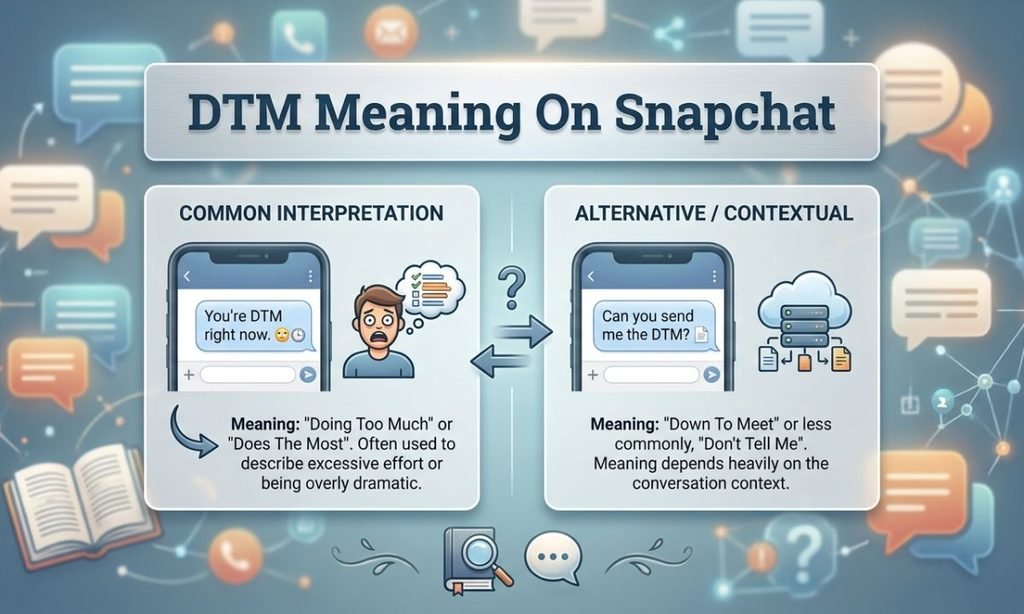
Snapchat has its own culture of quick, casual slang, and DTM meaning on Snapchat usually lines up with the same “Down To Meet” definition used everywhere else. Since Snapchat conversations tend to revolve around plans, streaks, and quick check-ins, this makes sense.
A typical Snapchat exchange might look like this:
Person A: party at mine tonight, u coming? Person B: dtm, what time
Here, “dtm” is functioning as a fast, low-effort way to confirm interest without typing out a full sentence. Snapchat culture leans heavily on abbreviations like this because messages are meant to be quick and disposable, not polished.
If you’re new to Snapchat slang, it helps to know that most abbreviations there follow the same rule: shorter is better, and full sentences are rare unless someone’s explaining something complicated.
Is DTM Slang, an Abbreviation, or Both?
Technically, DTM functions as both. As a DTM abbreviation, it simply shortens a common phrase for faster typing. As DTM slang, it carries a casual, informal tone that wouldn’t fit in a formal setting.
Think of it like “BRB” or “TTYL.” Nobody’s using those in a work email, but they’re second nature in a group chat. The same logic applies here. DTM stands for different phrases depending on context, but it always stays firmly in casual, conversational territory.
If you search DTM meaning urban dictionary style, you’ll notice the definitions line up closely with what we’ve already covered, with “Down To Meet” ranking as the top and most frequently searched meaning, followed by “Dead To Me” and the lesser-used flirtier version.
Where Did DTM Come From?
Like most texting slang, DTM didn’t come from a single source. It grew out of the same shorthand culture that gave us “TTYL,” “BRB,” and “IDK,” terms designed to save keystrokes back when texting meant punching numbers on a flip phone keypad. As smartphones took over and typing got faster, the habit of shortening common phrases stuck around anyway, mostly because it fits the fast, casual rhythm of texting.
“Down To Meet” likely picked up steam as a natural cousin of “DTF” and “DTP,” two older abbreviations that follow the same “Down To ___” pattern. Once that structure became familiar, it made sense for people to apply it to plain, everyday invitations, and “Down To Meet” filled that gap perfectly. It’s friendly, low-pressure, and doesn’t carry the loaded undertones some of its cousins do.
The “Dead To Me” version has a completely separate history. That phrase has been used in everyday English for decades, long before texting existed. Shortening it to DTM was simply the next logical step once people started typing everything in a hurry. Two unrelated phrases landing on the same three letters is exactly why context matters so much when you’re trying to figure out which one someone means.
DTM vs. Similar Texting Abbreviations
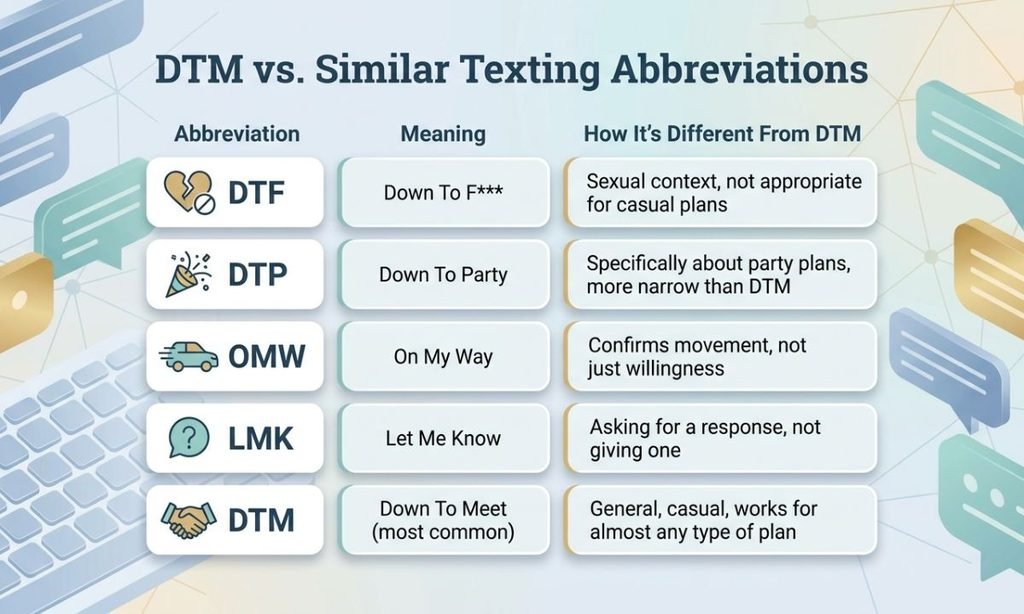
It helps to see how DTM stacks up against other short, plan-related abbreviations you’ve probably run into before. A lot of people mix these up simply because they look alike at a glance.
| Abbreviation | Meaning | How It’s Different From DTM |
| DTF | Down To F*** | Sexual context, not appropriate for casual plans |
| DTP | Down To Party | Specifically about party plans, more narrow than DTM |
| OMW | On My Way | Confirms movement, not just willingness |
| LMK | Let Me Know | Asking for a response, not giving one |
| DTM | Down To Meet (most common) | General, casual, works for almost any type of plan |
Seeing these side by side makes it easier to understand why DTM caught on the way it did. It’s broader and more flexible than “DTP” or “DTF,” which makes it easy to drop into almost any conversation about getting together, whether that’s grabbing food, going to a game, or just hanging out at someone’s house.
Common Mistakes People Make With DTM
Even once you know the basic definitions, it’s easy to slip up. Here are a few mix-ups worth watching out for:
- Assuming it always means “Down To Meet.” As covered earlier, context can flip the meaning entirely, especially in venting conversations.
- Using it in professional messages. A coworker or client isn’t going to appreciate abbreviations meant for group chats with friends.
- Sending it without enough context. If you text someone “dtm” out of nowhere, they might not know what you’re responding to. Pair it with a bit of context when the conversation isn’t obvious.
- Confusing it with similar-looking abbreviations. DTM, DTF, and DTP look alike but mean very different things, so a small typo or misread can cause real confusion.
Paying attention to these small details keeps your texting clear and helps you avoid sending a message that lands completely differently than you intended.
Real Text Message Examples
Sometimes the easiest way to understand slang is to see it in action. Here are a few realistic scenarios showing how DTM gets used differently depending on the situation.
Example 1: Making Weekend Plans
Mia: beach day Saturday? weather’s supposed to be perfect Chris: dtm for sure, what time we leaving
Example 2: Venting About a Friend
Alex: she cancelled on me again for the third time Jordan: yeah honestly she’s dtm at this point
Example 3: Joking Around
Tyler: bet you $20 you can’t finish that burger Sam: dtm lol don’t hold me to anything I say after 10pm
Example 4: Dating App Context
Profile bio: love hiking, dogs, and good food. dtm if you’re cool 😄
Notice how the surrounding words completely shift the tone. Nobody’s confused about which DTM meaning applies once they see the full sentence, which is exactly why abbreviations like this survive in everyday texting. They’re efficient, but they still rely on context to land correctly.
Why Slang Like DTM Keeps Evolving
Texting slang doesn’t sit still. New abbreviations pop up constantly, older ones shift meaning, and some quietly disappear once they’ve had their moment. DTM has managed to stick around because it’s flexible enough to fit multiple situations without losing its casual, quick-hit style.
A few reasons abbreviations like this stay popular:
- They save time when typing on a phone.
- They fit naturally into fast-paced conversations.
- They carry tone and personality in just a few letters.
- They travel easily across platforms like Snapchat, Instagram, and group texts.
This is also why it’s worth double-checking meaning before assuming. Slang doesn’t come with a manual, and definitions can vary slightly between friend groups, regions, and even generations.
It’s also worth pointing out that not everyone uses DTM the same way. A high schooler texting friends about weekend plans is almost certainly using “Down To Meet.” Someone a bit older, or someone in a more sarcastic friend group, might lean toward “Dead To Me” more often. Even within the same city or school, different circles can develop their own shorthand habits, which is part of why slang spreads unevenly instead of settling on one universal meaning right away.
This kind of drift is completely normal. Plenty of abbreviations start out meaning one specific thing and slowly pick up secondary meanings as more people start using them in different situations. DTM is a good example of that process happening in real time.
How to Respond When Someone Sends You DTM
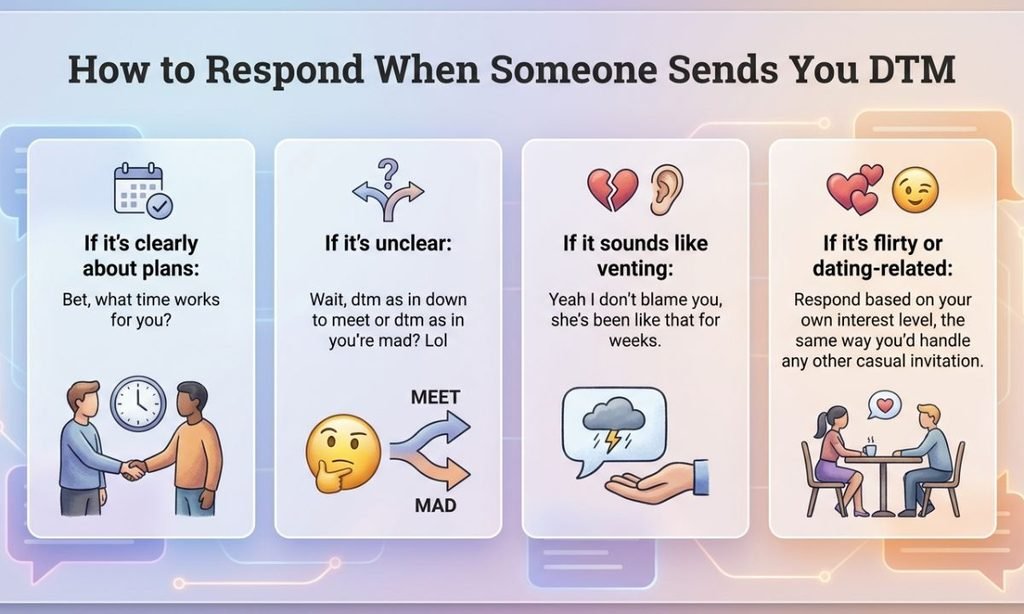
Getting a text with DTM in it doesn’t have to leave you stuck. If the context makes the meaning obvious, just respond naturally, the way you would to any other casual message. But if you’re genuinely unsure which version someone means, it’s completely fine to ask.
A few easy ways to respond:
- If it’s clearly about plans: “Bet, what time works for you?”
- If it’s unclear: “Wait, dtm as in down to meet or dtm as in you’re mad? Lol”
- If it sounds like venting: “Yeah I don’t blame you, she’s been like that for weeks.”
- If it’s flirty or dating-related: Respond based on your own interest level, the same way you’d handle any other casual invitation.
Asking for clarification isn’t awkward. Most people appreciate it more than a confused or mismatched reply. A quick “wait what do you mean by that” keeps the conversation moving without any guesswork.
DTM in Group Chats vs. One-on-One Texts
The setting where DTM shows up can also shape how it’s understood. In a group chat, it usually functions as a quick way to vote yes on plans without slowing down the conversation. Everyone’s typing fast, and a short “dtm” keeps things moving.
Group Chat: Emma: movie night at my place Friday? Noah: dtm Priya: dtm same Liam: can’t, working, but dtm next time
In a one-on-one conversation, DTM tends to carry a bit more weight because there’s no group energy pushing the pace. It might show up as a direct answer to a specific invitation, or, depending on tone, as a more personal comment like “dead to me” after a falling out.
One-on-One: Jess: I still can’t believe he did that Taylor: he’s dtm after that, ngl
Recognizing the setting, group chat versus private conversation, gives you one more clue for figuring out which meaning fits best.
Should You Use DTM In Your Own Texts?
If you’re comfortable with casual texting slang, using DTM is completely natural, especially with friends who already text this way. It fits well in:
- Group chats about weekend plans
- Quick replies to invitations
- Casual venting conversations
- Light, joking exchanges
It’s less appropriate in:
- Work or professional messages
- Texts to people you don’t know well
- Formal emails or written communication
A good rule of thumb: if the conversation already feels relaxed and abbreviation-heavy, DTM will blend right in. If you’re texting your boss about a deadline, it’s best to spell things out.
It also helps to pay attention to who you’re texting. Close friends who already text in shorthand will understand DTM instantly, no matter which meaning you intend, because the surrounding conversation usually makes it obvious. A newer friend or someone you’ve only recently started talking to might need a touch more clarity, at least until you both settle into a texting rhythm together. There’s nothing wrong with spelling out “down to meet” the first few times before switching to the shorter version once the slang becomes familiar between you.
The same goes for family group chats. Parents and older relatives don’t always keep up with fast-moving texting slang, so an abbreviation that feels obvious to you might just look like a typo to them. If you’re texting a family group chat and want to avoid confusion, it’s usually safer to write things out in full.
A Few Final Thoughts on Texting Slang
Abbreviations like DTM exist because texting rewards speed. Nobody wants to type out a full sentence when three letters get the job done just as well, especially in a fast-moving group chat where five people are replying at once. That’s really the whole appeal here: DTM lets you confirm plans, vent about someone, or joke around without slowing the conversation down.
The tricky part, as you’ve probably noticed by now, is that the same three letters cover more than one meaning. That’s not unusual. Plenty of texting slang works this way, and once you know the possible options, spotting the right one becomes second nature. You stop needing to stop and think about it, the same way you don’t have to consciously translate “lol” or “omw” anymore.
If you take one thing away from this guide, let it be this: context is everything. The words around DTM, the tone of the conversation, and who you’re texting will almost always tell you exactly which meaning applies. Once you get comfortable reading those signals, you’ll never be caught off guard by this abbreviation again.
Quick Recap
Here’s the short version if you’re skimming:
- What does DTM mean in text? Most often, “Down To Meet.”
- It can also mean “Dead To Me,” “Don’t Trust Me,” or “Down To Mingle,” depending on tone and context.
- DTM meaning on Snapchat almost always lines up with “Down To Meet.”
- Context clues, like the tone of the message before it, usually make the correct meaning obvious.
- It’s casual slang, best kept for friends, group chats, and informal conversations.
Texting slang moves fast, but once you know the different sides of DTM, you’ll never be left guessing when it pops up in your messages again. Next time someone sends it your way, you’ll know exactly how to reply.
FAQs
What does DTM mean in text?
DTM most commonly means “Down To Meet,” used when someone is agreeing to hang out or make plans. It can also mean “Dead To Me” depending on the tone of the conversation. Context clues usually make the correct meaning clear right away.
What does DTM stand for?
DTM stands for a few different phrases, but “Down To Meet” is the most widely used. Other versions include “Dead To Me,” “Don’t Trust Me,” and “Down To Mingle.” The surrounding message usually tells you which one applies.
What does DTM mean on Snapchat?
DTM meaning on Snapchat almost always lines up with “Down To Meet.” It’s a quick, casual way to confirm you’re interested in hanging out or joining plans someone mentioned in a Snap or chat.
Is DTM the same as DTF?
No, DTM and DTF are not the same. DTM (“Down To Meet”) is a general, casual way to agree to plans, while DTF carries a sexual meaning. They look similar but mean very different things.
What does DTM mean in slang?
As DTM slang, it’s a casual abbreviation used mostly in texting and social media, not formal writing. It usually reflects a relaxed, friendly tone rather than anything serious or official.
Can DTM mean “Dead To Me”?
Yes, DTM can mean “Dead To Me” when someone is venting or annoyed about a person. This meaning usually shows up in emotional or frustrated messages rather than plan-making conversations.
Is it okay to use DTM in a professional text?
No, DTM is casual slang and doesn’t fit well in professional or formal messages. It’s best kept for texts with friends, group chats, or informal social media conversations.
