

You already know “hola” means “hello.” That part’s easy. What most people never learn is where the word actually came from, why it isn’t always the right greeting to use, and why the way you say it can matter more than the word itself.
If you’ve ever typed “hola meaning” into Google expecting a one-line answer and gotten a wall of grammar-textbook filler instead, this article is the fix. We’re covering the real history, the regional differences nobody talks about, and the small mistakes that make English speakers sound like they just started Duolingo yesterday.
What Does “Hola” Meaning?
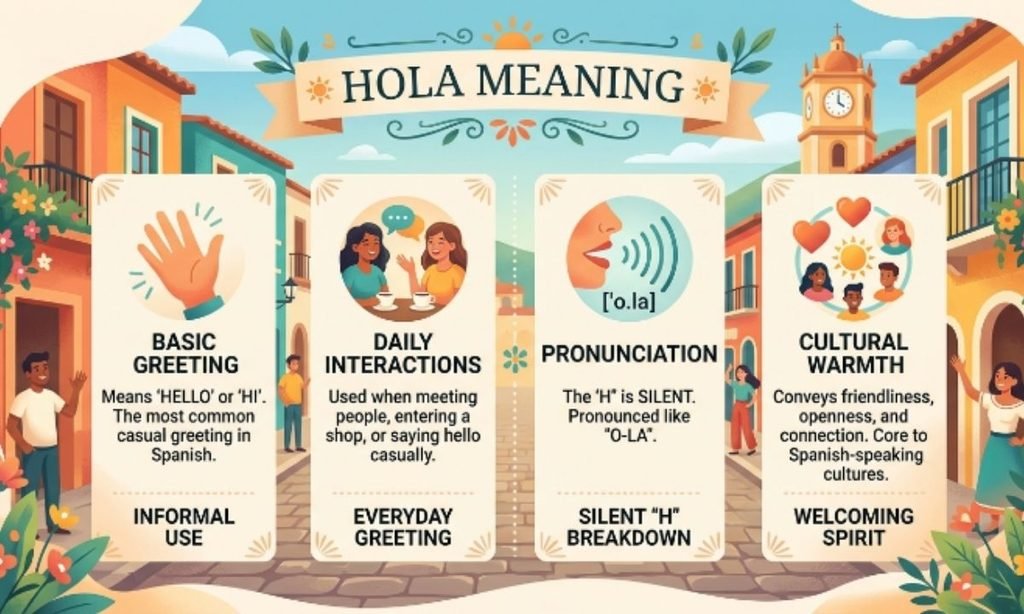
“Hola” is a Spanish interjection that translates to “hello” or “hi” in English. It’s used to greet someone — in person, on the phone, in a text, or even to get a stranger’s attention.
Grammatically, it’s not a noun or a verb. It’s what linguists call an interjection: a standalone word that expresses a reaction or opens communication, similar to “hey” or “oh” in English. It doesn’t conjugate, it doesn’t change with gender, and it works the exact same way whether you’re talking to one person or a room full of them.
That simplicity is part of why it’s the first word almost every Spanish course teaches. But simplicity hides a few details that actually matter if you want to sound natural instead of textbook-stiff.
Where Does the Word “Hola” Actually Come From?
Here’s the part most articles get wrong, or skip entirely.
There’s a popular claim floating around the internet that “hola” comes from the Arabic phrase “wa Allah” (meaning “and God” or “by God”), supposedly left over from the centuries of Moorish rule in Spain. It sounds plausible. It’s also almost certainly false, and etymologists have pushed back on it repeatedly.
The more credible origin traces “hola” back to the Old Spanish interjection “ola,” which itself likely descends from a broader European pattern of “hail” or “hollo” sounds used to call out to someone from a distance — think of a sailor shouting to another ship, or someone hailing a person across a field. This same root shows up in:
- Italian: “olà”
- French: “holà”
- Catalan: “hola”
- Old Germanic-influenced greetings that eventually fed into English words like “hello” and “holler”
So “hola” isn’t a religious leftover — it’s a distant cousin of “holler.” Both words trace back to the same instinct: raising your voice to get someone’s attention. That’s a far more satisfying (and accurate) answer than the Arabic myth that keeps getting copy-pasted across language blogs.
How to Pronounce “Hola” Correctly
The spelling trips up more English speakers than you’d expect, mostly because of one silent letter.
Pronunciation: OH-lah
The “h” at the beginning is always silent in Spanish. This is a hard rule with almost no exceptions. English speakers sometimes want to breathe air into it out of habit — don’t. Say “OH-lah” like you’re saying “oh” followed immediately by “lah.”
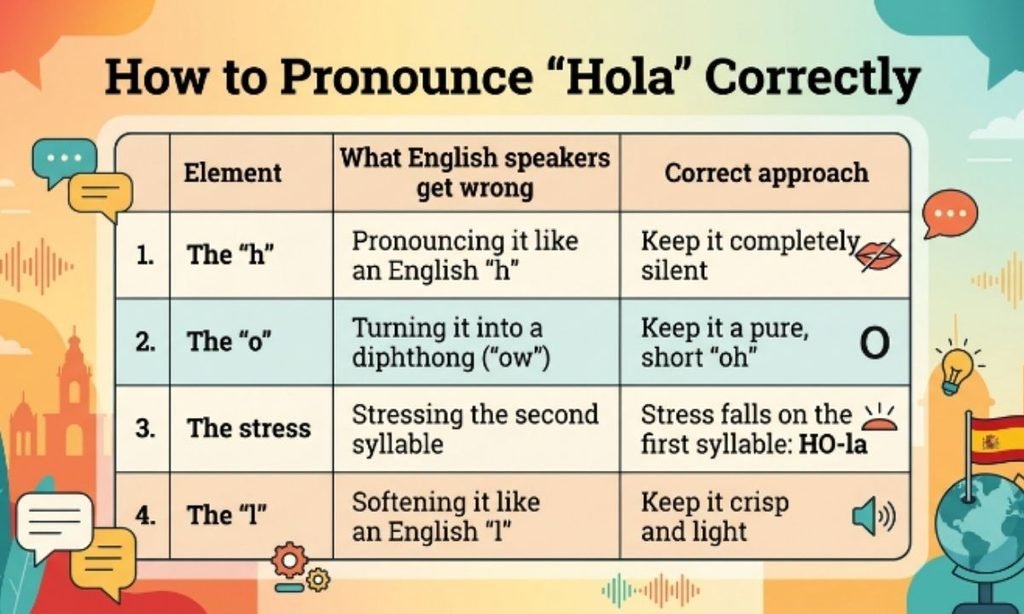
| Element | What English speakers get wrong | Correct approach |
| The “h” | Pronouncing it like an English “h” | Keep it completely silent |
| The “o” | Turning it into a diphthong (“ow”) | Keep it a pure, short “oh” |
| The stress | Stressing the second syllable | Stress falls on the first syllable: HO-la |
| The “l” | Softening it like an English “l” | Keep it crisp and light |
If you want a mental shortcut: say the English word “over” but stop after “o,” then add “lah.” That gets you close enough to be understood anywhere in the Spanish-speaking world.
Hola vs. Ola: Don’t Mix These Up
This is one of the most common written mistakes, and spellcheck won’t always catch it because both are real Spanish words.
| Word | Meaning | Example |
| Hola | Hello / Hi | “¡Hola! ¿Cómo estás?” |
| Ola | Wave (as in ocean wave) | “La ola rompió en la orilla.” |
They’re pronounced almost identically in casual speech, which is exactly why people confuse them in writing. The silent “h” is the only difference on paper, but it changes the entire meaning of the sentence. Drop the “h” in a text message and you’ve gone from greeting a friend to talking about ocean waves — which, depending on context, can make for a genuinely confusing conversation.
Is “Hola” Formal or Casual?
Here’s where a lot of guides oversimplify. “Hola” sits in a strange middle zone — it’s casual enough for friends, but flexible enough to open a formal conversation too, as long as you follow it with the right words.
| Situation | Recommended greeting | Why |
| Texting a friend | Hola / Holi (playful variant) | Casual, no formality needed |
| Meeting a stranger your age | Hola, ¿qué tal? | Friendly but neutral |
| Addressing a boss or elder | Hola, buenos días / buenas tardes | “Hola” alone can feel abrupt in formal settings |
| Business email opener | Estimado/a + name (skip “hola” entirely) | Written formal Spanish rarely opens with “hola” |
| Answering the phone | Depends heavily on country (see below) | Phone etiquette varies more than in-person greetings |
The mistake a lot of learners make is treating “hola” as universally safe. It’s a fine default, but pairing it with a time-of-day greeting (“buenos días,” “buenas tardes,” “buenas noches”) instantly makes it more polite without losing warmth.
How “Hola” Actually Gets Used Across Different Countries
This is the part almost no article covers well, and it’s the difference between sounding like a language learner and sounding like someone who’s actually spent time around native speakers.
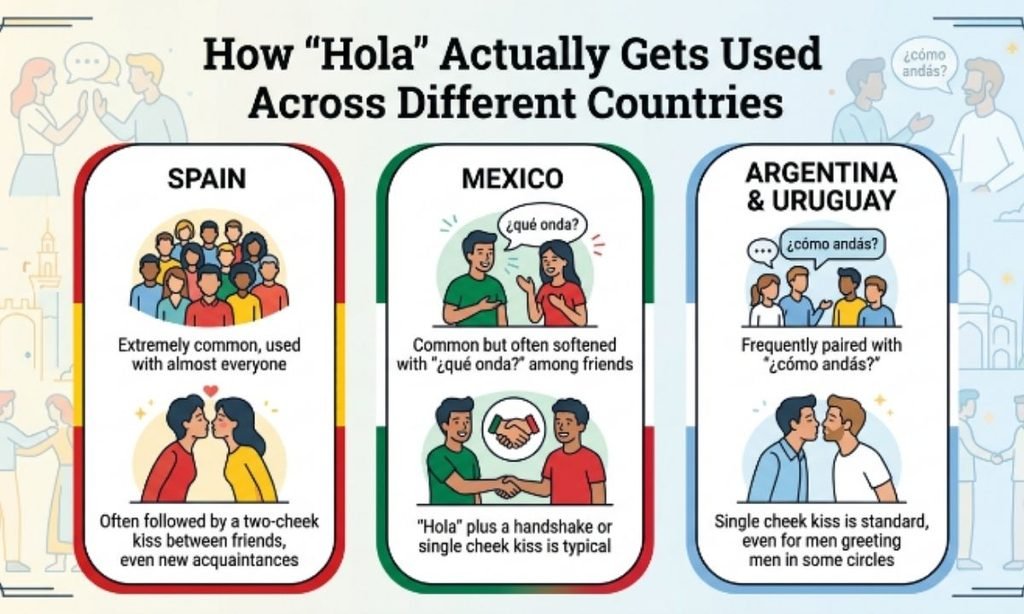
| Region | How “hola” is typically used | Notable local habits |
| Spain | Extremely common, used with almost everyone | Often followed by a two-cheek kiss between friends, even new acquaintances |
| Mexico | Common but often softened with “¿qué onda?” among friends | “Hola” plus a handshake or single cheek kiss is typical |
| Argentina & Uruguay | Frequently paired with “¿cómo andás?” | Single cheek kiss is standard, even for men greeting men in some circles |
| Caribbean (Cuba, Puerto Rico, Dominican Republic) | Used, but “¿qué lo que?” or “¿qué bolá?” often replace it among close friends | Greetings tend to be louder and more animated |
| Colombia | Common, often with “¿cómo vas?” or “¿quihubo?” | Slightly more reserved physical greeting than Southern Cone countries |
None of this changes the dictionary definition. But it changes how the word actually lands in a real conversation — and that’s usually the gap between someone who memorized Spanish and someone who can actually use it.
Answering the Phone: Is It Still “Hola”?
This one surprises a lot of learners. In-person, “hola” is nearly universal. On the phone, it isn’t.
- Mexico: “¿Bueno?”
- Spain: “¿Diga?” or “¿Dígame?”
- Argentina, Peru, and much of South America: “¿Aló?”
- Colombia: “¿Aló?” or “¿A ver?”
- Casual, informal calls almost anywhere: “Hola” still works fine, especially between friends or on video calls
If you’re calling a business or an older relative in most Spanish-speaking countries, opening with “hola” on the phone can sound slightly off. Opening with the local phone-specific greeting immediately signals you know how the language actually works, not just how it’s written in a textbook.
Common Phrases Built Around “Hola”
Once you’ve got the base word down, these combinations come up constantly:
- ¡Hola! ¿Cómo estás? — Hi! How are you?
- ¡Hola a todos! — Hi everyone!
- Hola de nuevo — Hello again
- Holi — a cutesy, informal version used mostly in texting between close friends (roughly like “hiii”)
- Hola, ¿qué tal? — Hi, how’s it going?
- ¡Hola, mucho gusto! — Hi, nice to meet you (used when meeting someone new)
Note that “holi” isn’t standard Spanish — it’s internet and texting slang, similar to how “heyyy” isn’t in an English dictionary but everyone understands it instantly.
The Body Language Nobody Mentions
A word doesn’t exist in a vacuum, and this is where a lot of “hola meaning” guides stop short. In most Spanish-speaking cultures, “hola” comes with physical contact attached:
- In Spain, two cheek kisses are standard between friends, and often between new acquaintances of different genders.
- In much of Latin America, one cheek kiss is more common, though this varies heavily by country and by how well people know each other.
- Among men greeting men in many regions, a handshake or brief hug (“abrazo”) replaces the kiss.
- Skipping physical greeting entirely can come across as cold or overly formal, depending on the setting.
Saying “hola” without the accompanying gesture isn’t wrong — but understanding that the word and the physical greeting are culturally linked helps explain why native speakers’ greetings feel warmer than a flat verbal “hello” often does in English-speaking contexts.
Common Mistakes English Speakers Make
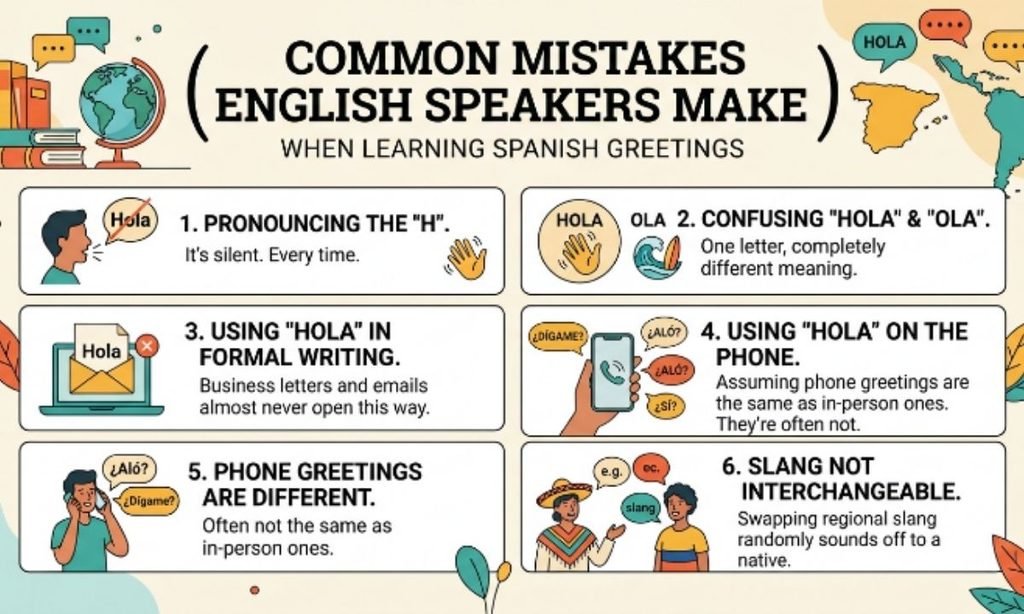
- Pronouncing the “h.” It’s silent. Every time.
- Confusing “hola” with “ola.” One letter, completely different meaning.
- Using “hola” in formal written Spanish. Business letters and emails almost never open this way.
- Assuming phone greetings are the same as in-person ones. They’re often not.
- Treating regional slang greetings as interchangeable with “hola.” They’re related but not identical — swapping them randomly can sound off to a native ear.
Final Thoughts
“Hola” looks like the simplest word in Spanish, and in a lot of ways, it is. But the details around it — how it’s pronounced, how it changes by region, when it gets swapped out entirely — are what separate someone who’s memorized a vocabulary list from someone who actually understands the language.
Next time you say it, you’re not just saying “hello.” You’re using a word with roots stretching back through Old Spanish and its European cousins, one that carries different weight depending on whether you’re texting a friend in Mexico City, answering a landline in Buenos Aires, or greeting someone with a kiss on the cheek in Madrid. That’s a lot of history packed into four letters.
FAQs
What does “hola” mean in English?
“Hola” is the Spanish word for “hello” or “hi.” It’s an interjection used to greet someone in person, on a call, or in a text message.
Is the “h” in “hola” silent?
Yes, the “h” is always silent in Spanish. The correct pronunciation is “OH-lah,” with stress on the first syllable.
Does “hola” come from Arabic?
No. Despite a popular myth linking it to the Arabic phrase “wa Allah,” etymologists trace “hola” to the Old Spanish “ola,” related to European “hail” or “holler” sounds.
What’s the difference between “hola” and “ola”?
“Hola” means “hello,” while “ola” means “wave” (as in an ocean wave). The only difference in spelling is the silent “h,” but it completely changes the meaning.
Is “hola” formal or informal?
“Hola” is casual by default but can open formal conversations too, especially when paired with “buenos días” or “buenas tardes.” It’s rarely used to start formal written Spanish, like business emails.
Do people say “hola” when answering the phone?
Not usually. Many countries use different phone greetings — “¿Bueno?” in Mexico, “¿Diga?” in Spain, and “¿Aló?” across much of South America. “Hola” is more common for casual calls between friends.
What is “holi”?
“Holi” is an informal, playful variant of “hola” used mainly in texting between close friends, similar to “hiii” in English. It’s internet slang, not standard dictionary Spanish.
Does “hola” change based on region?
The word itself stays the same, but how it’s used varies — often paired with local phrases like “¿qué onda?” (Mexico) or “¿qué bolá?” (Cuba), and accompanied by different greeting customs like cheek kisses or handshakes.
