

You got a text with “TMB” in it and now you’re stuck. Does it mean something sweet? Something sarcastic? Or is your friend just telling you to text them back? The TMB meaning in text actually splits into two very different directions, and picking the wrong one can make you look like you didn’t get the joke — or worse, that you’re ignoring someone.
Here’s the part almost nobody explains properly: TMB isn’t one slang term. It’s two unrelated ones that happen to share the same three letters, and they come from completely different corners of internet culture. One is decades old. The other exploded out of TikTok comment sections in the last couple of years. Knowing which one you’re looking at changes everything about how you should reply.
If you’ve searched the TMB meaning in text before landing here, chances are you already found a page that gave you half the answer and moved on. That’s the problem with most explanations floating around — they pick one meaning, explain it in a sentence or two, and never tell you how to actually tell the two apart in a real conversation. This guide fixes that.
What Does TMB Meaning in a Text? (Quick Answer)
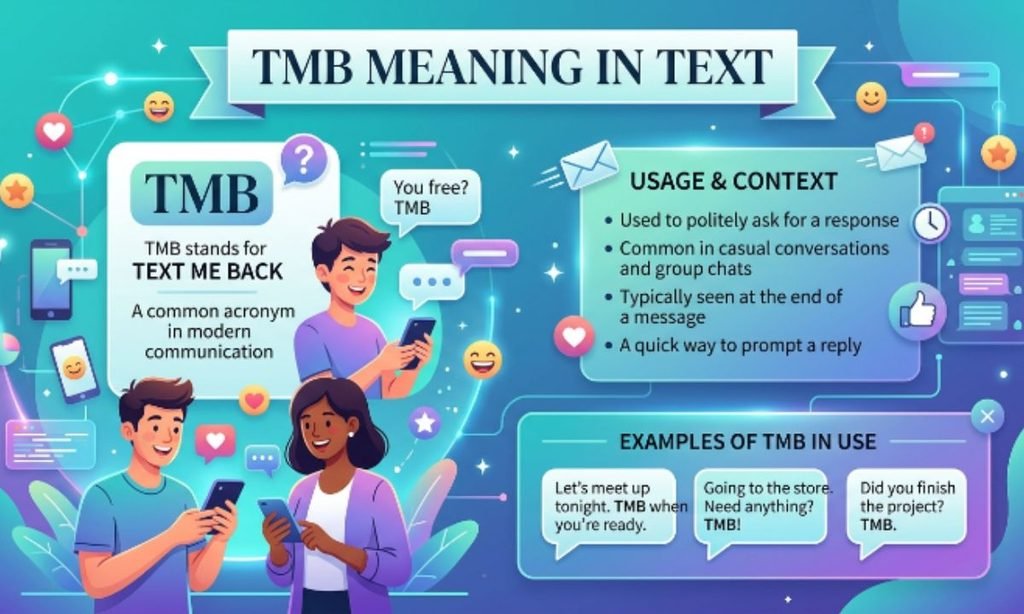
In most texts today, TMB means one of two things:
- “Text Me Back” — a direct request, usually sent after someone hasn’t responded in a while.
- “Trust Me Bro” — a sarcastic phrase used to mock a claim that sounds made up or exaggerated.
The one you’re seeing almost always depends on the sentence around it, not the letters themselves. That’s the whole trick to reading TMB correctly, and it’s exactly why so many people get the TMB meaning in text wrong on the first try.
Why TMB Has Two Completely Different Meanings
Most slang terms drift over time, but they usually keep one core idea. TMB is unusual because its two meanings don’t share any DNA at all. One is a functional shorthand from the early texting era. The other is a meme-driven, tone-heavy phrase born from online skepticism culture. Understanding where each one came from actually helps you spot them faster in the wild — and it’s the missing piece in most explanations of the TMB meaning in text you’ll find elsewhere.
It also explains why asking “what does TMB mean” gets you two totally different answers depending on who you ask. A parent will tell you it means “text me back” without hesitation. A teenager will laugh and tell you it’s short for “trust me bro.” Both are right. Neither is wrong. The trick is knowing which crowd you’re texting with.
Meaning 1: “Text Me Back” — The Practical, Everyday Use
This is the older, simpler use. It shows up when someone sent a message earlier, got silence, and is nudging you.
- “Hey, TMB when you get a sec”
- “Called you twice, TMB please”
- “TMB about tonight, still on?”
There’s no hidden tone here. It’s a polite (or mildly impatient) follow-up, plain and simple. You’ll see this version most often from parents, coworkers, or anyone over the age of about 30, since it follows the same logic as older abbreviations like “ASAP” or “RSVP.”
Meaning 2: “Trust Me Bro” — The Sarcastic Meme Version
This is the version that’s confusing people right now, and it’s the one most other articles either skip entirely or explain in one lazy sentence. “Trust me bro” started as a reaction to people making bold claims with zero proof — think gym bros giving workout advice, someone bragging about a “guaranteed” crypto tip, or a friend swearing they saw something wild with no evidence to back it up.
Over time, “trust me bro” got shortened to TMB in fast-typed comments and group chats, especially among Gen Z. It’s almost never sincere. It’s a tag you slap onto a statement to flag it as unverified, exaggerated, or flat-out doubtful.
- “He said he benches 405 TMB”
- “She’s definitely getting back with him TMB”
- “My cousin knows a guy who can get us backstage TMB”
Notice the pattern: TMB shows up after a claim, not as a request on its own line. That positioning is your biggest clue.
TMB Decode Table: Spotting the Difference Fast
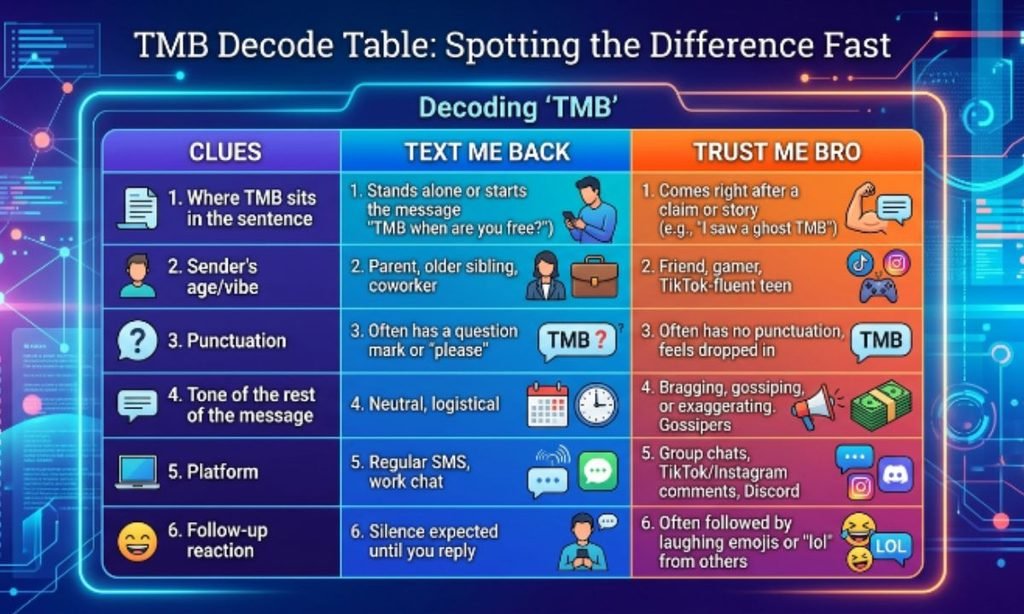
Here’s a breakdown you won’t find laid out this clearly anywhere else. Use it as a quick reference the next time you’re staring at a confusing text and trying to nail down the TMB meaning in text without having to ask.
| Clue | Points to “Text Me Back” | Points to “Trust Me Bro” |
| Where TMB sits in the sentence | Stands alone or starts the message | Comes right after a claim or story |
| Sender’s age/vibe | Parent, older sibling, coworker | Friend, gamer, TikTok-fluent teen |
| Punctuation | Often has a question mark or “please” | Often has no punctuation, feels dropped in |
| Tone of the rest of the message | Neutral, logistical | Bragging, gossiping, or exaggerating |
| Platform | Regular SMS, work chat | Group chats, TikTok/Instagram comments, Discord |
| Follow-up reaction | Silence expected until you reply | Often followed by laughing emojis or “lol” from others |
A Context-Based Way to Never Get It Wrong
Instead of memorizing examples, run any confusing TMB through these three quick questions. This is the framework the top competing pages skip, and it works on almost every edge case.
- Is TMB attached to a statement, or is it the whole message? Attached to a claim → sarcastic. Standing alone → a request to reply.
- Would the sentence make sense if you replaced TMB with “seriously, believe me”? If yes, it’s the sarcastic meme use. If it sounds broken, it’s “text me back.”
- Does the conversation feel doubtful or logistical? Doubtful, exaggerated, or gossip-driven = sarcasm. Scheduling, checking in, or following up = literal request.
If you run through these and you’re still unsure, it’s completely fine to just ask. Nobody will think less of you for double-checking slang — everyone’s been confused by it at some point.
TMB Across Different Platforms
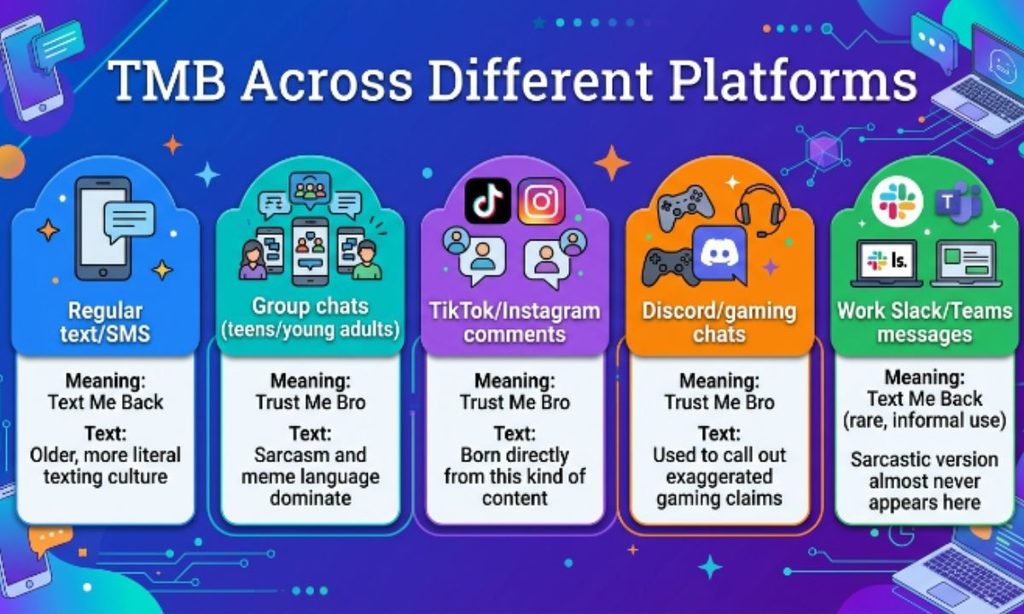
TMB doesn’t behave the same everywhere, and that’s another gap most guides miss. Where you see it matters almost as much as what surrounds it.
| Platform | Most Common Meaning | Why |
| Regular text/SMS | Text Me Back | Older, more literal texting culture |
| Group chats (teens/young adults) | Trust Me Bro | Sarcasm and meme language dominate |
| TikTok/Instagram comments | Trust Me Bro | Born directly from this kind of content |
| Discord/gaming chats | Trust Me Bro | Used to call out exaggerated gaming claims |
| Work Slack/Teams messages | Text Me Back (rare, informal use) | Sarcastic version almost never appears here |
How to Respond to TMB Without Looking Confused
Your reply should match the meaning, and getting this backwards can genuinely change the mood of a conversation.
If it means “Text Me Back”:
- “Sorry, been slammed! Calling you now.”
- “Yes still on for tonight, my bad for the delay.”
If it means “Trust Me Bro”:
- “Lmaooo sure it did”
- “TMB energy right there 😂”
- “Bro really said TMB and expects us to believe it”
Answering a sarcastic TMB with a sincere “sorry I’ll text you back!” is a fast way to confuse everyone in the chat, so read the room before you reply.
Other, Rarer Meanings of TMB Worth Knowing
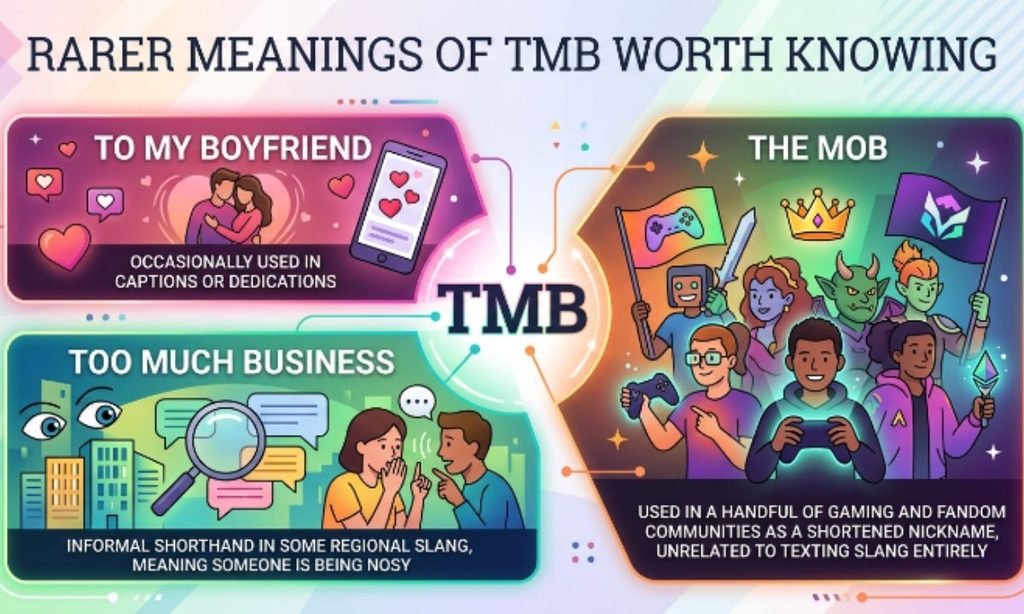
These show up far less often, but you might still run into them depending on the context:
- To My Boyfriend — occasionally used in captions or dedications
- Too Much Business — informal shorthand in some regional slang, meaning someone is being nosy
- The Mob — used in a handful of gaming and fandom communities as a shortened nickname, unrelated to texting slang entirely
If none of the main two meanings fit the sentence at all, it’s worth considering these before assuming autocorrect broke something.
Real Conversation Examples
Text Me Back version:
Mom: Hey, saw you called earlier. TMB when free, want to check on Sunday dinner.
Trust Me Bro version:
Jordan: bro said he ran a 4.3 forty TMB Casey: absolutely not lol
Reading these side by side makes the difference obvious almost instantly — the tone of everything around TMB tells the real story.
Final Thoughts
The TMB meaning in text isn’t complicated once you know to look at what’s happening around it. Ninety percent of the confusion disappears the moment you notice whether TMB is riding on the back of a bold claim or standing on its own as a simple ask. Next time it shows up in your messages, you won’t have to guess — you’ll already know exactly which TMB you’re dealing with.
Slang like this moves fast, and TMB is a good reminder that three letters can carry two completely opposite tones depending on who’s typing them. Keep the decode table handy for the next few weeks while you’re getting used to spotting the difference. After a while, you’ll catch it instantly, without even needing to think through the framework — it’ll just click the moment you read the sentence around it.
FAQs
Does TMB always mean “trust me bro”?
No. The TMB meaning in text still commonly comes back to “text me back,” especially from older texters or in non-sarcastic conversations. Context always decides which one applies, so never assume the sarcastic version by default.
Is the TMB meaning in text different on every app?
Somewhat. The literal “text me back” version shows up more in plain SMS and work chats, while the sarcastic “trust me bro” version dominates group chats, TikTok comments, and gaming platforms like Discord. The app you’re on is a useful clue, but it’s not the only one.
Is “trust me bro” TMB meant to be an insult?
Not usually. It’s more playful teasing than a genuine insult, though it does imply the claim being made is exaggerated or unverified.
How do I know which TMB meaning someone intended?
Check whether TMB follows a claim (sarcastic) or stands alone as a request (literal). The surrounding tone almost always gives it away.
Can I use TMB in a professional message?
Stick to the literal “text me back” version if you do, and even then, it’s better to spell it out in formal or work-related texts to avoid confusion.
Where did “trust me bro” as TMB come from?
It grew out of online skepticism toward unverified claims, especially in fitness, gaming, and social media comment sections, before getting shortened into TMB as fast typing took over.
