

You’re scrolling through a group chat, and someone types: “Can we talk about this IRL instead?”
No context. No explanation. Just three letters that everyone else seems to understand instantly.
If you’ve ever paused mid-conversation trying to figure out what someone actually meant, you’re not alone. The IRL meaning in text seems obvious once you know it — but there’s a lot more nuance to how, when, and why people use it than a quick definition can capture.
Let’s break it down properly.
What Does IRL Meaning in Text?
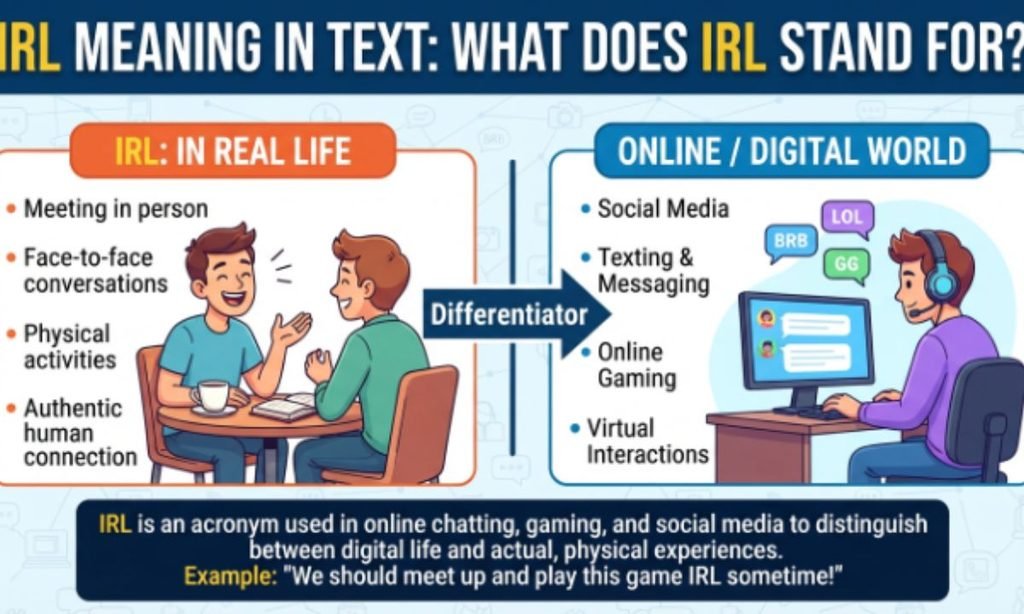
IRL stands for “In Real Life.” People use it to draw a line between something happening online or through a screen and something happening in the physical, offline world.
So when someone says, “I only know her from Instagram, we’ve never met IRL,” they’re telling you the friendship exists digitally, not face-to-face.
That’s the textbook answer. But here’s where most explanations stop — and where the real usage gets interesting.
Where IRL Actually Came From
IRL didn’t start on TikTok or Instagram. It’s actually one of the oldest pieces of internet slang still in daily use.
The term traces back to 1980s and early 1990s internet culture, specifically bulletin board systems (BBS) and early chat rooms like IRC (Internet Relay Chat — yes, that’s a different IRC). Back then, the internet was a genuinely separate space from daily life. People needed a quick way to distinguish between their “online persona” and their actual physical existence.
That distinction mattered a lot more in the early internet than it does now. Today, most of us live seamlessly between both worlds — but the phrase stuck around because the need to clarify never fully disappeared.
IRL Means Something Different Depending on Where You See It
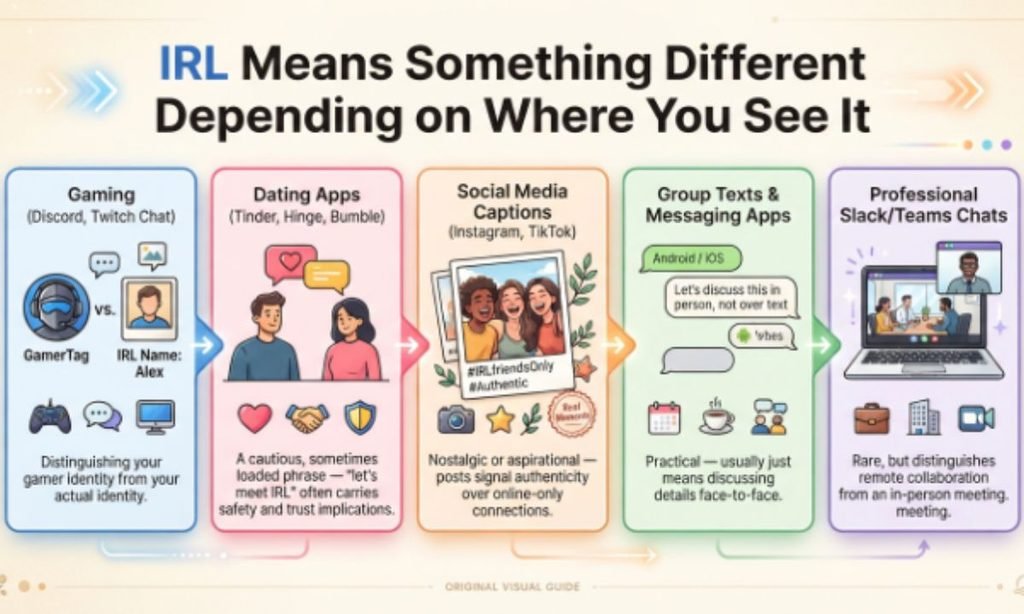
This is the piece most articles gloss over. IRL isn’t a single, fixed meaning — its emotional weight and practical use shifts depending on the platform.
| Platform/Context | What IRL Usually Signals |
| Gaming (Discord, Twitch chat) | Distinguishing your gamer identity from your actual identity — “IRL name” vs. gamertag |
| Dating apps (Tinder, Hinge, Bumble) | A cautious, sometimes loaded phrase — “let’s meet IRL” often carries safety and trust implications |
| Social media captions (Instagram, TikTok) | Nostalgic or aspirational — “IRL friends only” posts signal authenticity over online-only connections |
| Group texts and messaging apps | Practical — usually just means “let’s discuss this in person, not over text” |
| Professional Slack/Teams chats | Rare, but when used, it usually distinguishes remote collaboration from an in-person meeting |
Notice how the emotional tone changes completely from context to context. On a dating app, “meet IRL” can feel like a milestone or even a risk. In a group chat about weekend plans, it’s just logistics. Most guides treat IRL as one flat definition — but the way it lands depends entirely on where you’re reading it.
How to Actually Use IRL in a Sentence
Here are real, natural examples of how IRL shows up in everyday texting:
- “We’ve been talking for weeks, but I still haven’t met her IRL.”
- “My IRL friends don’t even know I have a YouTube channel.”
- “This meme is funnier IRL than it sounds when I explain it.”
- “Can we finish this conversation IRL? Typing it all out is exhausting.”
- “She’s way more confident IRL than she seems online.”
Notice the pattern: IRL almost always functions as an adverb or a qualifier — it modifies how, where, or whether something is happening, rather than standing alone as a noun.
IRL vs. Similar Terms: What’s the Actual Difference?
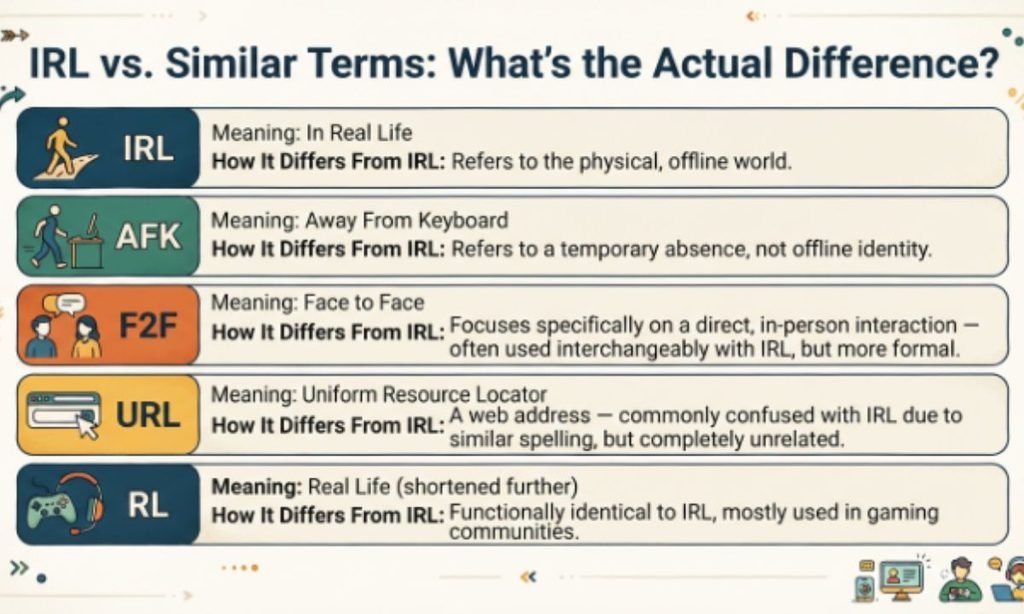
A lot of people use IRL interchangeably with other terms that don’t mean quite the same thing. Here’s where they actually differ.
| Term | Meaning | How It Differs From IRL |
| IRL | In Real Life | Refers to the physical, offline world |
| AFK | Away From Keyboard | Refers to a temporary absence, not offline identity |
| F2F | Face to Face | Focuses specifically on a direct, in-person interaction — often used interchangeably with IRL, but more formal |
| URL | Uniform Resource Locator | A web address — commonly confused with IRL due to similar spelling, but completely unrelated |
| RL | Real Life (shortened further) | Functionally identical to IRL, mostly used in gaming communities |
That IRL/URL mix-up is more common than people admit — especially with autocorrect. If you’ve ever sent “check the IRL” instead of “check the URL,” you’re in good company.
The Generational Divide Nobody Talks About
Here’s a genuinely underreported angle: IRL doesn’t mean the same thing to a 45-year-old as it does to a 16-year-old, and it’s not just about frequency of use.
For millennials and older Gen X, who remember a pre-smartphone world, IRL still carries its original meaning — a genuine separation between “online” and “real.” It implies two distinct spaces.
For Gen Z and younger users, who’ve never known a life without constant connectivity, IRL is used more loosely. It often just means “in person” rather than implying that online interactions are somehow less real. A Gen Z user texting “let’s hang IRL” isn’t drawing a philosophical line between digital and physical existence — they’re just saying “let’s meet up.”
This shift matters because it changes how the phrase should be interpreted in conversation. Older users might read more meaning into “IRL” than the sender intended.
When IRL Gets Awkward (Or Even Risky)
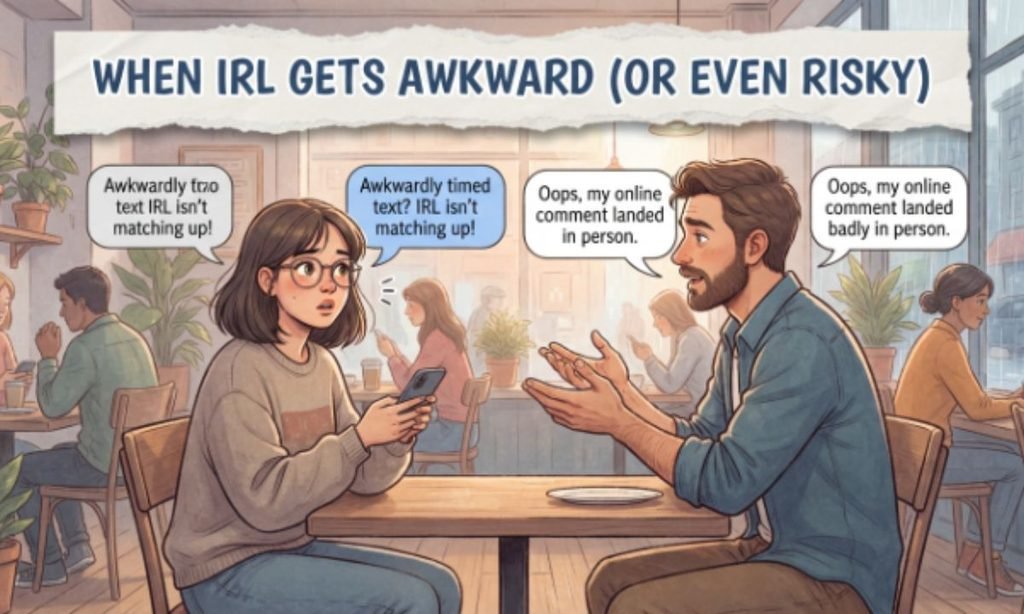
This is the part that almost no guide covers, and it’s arguably the most useful.
IRL isn’t always a casual, harmless phrase. In certain contexts, it comes with real considerations:
In dating and meeting strangers online:
- Always meet in a public place first
- Tell a friend or family member where you’re going and who you’re meeting
- Video call before agreeing to meet IRL — it confirms the person is who they say they are
- Trust your gut if something feels off before or during the meeting
In professional settings:
- Overusing IRL in workplace messaging can come across as too casual, especially with clients or senior colleagues
- “Let’s discuss this in person” is often the safer, more polished alternative in formal emails
In social situations:
- Constantly saying “you’re so different IRL” to someone can unintentionally sound like an insult, implying their online persona is fake or performative
- Be mindful of tone — what feels like a compliment in your head can land differently in text
Quick Reference: When to Use IRL (and When Not To)
| Situation | Use IRL? | Better Alternative |
| Texting close friends about hanging out | Yes | — |
| Formal work email | No | “in person” |
| First-time meetup from a dating app | Use with caution | Be explicit about safety plans, not just “let’s meet IRL” |
| Gaming chat with your squad | Yes | — |
| Talking to someone about how they seem “different” online vs. offline | Use carefully | Frame it as a compliment, not a comparison |
| Customer service or client communication | No | “outside of this chat” or “over a call” |
Does IRL Need Capital Letters or Punctuation?
Not really — and this trips people up more than you’d think. IRL is almost always written in all caps as an acronym, but it doesn’t need periods (I.R.L. is outdated and rarely used today). It also doesn’t require quotation marks or italics in casual texting. Treat it like any other everyday abbreviation — LOL, BTW, TBH — and it’ll read naturally.
Final Thoughts
The IRL meaning in text is simple at its core: it separates the online world from the physical one. But how people actually use it — the tone, the platform, the generational lens, even the safety implications — is where the real understanding lives.
Next time you see “let’s meet IRL” pop up in a text, you’ll know it’s not just three random letters. It’s a small phrase carrying a surprising amount of context, depending on who sent it and where.
So whether you’re planning a coffee date with someone from a dating app, catching up with your gaming crew, or just trying to get a friend off their phone for a real conversation — now you know exactly what’s being asked, and how to respond with the right tone.
FAQS
What does IRL mean in a text message?
IRL stands for “In Real Life.” People use it to refer to something happening in the physical world, as opposed to online or through a screen.
Is IRL only used online, or can it be spoken too?
IRL started as internet slang, but it’s now used in everyday speech too. You’ll hear people say “I met her IRL” out loud just as often as they’d type it.
What’s the difference between IRL and F2F?
IRL means “In Real Life” and refers broadly to the offline world, while F2F means “Face to Face” and specifically describes a direct, in-person interaction. They’re often used interchangeably, but F2F is more precise.
Is it rude to say “you’re different IRL” to someone?
It can come across that way if it’s not framed carefully. It may sound like you’re saying their online personality is fake, so it’s safer to phrase it as a compliment.
Can IRL be used in professional or work emails?
It’s best avoided in formal communication. “In person” or “outside of this chat” reads as more polished for workplace or client messaging.
Does IRL need periods or capital letters?
No. IRL is written in all caps without periods (I.R.L. is outdated). It’s treated like other casual abbreviations such as LOL or BTW.
Is it safe to meet someone IRL from a dating app?
It can be, if you take precautions. Meet in a public place, tell someone where you’re going, and consider a video call first to confirm the person is who they claim to be.
Do older and younger generations use IRL differently?
Yes. Older users often use IRL to draw a clear line between online and offline identity, while Gen Z frequently uses it more loosely, simply meaning “in person.”
