

You get a text. It just says “yfm?” No punctuation, no context, no warning.
So what does YFM mean in text slang? Nine times out of ten, it’s short for “you feel me” — a quick check-in to see if the other person understands or relates to what you just said. But here’s what almost nobody tells you: that one-line definition barely scratches the surface, and there are a couple of situations where YFM does not mean that at all.
This guide covers the actual meaning, sure. But it also covers the stuff most articles skip — how to tell what someone really means by it, what to text back so you don’t sound awkward, and the handful of times “YFM” has nothing to do with feelings at all.
What Does YFM Mean in Text Slang :The Short Answer
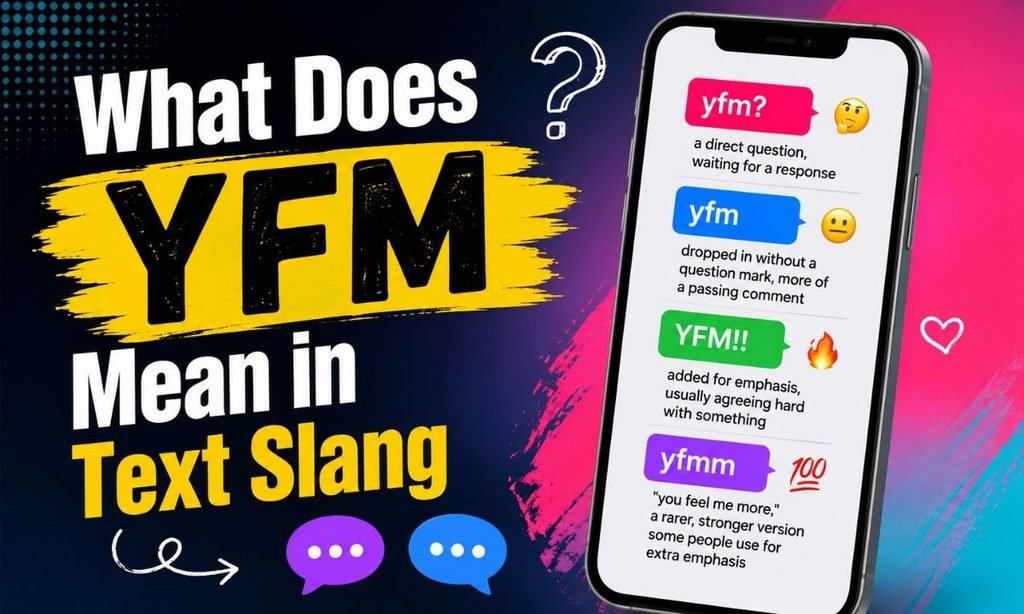
YFM stands for “you feel me.” It’s used as a casual question or a tag at the end of a sentence, and it’s asking one simple thing: do you get what I’m saying?
You’ll see it written a few different ways depending on who’s texting:
- yfm? — a direct question, waiting for a response
- yfm — dropped in without a question mark, more of a passing comment
- YFM!! — added for emphasis, usually agreeing hard with something
- yfmm — “you feel me more,” a rarer, stronger version some people use for extra emphasis
The core idea stays the same across all of them. Someone’s checking whether their point landed, or they’re inviting you to agree with them without spelling it out in full sentences.
Where “You Feel Me” Actually Came From
“You feel me” isn’t new. It’s been part of everyday spoken English for decades, especially in African American Vernacular English (AAVE), where it grew alongside hip-hop culture starting in the 1980s and ’90s. Rappers used it constantly — as a way to bond with listeners, to punctuate a bar, or to ask if the audience was following the story.
Texting didn’t invent the phrase. It just shrank it. Once phones had character limits and typing speed mattered, “you feel me” became “yfm,” the same way “be right back” became “brb.” What’s interesting is that the meaning didn’t change during that shrink — a lot of slang gets watered down or twisted once it goes digital, but YFM kept its original emotional weight. It’s still asking for real understanding, not just a quick “ok.”
The Part Nobody Explains: How to Actually Read YFM in Context
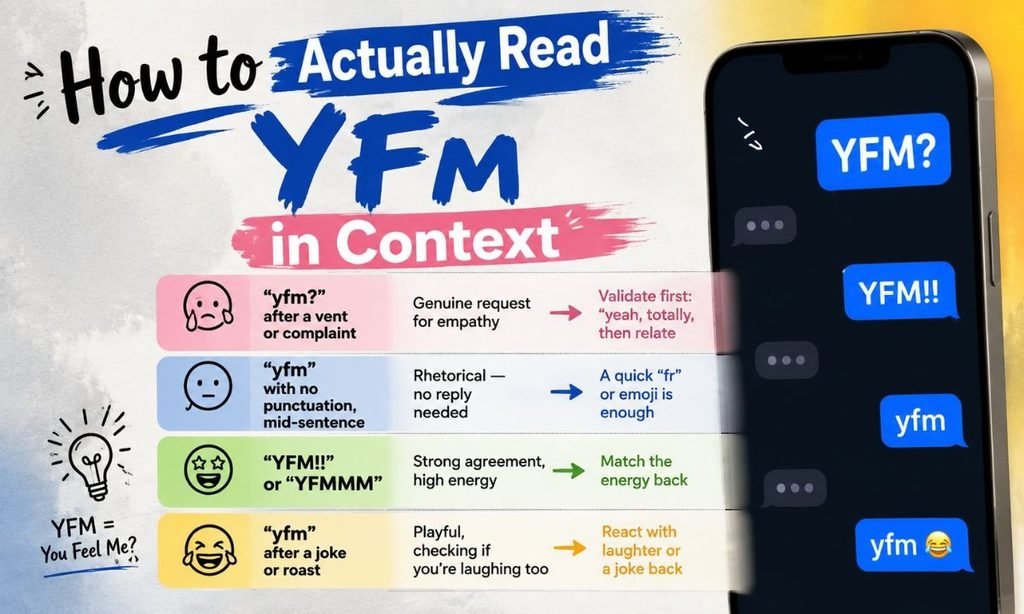
Here’s the honest truth — knowing that YFM means “you feel me” doesn’t actually tell you how to read it in the moment. The same three letters can land completely differently depending on what surrounds them. This is the piece most guides skip entirely, and it’s the part that actually matters when you’re staring at your phone trying to figure out a reply.
Think of it less like a fixed definition and more like a tone dial. Here’s how to read the signals:
| Signal | What It Usually Means | How To Respond |
| “yfm?” after a vent or complaint | Genuine request for empathy | Validate first: “yeah, totally,” then relate |
| “yfm” with no punctuation, mid-sentence | Rhetorical — no reply needed | A quick “fr” or emoji is enough |
| “YFM!!” or “YFMMM” | Strong agreement, high energy | Match the energy back |
| “yfm” after a joke or roast | Playful, checking if you’re laughing too | React with laughter or a joke back |
| “yfm” after a serious or emotional message | Deep check for connection, not just agreement | Slow down, respond with genuine empathy, not slang |
| “yfm?” from someone you don’t know well | Testing the waters, sometimes flirty | Read the rest of the conversation before replying casually |
That last row matters more than people give it credit for. A “yfm?” sent right after someone shares something vulnerable — a bad day, a breakup, stress about work — is a very different message than a “yfm” tossed onto a meme caption. Treating both the same way is exactly why texting slang causes so many small misreads.
Wait — Is YFM Always “You Feel Me”? Here’s When It’s Not
This is the part almost every other guide leaves out completely, and it genuinely trips people up.
If you search “YFM,” you’ll run into a few unrelated things that have nothing to do with texting:
- YFM the radio station. There’s an actual, well-known “YFM 99.2” radio station broadcasting out of Johannesburg, South Africa, since the late 1990s, playing hip-hop, house, and R&B for a young audience. If you see “YFM” mentioned alongside music, DJs, or South African pop culture, it’s very likely talking about the station, not the slang.
- YFM as a username or handle. Because the letters are short and catchy, plenty of people and small brands use “YFM” as a social media handle or channel name that has zero connection to “you feel me.”
- YFM in gaming or Discord usernames. Same idea — short, three-letter tags get reused constantly for handles that are just… names.
So if “YFM” shows up in a bio, a caption about music, or next to a logo, don’t assume slang. Context outside of a direct message almost always points somewhere else.
Don’t Mix These Up: YFM vs. Similar Slang
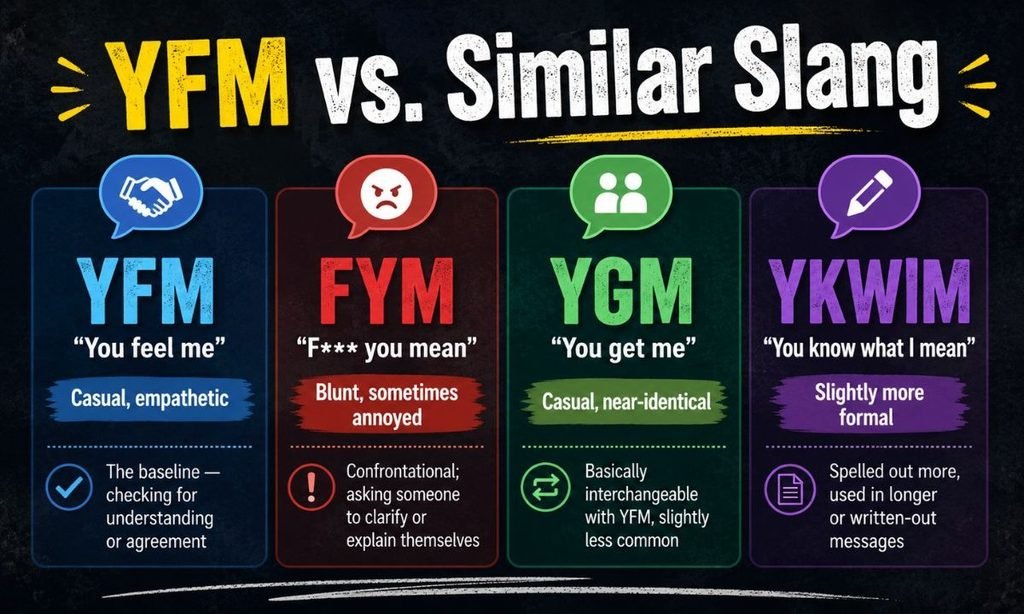
A lot of the confusion around YFM actually comes from how close it looks to other acronyms. This comparison rarely gets the depth it needs, so here it is laid out clearly:
| Term | Full Meaning | Tone | Key Difference from YFM |
| YFM | You feel me | Casual, empathetic | The baseline — checking for understanding or agreement |
| FYM | F*** you mean | Blunt, sometimes annoyed | Confrontational; asking someone to clarify or explain themselves |
| YGM | You get me | Casual, near-identical | Basically interchangeable with YFM, slightly less common |
| YKWIM | You know what I mean | Slightly more formal | Spelled out more, used in longer or written-out messages |
| YFMM | You feel me more | Emphatic | An intensified version, used for extra agreement |
| IYKYK | If you know, you know | Insider, exclusive | Implies shared knowledge rather than asking for it directly |
The one people mix up most is YFM and FYM — and the difference actually matters, because reading FYM as friendly instead of confrontational can seriously derail a conversation. If a message starts with “wait, fym,” that’s not someone checking for empathy. That’s someone asking you to explain yourself, and often with an edge to it.
How to Reply to YFM (Without It Feeling Forced)
Most guides tell you to just say “I feel you” back. That works, but it’s not the only option, and using the exact same reply every time makes conversations feel stiff. Here’s a wider set of natural replies, sorted by situation:
| Situation | Natural Reply Options |
| Friend venting about their day | “Ugh, yeah, I feel that.” / “Same energy honestly.” |
| Someone sharing an opinion you agree with | “Facts.” / “Real.” / “No cap, same.” |
| A joke or meme caption | A laughing emoji, or “dead 😭” |
| Deep or emotional message | “I hear you.” / “That makes total sense.” |
| You genuinely don’t relate | “Not gonna lie, not really — but I get why you feel that way.” |
That last one is worth pointing out: you don’t have to fake agreement just because someone asked “yfm?” A simple, honest response still keeps the conversation warm without pretending to relate to something you don’t.
Where YFM Shows Up Most

YFM isn’t locked to one app. It moves around depending on the crowd:
- Texting and iMessage — the most common spot, usually between close friends
- Instagram comments and captions — often used to invite agreement from followers
- Snapchat chats — quick, casual, matches the throwaway nature of the app
- Gaming voice/text chat — used after a shared win, loss, or frustrating moment
- TikTok comments — reacting to relatable content
It shows up far less on LinkedIn, email, or anywhere formal — and for good reason, which brings up the next point.
When You Should Just… Not Use YFM
Most guides mention “don’t use it at work” and leave it there. But the actual etiquette is more specific than that:
- Skip it in first messages to someone new. It can come across as overly familiar before there’s any rapport built.
- Skip it after bad news. “Sorry for your loss, yfm?” reads as tone-deaf, not empathetic — pair serious news with real words, not slang.
- Skip it in customer service or professional threads, even casual Slack channels, unless the whole team already talks that way.
- Think twice in cross-generational texts. Older relatives or coworkers may not know the term, and explaining slang mid-conversation kills the flow you were going for.
- Don’t lean on it as a substitute for actually explaining yourself. If someone keeps replying “wait what do you mean,” that’s a sign to use real words instead of “yfm” again.
Final Thought
YFM looks like one of those slang terms you can define in five words and move on from. In most cases, you can — it means “you feel me,” and that’s the answer that will cover 90% of what you see in your messages.
But texting slang rarely lives in a vacuum. The punctuation around it, the conversation it follows, and even the app you’re using all shape what someone actually means by those three letters. Once you start reading YFM that way — as a tone signal, not just a definition — you’ll stop second-guessing your replies and start responding the way the person actually wanted you to.
FAQ
What does YFM mean in text?
YFM stands for “you feel me,” a casual way of asking if someone understands, agrees with, or relates to what you just said. It’s most common in texting, DMs, and comments among younger users.
What does YFM mean from a girl or guy?
It carries the same meaning regardless of who sends it — “do you get me?” or “do you feel the same way?” Any flirtier undertone comes from the surrounding conversation, not the acronym itself.
Is YFM rude or disrespectful?
No, YFM is casual and friendly by default. It can only come across as rude if it’s paired with a sarcastic or confrontational message, which is closer to how “FYM” gets used.
Does YFM always require a reply?
Not always. If it’s dropped mid-sentence without a question mark, it’s usually rhetorical. A “yfm?” with a question mark is a more direct request for a response.
Is YFM only Gen Z slang?
It’s most popular with younger texters right now, but “you feel me” itself has been used in everyday spoken English for decades. Gen Z simply shortened it for faster typing.
What is the difference between YFM and FYM?
YFM means “you feel me” and asks for understanding or agreement. FYM means “f*** you mean” and is a blunt, often annoyed request to explain yourself — the two are easy to mix up but read very differently.
What does YFMM mean?
YFMM stands for “you feel me more,” an emphasized version of YFM used when someone wants stronger agreement or extra validation from the other person.
