

You’ve seen it on a pendant around someone’s neck, inked onto a wrist, or carved into an old church wall — and something about it made you pause. That’s the thing about a black cross. It doesn’t shout for attention, but it carries weight. The black cross meaning goes far deeper than a simple fashion choice or design preference, touching on faith, mourning, protection, and personal transformation all at once.
If you’ve ever wondered why this particular color and shape combination feels so loaded with significance, you’re in good company. This guide walks through where the symbol comes from, what it means across different contexts, and why so many people choose it to mark something important in their lives.
What Does a Black Cross Mean, Exactly?
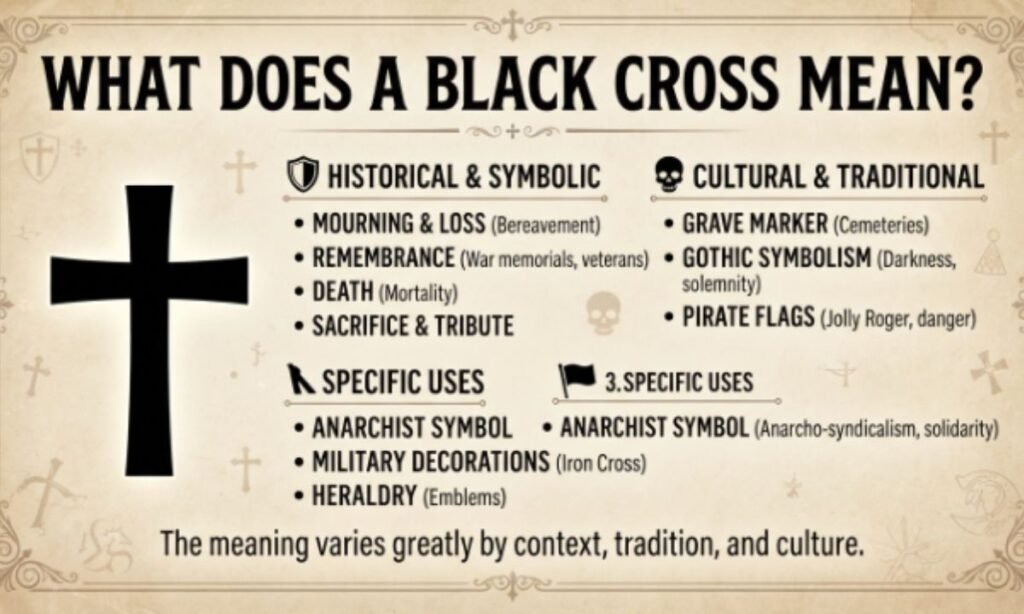
At its core, a cross represents sacrifice, faith, and redemption — that part hasn’t changed much in two thousand years. But when you make it black, you add another layer entirely.
Black as a color carries its own symbolic baggage. Depending on where you’re standing culturally, it can mean:
- Mourning and loss
- Mystery or the unknown
- Strength, discipline, and resilience
- Elegance and formality
- Protection from harm
So when someone asks what a black cross symbol means, the honest answer is: it depends on context. A black cross on a tombstone tells a very different story than a black cross tattooed on someone’s forearm. The shape stays constant. The meaning shifts with where you find it.
Black Cross Religious Meaning
Black Cross Meaning in Christianity
Within Christian tradition, the cross itself is the central symbol — it represents Christ’s crucifixion and, by extension, the promise of resurrection and eternal life. The black cross meaning in Christianity leans heavily into the somber side of that story: the suffering, the sacrifice, the darkness before the dawn of Easter morning.
You’ll notice black crosses show up prominently during specific points in the church calendar:
- Ash Wednesday — priests often use black to mark the beginning of Lent, a season of reflection and repentance
- Good Friday — black vestments and black crosses are traditional in many Catholic and Anglican services to mark the day of the crucifixion
- Funeral services — black crosses appear on programs, wreaths, and markers as a sign of mourning paired with hope
Catholic, Orthodox, Anglican, and Lutheran traditions all draw on black cross symbolism in slightly different ways, but the throughline is consistent: black doesn’t cancel out the hope of the cross, it just acknowledges the cost that came before it.
Denominational Differences
| Tradition | Common Use of Black Cross |
| Catholic | Lent, Good Friday, funerals, Ash Wednesday |
| Orthodox Christian | Mourning periods, monastic garments |
| Anglican | Good Friday vestments, memorial services |
| Lutheran | Funeral rites, seasonal liturgical color |
| Protestant (general) | Simplicity in worship, minimalist church decor |
Black Cross Spiritual Symbolism
Step outside strict religious doctrine, and the black cross spiritual meaning opens up even more. A lot of people who aren’t tied to any particular denomination still feel pulled toward this symbol because it speaks to something universal.
Here’s what it tends to represent in a broader spiritual sense:
- Protection — many wear a black cross believing it wards off negative energy or harm
- Strength through adversity — the darkness of the color paired with the endurance of the shape suggests surviving something difficult
- Rebirth — much like the Christian resurrection theme, black is often seen as the color that precedes renewal, not the end of the story
- Grounding — black is associated with stability, and a cross adds a sense of anchoring belief or purpose
None of this requires a specific faith background. It’s part of why the symbol has such staying power across so many walks of life.
Black Cross Tattoo Meaning
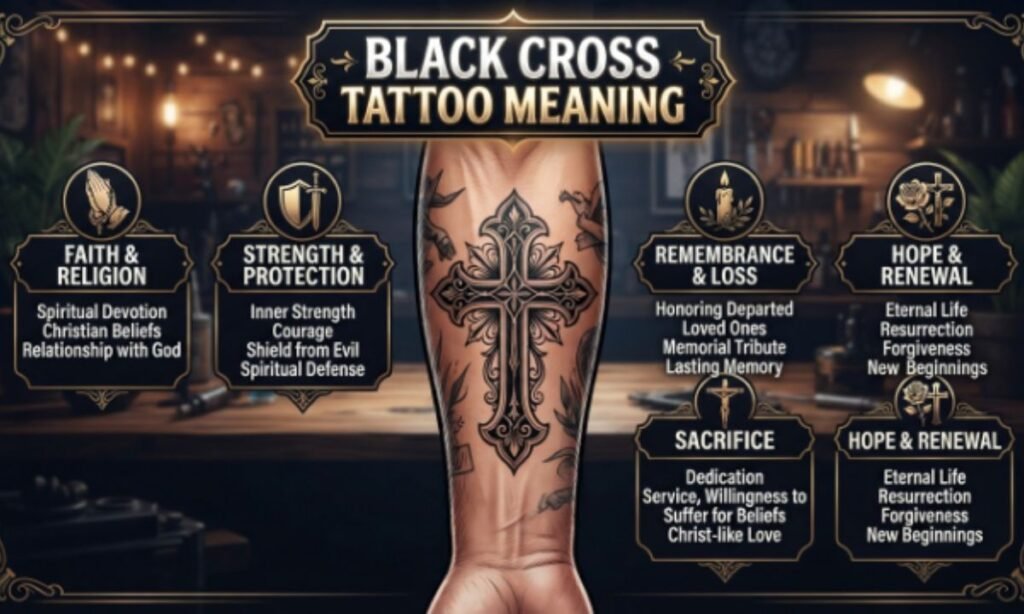
This is probably where most people encounter the symbol these days. A black cross tattoo has become one of the most requested minimalist tattoo designs, and for good reason — it’s simple, timeless, and deeply personal.
Common Placements and What They Suggest
- Wrist — often chosen as a quiet, personal reminder of faith or a loved one who’s passed
- Neck — a bolder statement, sometimes tied to resilience or a turning point in someone’s life
- Hand or finger — small and discreet, frequently linked to everyday faith or protection
- Behind the ear — subtle, personal, rarely explained to strangers
Popular Style Combinations
| Design Pairing | Typical Meaning |
| Cross with wings | Freedom, spiritual ascension, angelic protection |
| Cross with roses | Love and loss intertwined, beauty from pain |
| Cross with skull | Mortality, memento mori, facing death without fear |
| Simple black outline | Minimalism, quiet personal faith |
| Cross with a name or date | Memorial tattoo, honoring someone specific |
A lot of tattoo artists will tell you the black cross is one of those designs clients rarely need convincing on — they already know what it means to them before they sit in the chair.
Black Cross Necklace and Jewelry Meaning
Jewelry tells a slightly different story than tattoos, mostly because it can be taken off. A black cross necklace often functions as a daily, visible reminder rather than a permanent commitment.
People choose black cross jewelry for a mix of reasons:
- As a statement of faith that’s understated rather than flashy
- As protective symbolism, almost like a talisman
- For fashion, since black pairs easily with nearly any outfit
- As a memorial piece, sometimes passed down or given after a loss
Men’s and women’s black cross necklaces tend to differ mostly in scale and material — heavier, matte-black metal for a more rugged look, or a slim silver-and-black pendant for something more delicate. The underlying meaning doesn’t really change based on gender; it’s more about how bold or subtle someone wants that meaning to feel.
Black Cross in Dreams
Dream symbolism is subjective by nature, but a few interpretations come up again and again when people report seeing a black cross in a dream.
- Seeing a black cross from a distance is often linked to a warning — a sense that something in your waking life needs attention
- Holding a black cross can suggest you’re carrying a burden or responsibility you haven’t fully processed
- Finding a black cross unexpectedly is sometimes interpreted as a nudge toward faith or reconnecting with something you’ve drifted from
- A black cross appearing near someone you know may reflect worry about that person’s wellbeing, rather than a literal prediction
Islamic dream interpretation traditions also touch on cross symbolism, generally reading it through the lens of a test or trial the dreamer is facing. As with most dream analysis, context — how you felt in the dream, what else was happening — matters more than the symbol alone.
Black Cross and Death Symbolism
There’s no getting around it: black crosses are deeply tied to death, grief, and memorial culture. You’ll find them on:
- Gravestones and cemetery markers
- Funeral programs and memorial cards
- Wreaths and floral arrangements
- Roadside memorials marking accident sites
This isn’t a coincidence. Black has represented mourning in Western culture for centuries, and pairing it with a cross reinforces the idea of a life that’s ended but a spirit that continues on. It’s less about finality and more about honoring what was, while still holding onto a sense of hope.
Black Cross in History and Culture
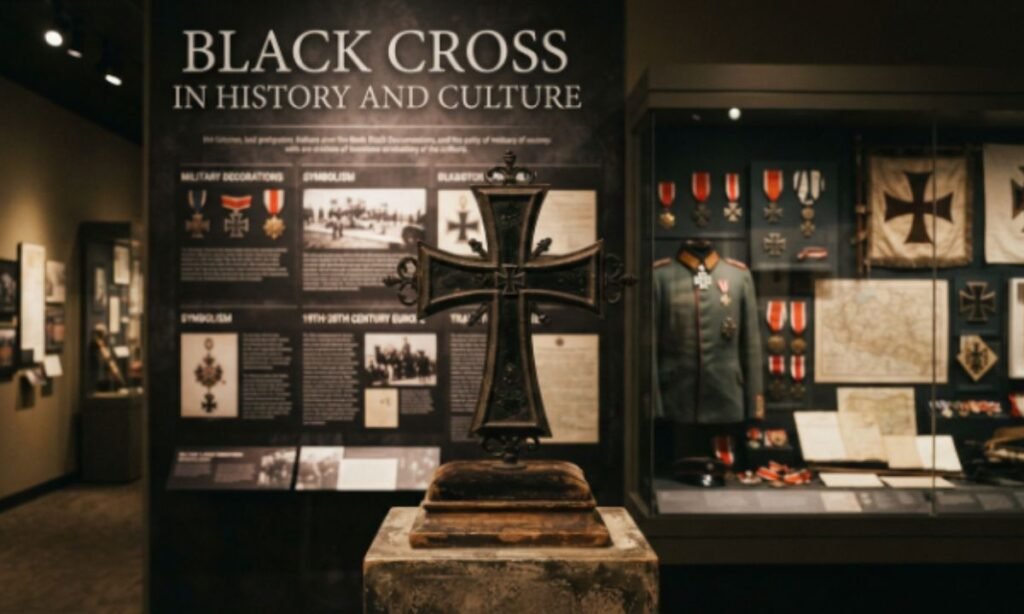
The symbol’s roots stretch back much further than any single religion. Long before Christianity adopted the cross, various ancient cultures used cross-like shapes to represent the four cardinal directions, balance, or the intersection of the earthly and divine.
A few historical touchpoints worth knowing:
- Medieval Europe — black crosses appeared on knightly banners and religious orders’ garments, often signaling penance or a vow
- German history — black cross imagery has military associations, most notably linked to Prussian and German armed forces insignia
- Celtic culture — while the Celtic cross is usually associated with intricate knotwork rather than black coloring specifically, black versions have become popular in modern Celtic-inspired jewelry and tattoos
- Gothic subculture — black crosses became a visual staple, blending religious imagery with a broader aesthetic built around darkness, drama, and individuality
Black Cross in Heraldry and Flags
Heraldry loves symbolism, and the cross is one of its most flexible tools. A black cross on a coat of arms or family crest typically signaled faith, martyrdom, or a family’s connection to a religious order or military campaign.
On flags, a black cross carries similarly serious weight — it’s rarely decorative. It tends to point toward a nation or group’s historical ties to religious conflict, military tradition, or a founding moment tied to sacrifice.
Inverted and Variant Black Cross Meanings
Not every black cross means the same thing, and orientation matters.
| Variation | Common Interpretation |
| Upright black cross | Faith, protection, traditional Christian symbolism |
| Inverted (upside-down) black cross | Historically tied to St. Peter’s cross (humility, martyrdom); in modern pop culture sometimes misread as anti-religious, though its origin is Christian |
| Black Celtic cross | Heritage, spirituality, connection to Irish or Scottish roots |
| Black Orthodox cross | Eastern Christian tradition, often with the extra slanted bar |
| Black cross with a circle | Sometimes tied to Celtic or nature-based spiritual traditions, representing eternity |
It’s worth noting that the inverted cross gets a bad reputation it doesn’t fully deserve. Its original Christian association — tied to the apostle Peter, who according to tradition was crucified upside down by choice, feeling unworthy to die in the same manner as Christ — is about humility, not rebellion.
Final Thoughts
A black cross isn’t just one thing. It’s a symbol flexible enough to sit on a church altar and a rebellious teenager’s jacket without losing its core meaning. Faith, protection, mourning, strength — it holds all of that at once, and which one resonates depends entirely on who’s looking at it and what they’re carrying that day.
If you’re thinking about wearing one, tattooing one, or simply noticed one somewhere and got curious, there’s no wrong way to connect with it. That’s part of what’s kept this symbol alive for so long — it meets people exactly where they are.
FAQS
What does a black cross symbolize?
A black cross generally symbolizes faith, sacrifice, and protection, with the black color adding themes of mourning, strength, or mystery depending on the setting. Its exact meaning shifts based on where it appears — a tattoo, a necklace, or a memorial marker all carry slightly different weight.
Is a black cross a bad sign?
No. A black cross isn’t inherently negative. It’s most often tied to mourning, faith, or resilience rather than anything sinister. The idea that it’s a “bad” symbol is largely a modern misconception, especially when it comes to the inverted cross, which has Christian roots tied to humility rather than rebellion.
What does a black cross tattoo mean?
A black cross tattoo typically represents personal faith, remembrance of a loved one, or a marker of strength through a hard period in someone’s life. The specific meaning often depends on placement and any additional imagery, like wings, roses, or a name.
What does it mean to dream about a black cross?
Dreaming of a black cross is often interpreted as a sign to pay attention to something in your waking life — a warning, an unresolved burden, or a nudge back toward faith. The feeling you had during the dream usually matters more than the symbol itself.
Why do people wear a black cross necklace?
People wear a black cross necklace as a quiet expression of faith, a form of spiritual protection, or simply as a minimalist accessory that pairs well with most outfits. For some, it also serves as a memorial piece connected to a specific person or moment.
What’s the difference between a black cross and an inverted black cross?
An upright black cross is the traditional Christian symbol of faith and sacrifice. An inverted black cross is historically associated with St. Peter, who was said to have been crucified upside down out of humility — it’s a Christian symbol at its core, even though pop culture sometimes misreads it as anti-religious.
Does the meaning of a black cross change by religion or culture?
Yes. Catholic, Orthodox, Anglican, and Lutheran traditions each use black cross imagery slightly differently, mostly around mourning periods and liturgical seasons like Lent. Outside organized religion, the symbol takes on broader spiritual meanings tied to protection and personal strength.
