
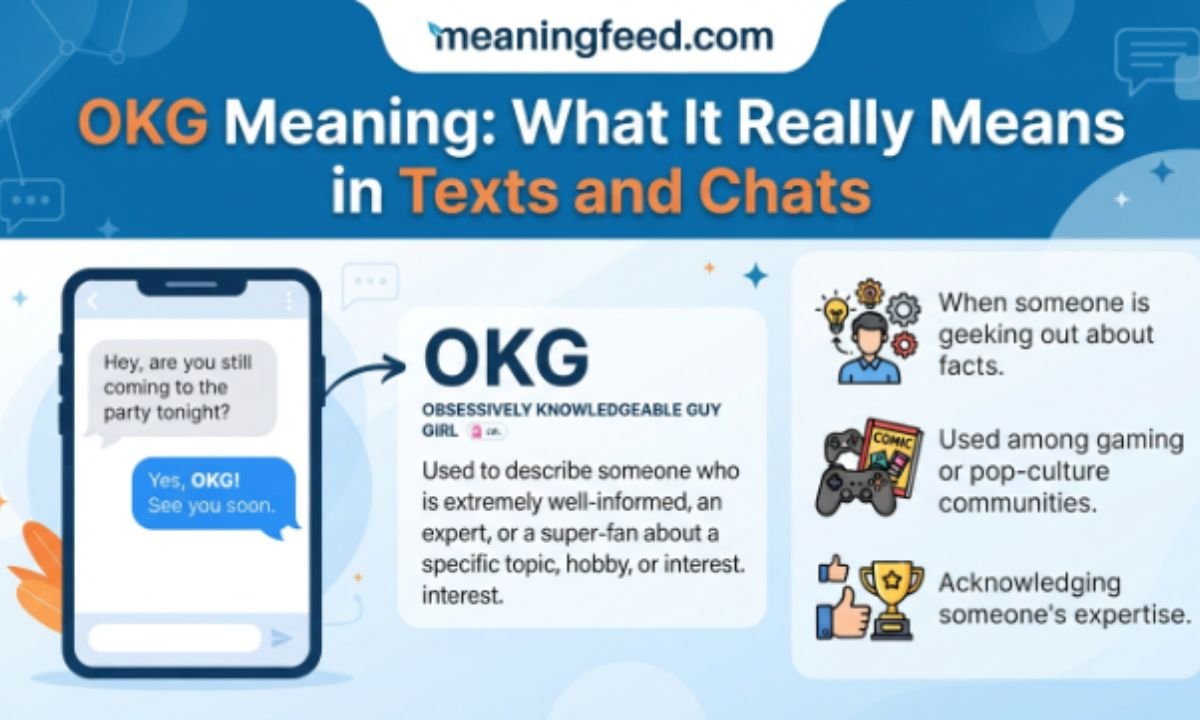

OKG meaning is simpler than it looks once you break it down. You get a text back that just says “okg.” No punctuation. No emoji. No context clues.
Is that a typo? A new slang term you’re supposed to already know? Or is your friend low-key annoyed with you?
If you’ve landed here because a text like that stopped you mid-scroll, you’re in good company. OKG meaning has quietly become one of those texting shortcuts that everyone seems to understand except the person who just received it for the first time. Here’s the full breakdown — what it means, where it came from, and how to actually use it without sounding out of touch.
What Is OKG Meaning?
In most everyday texting, OKG meaning boils down to “okay, good” — a quick way to acknowledge something and show mild approval at the same time.
Think of it as a slightly warmer version of “OK.” Plain “OK” can read as flat, or even a little cold, depending on the conversation. Add the G, and suddenly the message feels friendlier. It’s the difference between someone saying “sure” in a flat voice and someone saying “sure, sounds good” with an actual smile behind it.
That said, the OKG meaning isn’t a fixed, dictionary-official definition. It’s internet shorthand, and internet shorthand bends to fit the person typing it. So while “okay, good” is the most common reading, you’ll also see it used to mean:
- Okay, got it — a quick confirmation that a message was received and understood
- Oh, okay — a softer, sometimes surprised acknowledgment
- A typo for OMG — since O, K, and G sit close together on a keyboard, especially on mobile
- Okay, girl — occasionally used between friends as a casual, familiar sign-off
The real meaning almost always comes down to context. A single “okg” sitting alone in a chat thread can carry five different tones depending on who sent it and what came right before it.
Where OKG Came From
There’s no single inventor or launch date for OKG the way there is for, say, a branded hashtag. It grew the same way most texting slang grows: out of pure convenience.
As messaging apps took over from phone calls, people started shaving letters off common phrases to keep up with the pace of a conversation. “Okay, good” is four syllables and a comma. “Okg” is one quick tap. Multiply that by the hundreds of texts an average person sends in a week, and the appeal of shorthand makes a lot more sense.
It’s part of the same family as terms like “kk,” “sup,” and “ikr” — abbreviations that exist purely to keep digital conversation moving without slowing anyone down to type full sentences. OKG never went viral the way “YOLO” or “FOMO” did, but it spread steadily through group chats, comment sections, and DMs, especially among Gen Z and younger millennial users.
How OKG Is Used Across Different Platforms
The OKG meaning stays fairly consistent wherever you see it, but the vibe shifts a little depending on where the conversation is happening.
| Platform | Typical Use | Common Vibe |
| Text messages (iMessage/SMS) | Quick confirmations, plan-making | Casual, friendly |
| Group chat replies, family threads | Efficient, keeps conversation flowing | |
| Instagram DMs/comments | Reacting to a post or suggestion | Light, low-effort agreement |
| TikTok comments | Reacting to videos or other comments | Playful, sometimes joking |
| Snapchat | Fast back-and-forth chats | Casual, occasionally a stand-in for “OMG” |
| Dating apps | Responding to a suggestion or plan | Comfortable but not overly enthusiastic |
| Workplace chat tools | Rare, but appears in casual internal channels | Only used with people you already know well |
Notice a pattern? OKG belongs to informal spaces. It’s built for speed and familiarity, not formality. Drop it into a client email or a first message to a hiring manager, and it’ll land wrong every time.

OKG From a Guy vs. From a Girl
People search this specific angle a lot, so let’s address it directly: the OKG meaning doesn’t change based on gender. It’s slang, not a code word.
That said, tone often depends more on the relationship than anything else:
- From a guy, OKG in a casual or flirty conversation can signal light interest or easy agreement — think “I’m cool with that, and I’m not overthinking it.”
- From a girl, it can carry a similar tone, sometimes read as playful or sassy depending on the emoji or punctuation tacked on.
- In a professional or neutral context, it’s simply a shorthand acknowledgment, no romantic subtext attached.
If you’re trying to figure out what someone “really meant” by sending OKG, the safest move is to look at everything around it — the emoji, the punctuation, how long they took to reply, and the general history of the conversation. A lone “okg.” with a period can read very differently from “okg!! 😂” sent a second after your message.
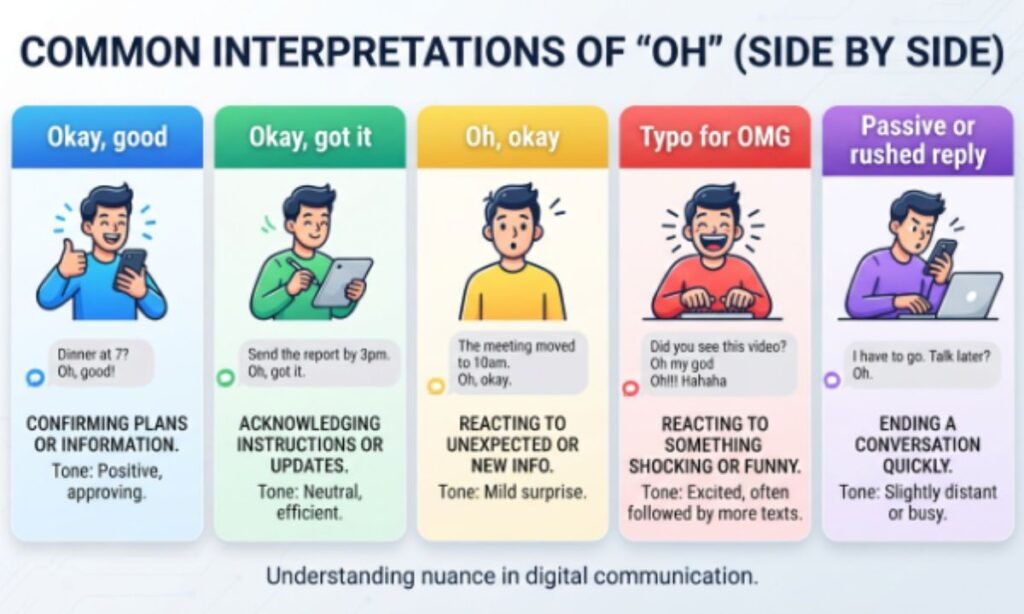
Common Interpretations of OKG Meaning, Side by Side
Since the OKG meaning doesn’t have one locked-in definition, here’s a quick side-by-side to help you read the room faster.
| Interpretation | When It Usually Shows Up | Tone |
| Okay, good | Confirming plans or information | Positive, approving |
| Okay, got it | Acknowledging instructions or updates | Neutral, efficient |
| Oh, okay | Reacting to unexpected or new info | Mild surprise |
| Typo for OMG | Reacting to something shocking or funny | Excited, often followed by more texts |
| Passive or rushed reply | Ending a conversation quickly | Slightly distant or busy |
If you’re ever unsure which one applies, the fastest fix is just asking. A simple “haha wait, good or omg? 😂” clears it up in seconds and honestly keeps the conversation going.
Is the OKG Meaning the Same as “OK”?
Not quite, even though they look almost identical on the surface.
“OK” by itself is neutral. It’s efficient, but it can come across as short or even a little dismissive, especially in a longer conversation where the other person put in more effort. Add anything to it — a “!,” a “G,” an emoji — and it instantly softens.
The OKG meaning specifically adds a sense of approval on top of the basic acknowledgment. It’s less “I heard you” and more “I heard you, and I’m good with it.” That small difference matters more than people think in text-based communication, where tone is so easy to misread without a voice or facial expression attached.
When You Should (and Shouldn’t) Use It
Good times to use OKG:
- Confirming casual plans with friends (“Meet at 7?” → “okg see you then”)
- Responding to a group chat update
- Reacting to a text from a partner or someone you’re comfortable with
- Wrapping up a light, informal exchange
Times to skip it:
- Emails or messages to coworkers you don’t know well
- Job applications or interview-related communication
- Formal customer service chats
- Any conversation where clarity matters more than speed, like coordinating something time-sensitive or important
Basically: if you’d feel fine texting “lol” or “np” in that same conversation, OKG fits right in. If you wouldn’t, skip it.
How to Respond When Someone Sends You OKG
Here’s the good news — you usually don’t need to overthink your reply.
If it’s confirming something you already said, you don’t need to respond at all. That’s the whole point of the term; it closes the loop.
If you want to keep the conversation moving, a short continuation works fine:
- “okg, talk soon!”
- A thumbs-up or matching emoji
- Adding the next detail, like “okg, I’ll bring snacks”
If the “okg” feels off — too short, too delayed, punctuated oddly — and you’re genuinely unsure what it means, it’s completely fine to just ask. Texting tone is famously hard to read, and a quick clarifying question saves everyone from a misunderstanding that didn’t need to happen.
Final Thoughts
The OKG meaning isn’t complicated once you see it in context. Most of the time, it simply means “okay, good” — a warm, low-effort way to confirm you’re on the same page as whoever you’re texting. Sometimes it’s a stand-in for “got it,” sometimes it’s a rushed typo for “OMG,” and every so often it’s just a personal habit someone’s picked up along the way.
The real skill isn’t memorizing a definition. It’s paying attention to who sent it, what the conversation looked like right before it showed up, and how it’s punctuated. Do that, and you’ll never have to sit there wondering what a three-letter text actually meant ever again.
Frequently Asked Questions
What does OKG mean in text?
OKG most commonly means “okay, good” — a casual way to acknowledge a message and show mild approval at the same time. Depending on the conversation, it can also mean “okay, got it” or serve as an accidental typo for “OMG.”
Is OKG an official abbreviation?
No. OKG isn’t a standard, dictionary-recognized acronym the way terms like LOL or BRB are. It’s informal internet slang, so its exact meaning shifts based on who’s using it and the context of the conversation.
Is OKG the same as saying OK?
Not exactly. “OK” on its own can feel neutral or even a little flat, while OKG adds a layer of approval on top of the acknowledgment. It reads more like “I heard you, and I’m good with it” rather than just “I heard you.”
What does OKG mean from a guy?
From a guy, OKG is usually just a casual or laid-back way to agree with something. In a flirty conversation it can hint at light interest, but in most everyday chats it carries no deeper meaning beyond easy agreement.
What does OKG mean from a girl?
From a girl, OKG typically carries the same core meaning — casual agreement or acknowledgment — though it can come across as playful or sassy depending on the emoji or punctuation used alongside it.
Is OKG just a typo for OMG?
Sometimes. Because O, K, and G are close together on a keyboard, OKG can happen as an accidental slip while typing OMG quickly. Context clues, like the tone of the conversation, usually make it clear which one was intended.
Should I use OKG in professional or work conversations?
Generally, no. OKG works best in casual settings like texts with friends or family group chats. In emails, job-related communication, or conversations with coworkers you don’t know well, it’s safer to stick with clearer, more formal language.
