

You’re scrolling through a group chat when a friend answers a plan with a lone “IDGAF 😂.” Is that a joke, a shrug, or a quiet insult? The IDGAF meaning in text is simple once you know the letters, but the feeling behind it shifts from message to message.
People search for this one because it shows up everywhere: text threads, TikTok comments, Instagram captions, memes, even the occasional work chat. It also contains a swear word, so readers worry about taking it the wrong way or sending it at the wrong moment.
This guide covers what IDGAF stands for, how it’s used in real conversations, and when it sounds rude. You’ll also get its origin, polite alternatives, and a section for parents who spot it on a teen’s phone.
IDGAF stands for “I don’t give a fuck.” It is an informal, crude slang acronym that means “I really don’t care.” People send it to show strong indifference, confidence, or frustration. The tone depends on context: between friends it can be a playful shrug, while in an argument it can sound dismissive or rude.
What Does IDGAF Stand For?
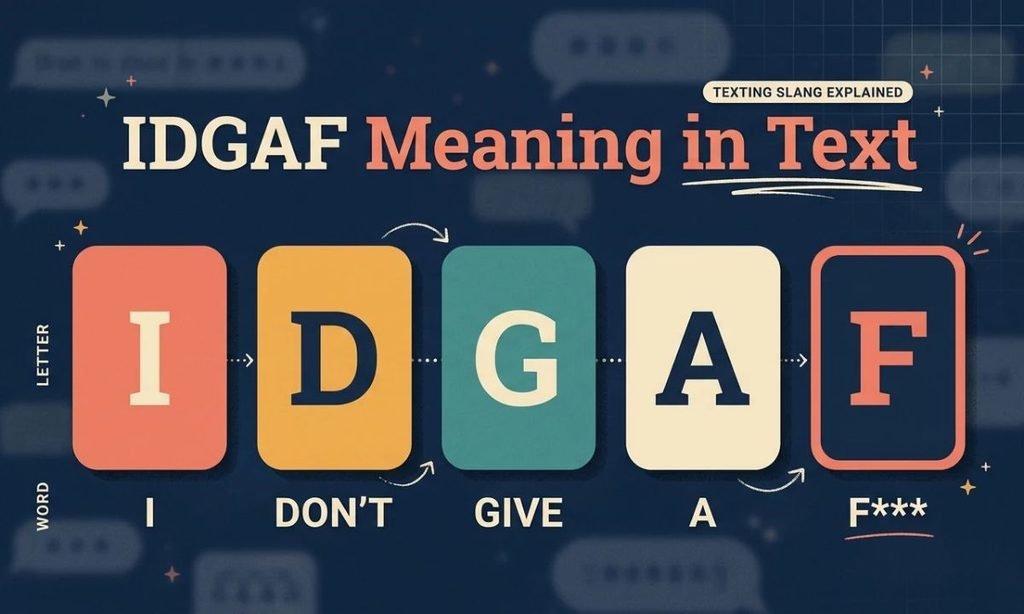
IDGAF is an acronym built from the first letters of five words.
| Letter | Word |
| I | I |
| D | Don’t |
| G | Give |
| A | A |
| F | Fuck |
The plainest translation is “I don’t care.” That covers the meaning in everyday language, but it undersells the phrase. The profanity works like a raised voice, so IDGAF hits harder than a flat “I don’t care.”
Say a friend texts, “Everyone is talking about what I wore, but IDGAF.” The gossip doesn’t bother them. Or take “They can say whatever they want. IDGAF.” Same message: other people’s opinions have no grip on the speaker.
What Does IDGAF Mean in Text Messages?
In a text, IDGAF mostly signals indifference. Sometimes the sender is saying “I don’t mind, you pick.” Other times it comes from someone who has stopped worrying about what others think of a decision.
Tone does the heavy lifting. Picture this exchange: “What if they don’t like your decision?” “IDGAF. It’s my decision.” That sender is serious. They don’t care whether anyone approves.
Now picture “IDGAF what movie we watch 😂.” Nobody is angry here. The sender is handing you the remote. I see this version constantly in group chats, where the phrase is a casual way to pass a choice to someone else.
That’s the catch with the IDGAF meaning in text. The same four letters can mean “relax, I’m easy” or “back off,” and only the surrounding conversation tells you which.
Common Ways People Use IDGAF
The acronym carries several meanings, and the emotional tone shifts with each. They overlap, but they’re worth separating.
“I Don’t Care”
This is the most straightforward use. Something is unimportant to the sender. “They don’t like my music? IDGAF.” It’s plain indifference, and the critic’s opinion goes nowhere.
“I’m Not Bothered”
Here the focus is on negative comments. “People keep complaining about my decision. IDGAF.” The complaints have not affected the sender, so the criticism lands and bounces off.
“I Don’t Care What People Think”
This one is especially common in social media posts, and it usually comes with a confident declaration. “I’m going to be myself. IDGAF what anyone thinks.” The writer isn’t chasing approval, and other opinions aren’t a vote. It’s self-expression and independence in a single line.
“This Doesn’t Matter to Me”
Sometimes the stakes are tiny. “IDGAF where we eat tonight” usually means “I don’t really care, you choose.” The tone depends heavily on the relationship between the people talking. Between friends deciding on dinner, it’s harmless. Between two people mid-disagreement, it can sting.
Anger or Frustration
IDGAF can also sound aggressive. “I’ve explained myself three times. IDGAF anymore.” In this case the sender is probably frustrated, emotionally tired, even exhausted. It’s less “I’m relaxed” and more “I’m finished.”
IDGAF Examples in Real Text Conversations
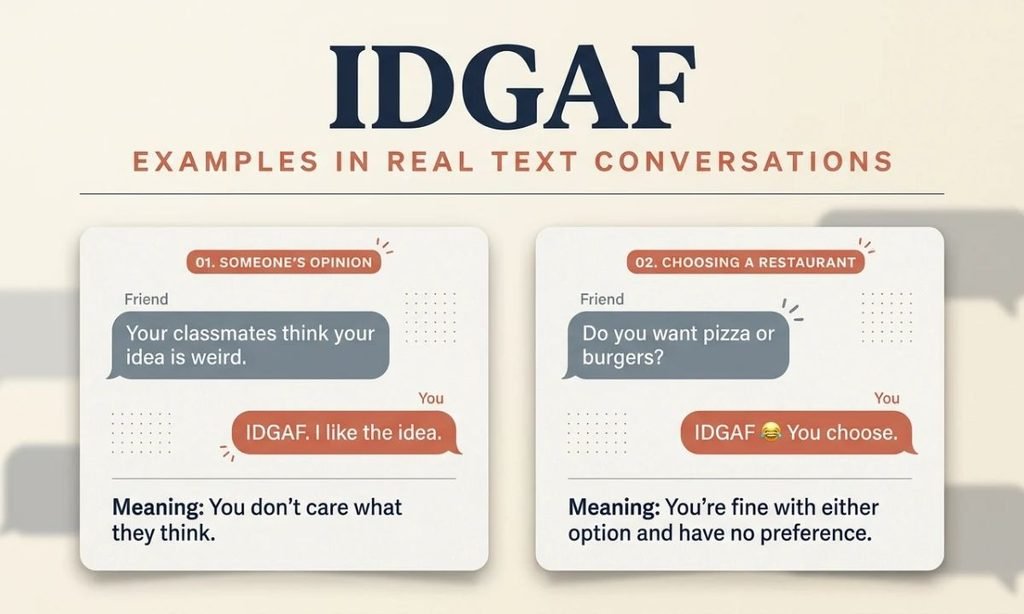
Slang makes more sense when you see it in realistic exchanges. Here are five, covering opinions, criticism, a restaurant choice, frustration, and a joke.
- Someone’s opinion. Friend: “Your classmates think your idea is weird.” You: “IDGAF. I like the idea.” You don’t care what they think.
- Choosing a restaurant. Friend: “Do you want pizza or burgers?” You: “IDGAF 😂 You choose.” You’re fine with either option and have no preference.
- Dealing with criticism. Friend: “People are criticizing your new haircut.” You: “IDGAF. I love it.” The criticism isn’t bothering you, and your appearance is your call.
- Being frustrated. Someone asks, “Are you still worried about what he thinks?” and you reply, “No. IDGAF anymore.” You’ve stopped caring about the situation.
- A joke. Friend: “You said you were going to eat healthy.” You: “IDGAF. Bring me the fries 😂.” Nobody is hostile here. It’s humor.
What Does IDGAF Mean on Social Media?
On social platforms, IDGAF is often used to show an attitude. You’ll spot it in Instagram captions, TikTok comments, Facebook posts, X posts, memes, and private messages. It’s a fast way to display not caring, usually packaged with confidence, a dig at criticism, or a shrug at approval.
“People will always have something to say. IDGAF.” That sender is unconcerned and signaling they won’t let the noise affect them. “Wearing what I want because IDGAF” is about clothing and appearance, and it reads as being yourself in public.
In this setting the line is often a statement about values, even when it’s wrapped in swagger. Other times it’s pure online personality, an exaggerated bit rather than a belief. “IDGAF, I’m ordering pizza at midnight” is a joke about consequences, not a life philosophy.
Can IDGAF Be a Joke, a Caption, or a Meme?
Yes, and it works well. “IDGAF about calories today. Give me the biggest burger.” Or “IDGAF that it’s raining. I’m going outside.” The phrase adds dramatic emphasis to something trivial.
Memes lean on it because it communicates an exaggerated attitude in four letters. Captions follow the same logic: “IDGAF what anyone says” under an unconventional picture reads as ignoring criticism with a smile. “IDGAF about my diet this weekend” and “IDGAF if it’s Monday. Coffee first” add personality without much effort.
Humor doesn’t wash out the vulgarity, though. It’s still a swear word, joking or not. Using it in every message can also make someone seem dismissive or aggressive. It lands best when it fits the moment.
Does IDGAF Always Sound Rude?
No, and I’d say that’s the most useful thing to learn about it. The words are strong, but the tone depends on context. “IDGAF 😂 Pick whichever restaurant you want” is flexible and friendly. “IDGAF what you think” is dismissive and confrontational.
Before reacting, I look for clues:
- Who sent the message, and who are they talking to?
- Is the conversation serious or playful?
- Are there emojis?
- Has the person been arguing?
- Is the phrase aimed at a specific person?
Those questions help you read the intended tone before you take offense.
Is IDGAF a Bad Word?
It contains profanity, so yes, with some nuance. The last letter stands for the F-word, a strong swear word, which makes IDGAF vulgar and sometimes offensive. Even so, it’s very common, especially among friends and in casual social media conversations.
Whether it’s acceptable depends on your relationship with the reader and their communication style. I’ve watched people use it with close friends all day, then switch to polite language the moment a manager joined the thread.
Skip it in a job interview, formal email, school assignment, business presentation, or any professional message. A simple rule covers most cases: if you wouldn’t say the F-word out loud in that situation, don’t type IDGAF.
Can You Use IDGAF at Work or School?
Generally no. It’s informal slang with a swear word inside, so save it for casual conversations where you know the audience is comfortable. That rules out these:
- Cover letters and job applications
- Professional emails and business reports
- Academic essays and school assignments
- Formal presentations and customer service messages
- Messages to teachers or supervisors
- Official documents
Picture a common workplace mistake: someone fires off “IDGAF what the client thinks” in a team chat, forgetting a manager is in the channel. Screenshots travel fast. Here’s how to say the same thing without the risk:
| Instead of | Try |
| “IDGAF what the customer thinks.” | “I don’t think the customer’s opinion should affect the decision.” |
| “IDGAF about that.” | “I’m not concerned about that issue.” |
These versions are less dramatic, but the point still lands.
IDGAF vs. IDC vs. “I Don’t Care”

These three share a basic meaning, but they aren’t equal in tone. IDC stands for “I don’t care,” and people often confuse it with IDGAF because the two look alike. The difference is force. IDC is casual indifference, and IDGAF is emphatic indifference.
| Expression | Tone | Example |
| I don’t care | Neutral, casual | “I don’t care what movie we watch.” |
| IDC | Casual, informal | “IDC what they think.” |
| IDGAF | Blunt, emphatic, more intense | “IDGAF what they think.” |
IDGAF is stronger because of the profanity, which makes it more forceful, rebellious, even aggressive. Neither IDC nor IDGAF necessarily means the sender is angry, but IDGAF is more likely to sound that way. It suggests genuinely no interest in the decision. When you want to stay polite, “I don’t mind” or “It’s up to you” is the better choice.
Longer IDGAF Phrases and What They Mean
A few variations change the weight of the message.
What Does “IDGAF About You” Mean?
This one turns personal. It generally means “I don’t care about you or your opinion,” and it can be insulting. “You keep asking me to explain myself, but IDGAF about your opinion.” That’s more than disinterest. It directly dismisses the other person.
During an argument it may signal anger, frustration, or emotional distance. Between friends, exaggerated language is sometimes used jokingly, so look at the broader relationship before assuming the worst.
What Does “IDGAF Anymore” Mean?
It usually means “I don’t care anymore,” and it often suggests the sender is tired, frustrated, and emotionally exhausted. “I’ve tried to make everyone happy, but IDGAF anymore.” That marks a strong change in attitude. The person may have cared a lot before and has now decided to stop giving the issue attention.
What Does “IDGAF What You Think” Mean?
A very direct statement. It says “I don’t care about your opinion,” and nothing you say will change the sender’s mind. “You don’t like my decision? IDGAF what you think.” Because it dismisses another person outright, it can sound rude, hostile, and unnecessarily offensive.
A softer option: “I understand your opinion, but I’m comfortable with my decision.” You keep the independence without the sting.
What Are Polite Alternatives to IDGAF?
You have plenty of ways to express the same general idea without profanity. Pick one based on how strongly you want to express yourself and who’s reading.
Casual alternatives
- I don’t care.
- I don’t mind.
- Whatever.
- Doesn’t matter to me.
- I’m not bothered.
- I’m fine either way.
- I couldn’t care less.
More polite alternatives
- I’m not concerned about it.
- I don’t have a strong opinion.
- I’m comfortable with whatever you decide.
- I’m going to do what works for me.
If you only want to signal that you have no strong opinion, the mild options win every time.
Why Do People Say IDGAF Instead of “I Don’t Care”?
The main reason is emphasis. “I don’t care what they say” can sound neutral or ordinary, while “IDGAF what they say” is much stronger. It can carry confidence, frustration, rebellion, humor, or irritation, and it communicates the general feeling right away.
Online communication also rewards short forms. Four letters do the work of a full sentence, which is how IDC, IMO, TBH, and LOL became popular too.
Where Did IDGAF Come From?
The spoken phrase is older than the acronym. People said “I don’t give a fuck” long before anyone typed it as four letters, and similar lines such as “I don’t give a damn” go back further. The abbreviation most likely grew out of early chat and texting habits, when shorter was better.
Beyond that, the origin is debated. I haven’t seen anyone pin down who typed it first, and I’d be wary of any source that claims to.
Music helped keep it visible. There are numerous songs titled IDGAF, by artists such as 2Pac, Dua Lipa, and Nelly. A title like that shows how long the attitude has been circulating.
How Do You Respond When Someone Says IDGAF?
Your answer depends on the situation. If the person is simply passing a choice to you, “Fair enough” works, or “Okay, you choose then.”
If it lands in the middle of an argument, don’t answer aggressively. Something like “I understand. We can leave it there” helps prevent a heated spiral. And if someone writes “IDGAF what you think,” you might say, “That’s fine. I was only giving my opinion.” You don’t have to match their tone.
What Other Slang Acronyms Look Like IDGAF?

If you’re learning internet slang, you’ll run into related abbreviations soon enough. All of them are informal, and whether they’re appropriate still depends on your audience.
| Acronym | Stands for | Example |
| IDC | I don’t care | “IDC what they think.” |
| IDK | I don’t know | “IDK what happened.” |
| TBH | To be honest | “TBH I don’t really like it.” |
| IMO | In my opinion | “IMO the first option is better.” |
| IIRC | If I remember correctly | “IIRC the meeting starts at 10.” |
IDC is the closest relative and the more neutral alternative.
Does IDGAF Mean the Person Truly Doesn’t Care?
Not always, and the distinction matters. Saying IDGAF doesn’t mean the sender has no feelings about the topic. People use it to look confident and unaffected while secretly bothered.
“IDGAF what my ex thinks” is a classic. It shows how people want to present themselves, not necessarily what’s going on inside. Language reflects a mood more than a fact, so avoid reading too much into one slang expression.
How Do You Pronounce IDGAF?
People generally say the individual letters: “eye-dee-gee-ay-eff.” In practice, most readers take it in silently, so the sound rarely comes up. To someone unfamiliar, it looks like a random collection of letters. Once you know the phrase behind it, the meaning is straightforward.
Who Uses IDGAF?
Use varies by age, personality, culture, and personal preference. Some people use profanity casually and send it without a thought. Others treat swear words as a line they would never cross. You’ll see it more often in informal online communities than in professional or formal settings.
Slang shifts, and popularity rises and falls. IDGAF has stayed a recognizable internet acronym for many years.
How Do Teenagers Use IDGAF?
Teenagers frequently use this slang term to show utter indifference toward what other people think. The attitude points to a belief in absolute self-expression, regardless of rules or the judgement of others.
From reading group chats and comment threads, I’d say it works like a badge. Typing it says “I’m not asking permission.” It’s often less about the thing being ignored and more about how the sender wants to be seen.
What Does a Teen’s IDGAF Look Like?
A friend texts, “Hey, guess what we did last weekend.” The reply is just “IDGAF.” Another friend answers “OIC,” and the chat moves on. It’s short, a little cheeky, and not necessarily hostile.
Or the chaperones don’t want you to play a certain song, and the teen writes, “idgaf I’ll play it and play it hot.” That’s defiance with a grin.
Then there’s “IDGAF what she thinks,” which shrugs off one person’s opinion, and “IDGAF if they kick me out,” which treats a possible consequence as no big deal. That last one is bravado, and it’s worth a closer look from any parent who sees it.
How Can Parents Spot It?
You might learn your child uses this slang by chance, when a text pops up on the phone screen. Seeing it doesn’t mean much on its own. IDGAF is usually harmless, one more piece of slang in a teen’s vocabulary.
The bigger question is what sits next to it. Other teenage slang terms could point to risky behaviors or to contact with potentially dangerous people. Those are the messages worth noticing.
Do Parental Control Apps Help?
Having a parental control app installed on your child’s phone can give you peace of mind. It works by alerting you to exposure to risks the phone can bring. You can set alerts to help your teen avoid the pitfalls of predators, drug dealers, and other negative influences.
The level of monitoring can vary, which matters. You pick what is right for your child, and the settings can be adjusted easily at any time. You keep control and the power to choose.
How Should You Talk With Your Teen About It?
Defiance is a normal part of teenage development. Teenagers are trying to establish their own identities and set themselves apart from their families, so to a degree it’s healthy and to be expected. An IDGAF text can be part of that process.
Still, defiant behavior shouldn’t be allowed to go too far out of bounds. Pushed hard enough, it can lead to risky behaviors and life-altering consequences. A calm talk beats a lecture. Here are some conversation starters, and the tone should stay curious, not accusing:
- Start with the rules. “Do you understand the physiological reasons behind the rules made by the government, your school, and our family restricting the use of drugs and alcohol for teenagers?” This puts the reasoning on the table instead of the punishment.
- Ask about motive. “Why do you feel like you want to break the rules when you know you won’t enjoy the consequences?”
- Point toward a better outlet. “What are some ways you can think of to show your independence that won’t result in a negative outcome?”
- Offer support. “You are the master of your actions, and I’m here to support you in strengthening your affinities. What are some activities you’d enjoy taking part in?”
A teen who types IDGAF may be telling you they want room. Structured room, with limits that make sense, tends to land better than a flat no.
What Should You Remember About IDGAF?
The short version: IDGAF means “I don’t care,” “I’m not bothered,” “your opinion doesn’t matter,” or “I’m done worrying.” The exact meaning depends on context, and it can come across as funny, confident, dismissive, frustrated, rude, or angry.
Because it contains profanity, it fits informal situations and should stay out of professional and academic writing. Don’t assume the worst the moment you see it. Look at your relationship with the sender and the comments around it. “IDGAF 😂 you choose” is a very different message from “IDGAF what you think.”
So the IDGAF meaning in text comes down to this: it’s a vulgar but common internet acronym for strong indifference, a louder way to say “I really don’t care.” In friendly chats it often means “I don’t mind, you decide.” In an argument it can turn harsh. If you want a cleaner option, “It doesn’t matter to me” and “It’s up to you” do the job. Tone is the key to reading the slang, and the actual meaning is simple: the sender doesn’t care about something.
FAQs
What does IDGAF mean in text?
IDGAF stands for “I don’t give a f***.” It’s a blunt way of saying you don’t care about something or someone. It’s one of the most common examples of internet slang used in texts, social media, and captions.
Is IDGAF a bad word?
It contains a profanity, so it’s considered vulgar, though the letters soften it slightly. It’s fine among friends but not appropriate for work, school, or formal settings.
How do you use IDGAF in a sentence?
You can use it to show indifference or confidence, like “IDGAF what people think” or “Honestly, IDGAF anymore.” It works best in casual chats and social posts.
Is IDGAF rude?
It can be, depending on tone and who you’re talking to. Aimed at a person, it sounds dismissive or hostile; used about a situation, it can simply sound carefree.
What does IDGAF mean from a girl or a guy?
The meaning is the same regardless of gender: they don’t care about something. Context matters, since it may signal real indifference, frustration, or a defensive “I’m over it” attitude.
What does it mean when someone texts “IDGAF” to you?
They’re likely saying they don’t care about the topic, your opinion, or the situation. It can signal anger, being fed up, or an attempt to end the conversation, so read the tone of the full message.
What’s the difference between IDGAF and IDC?
IDC means “I don’t care” and is milder and more neutral. IDGAF is stronger, more emphatic, and more attitude-heavy.
What are the polite alternatives to IDGAF?
Try “I don’t mind,” “It doesn’t bother me,” “I’m not worried about it,” or “It’s not a big deal.” These keep the same meaning without the profanity.
Is IDGAF the same as “I don’t give a damn”?
Yes, they mean the same thing, but IDGAF is more intense because of the stronger swear word. “I don’t give a damn” is the milder, more traditional version.
Can you use IDGAF at work or in professional messages?
No, it’s best avoided in emails, work chats, and anything formal. Use neutral phrases like “I have no strong preference” or “I’m flexible” instead.
What does “IDGAF attitude” mean?
It describes a confident, carefree mindset where someone doesn’t worry about others’ opinions or drama. It can be a positive sign of self-assurance or come across as arrogant, depending on how it’s shown.
How do you reply to someone who says IDGAF?
Stay calm and match the situation: ask what’s bothering them or give them space. If it’s a joke, a casual reply like “Fair enough” works fine.
Is IDGAF used on social media like TikTok and Instagram?
Yes, it’s very common in captions, comments, and bios to express a carefree or unbothered vibe. Want to decode more texting slang? Check the JP meaning in text.
