
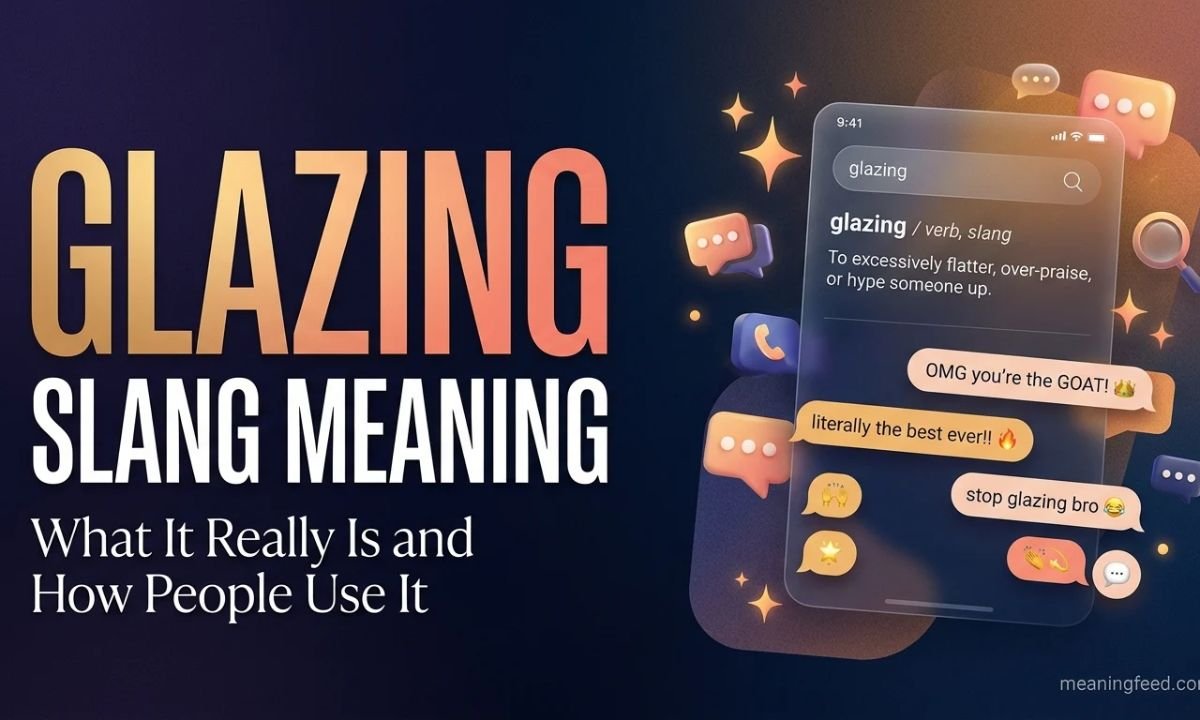

Someone in your group chat calls a rapper “the greatest of all time,” and another person fires back, “bro, stop glazing.” If you’ve ever stared at your screen wondering what just happened, you’re in the right place. The glazing slang meaning is simple once you see it, but the tone can swing from a playful tease to a real call-out depending on who’s talking.
I first picked up the word in a group chat, when a friend rolled his eyes at my gushing and typed it right back at me. It stung for about two seconds, and then I laughed. Let’s break down what the word means, where it came from, and how to use it without embarrassing yourself.
What Does Glazing Mean in Slang?

Glazing is internet slang for praising someone far more than the situation calls for. It can mean piling on admiration for a celebrity, athlete, or creator, or simply hyping a friend up. Depending on the speaker, it’s either a teasing call-out or a sincere compliment.
Here’s the longer version. Glazing refers to excessively praising, admiring, supporting, or defending someone to a level that feels unnecessary or even a little embarrassing. People often use it against an overly loyal fan, the kind of person acting like a superfan for no real reason, especially on social media. It’s most often aimed at a celebrity, influencer, athlete, or brand when the admirer seems to have stopped giving honest opinions.
The Simple Meaning
Think of glazing as compliments with the volume cranked to maximum. It’s over-the-top praise and constant defending, as if the target can do no wrong.
Here’s how it plays out:
- Friend 1: “He’s the greatest player ever. Nobody comes close.”
- Friend 2: “Bro, stop glazing.”
Saying “you’re glazing” tells the other person they’re praising way too much. The tone is usually humorous, sometimes sarcastic, and exaggerated praise is exactly what the word calls out.
One quick clarification: the slang has nothing to do with actual donuts. The donut connection is only a metaphor, and we’ll get to it next.
Where Glazing Came From: Donuts, TikTok, and Excessive Praise
“Glaze” had a long life before Gen Z got hold of it. You glaze a donut, a ham, or a piece of ceramics, and the idea is always the same: a thick, sweet, shiny layer of coating over something.
Around 2022 and 2023, gaming communities and TikTok comedians started using a verbal version. To glaze someone meant to coat them in compliments, applied a little too generously. The word began as teasing on TikTok.The word began as teasing on TikTok, and TODAY notes that it’s now a widely used internet slang term that took off in the 2020s.
Sports Twitter picked it up fast. Fans replying “GOAT” under every LeBron post were glazing. Stans defending their favorite from any criticism were glazing. A streamer’s chat repeating that someone is the best ever was glazing too.
I remember first seeing it in a gaming server, where someone told a guy to stop glazing a streamer who had just lost a match. It was funny, and it stuck with me.
The Original Definition
In its original sense, glazing meant excessive, often unwarranted praise aimed at a celebrity, athlete, or content creator. It worked as a mild call-out, a way of saying someone was being a bit too intense in another person’s corner.
How Glazing Went From Roast to Love Language

Words rarely stay put, and this one moved a lot in a short time.
- Early days: An ironic call-out. “Stop glazing” meant “you’re being weird about this person.”
- By 2024: People began using it unironically. You’d see “glaze me” before a job interview, or someone announcing they were about to glaze their partner. The teasing edge softened into something more genuine.
- By 2025: It became a plain synonym for hyping someone up. People glaze each other in group chats, glaze the chef when dinner turns out great, and glaze a friend’s outfit. It stopped being a roast and became a love language.
This is classic internet slang. A term starts as a joke, gets repeated until the edge wears off, and ends up as the everyday word for the thing itself. “Slay” followed that path, and so did “based.” In my own circle, the word now shows up almost entirely in a sincere way.
That’s also why you’ll see two different readings online. Older usage leans critical, while newer usage leans warm. Both are alive at once, so context matters.
Where Is Glazing Used?
The term is common across TikTok, YouTube, X (Twitter), Twitch, and Discord.
- TikTok and YouTube: Creators and commenters get accused of glazing celebrities, influencers, and athletes. A fanbase rallying around its favorite creator shows up constantly in reaction-video comments. The glazing slang meaning on TikTok is the same as anywhere else: praising or supporting someone in a way that seems exaggerated or biased.
- X (Twitter): Sports debates and celebrity discussions run the platform, and the replies are often pure glazing.
- Twitch: A streamer’s chat might spend a whole evening praising them. “Chat is glazing today” is a perfectly normal sentence.
- Discord and gaming communities: Friends use it jokingly with each other.
Anywhere there’s a comment section, a heated debate, and a team or player somebody adores, you’ll find glazing and someone calling it out. Every group has a favorite to gush over, and the word names that habit.
Why Do People Use the Term Glazing?
The reasons are practical:
- To call out excessive praise. When admiration feels unrealistic or exaggerated, “glazing” says so in one word.
- For humor. Most people say it jokingly among friends.
- To challenge bias. If someone seems unable to criticize their favorite person, others accuse them of glazing. That’s also why people say “stop glazing”: they think the speaker is defending someone too hard and ignoring flaws.
- Because it’s catchy. Internet culture loves short, memorable words, and memes made this one meme-worthy fast.
A term this short, funny, and accurate was always going to spread.
Real-Life Examples of Glazing
Slang makes more sense in action. Here are four everyday scenes.
- Sports discussion: Person A says, “He’s the best athlete in history.” Person B replies, “That’s serious glazing.” Person B thinks the praise is exaggerated.
- Celebrity fans: A fan insists everything a singer does is perfect. A commenter answers, “The glazing is unreal.” Celebrity fans get this treatment constantly.
- Gaming: A player says a streamer never makes mistakes. A friend replies, “You’re glazing hard.” The claim is unrealistic, and the friend says so.
- School or workplace: A coworker says, “The boss is a genius.” Another shoots back, “Stop glazing.” Even one compliment toward a boss can read as excessive.
The pattern is clear: glazing is less about the target than about the size of the praise.
What Sincere Glazing Looks Like
Now the warm version. The app GlazeTrain, which we’ll cover below, shows what friendly glazing looks like. Here are a few sample compliments from it:
- From sarah_k: “Your attention to detail is honestly inspiring. Everything you touch turns to gold!” (Hype Level 5)
- From Anonymous: “The way you carry yourself in meetings, calm, prepared, never reactive, has genuinely made me better at my job.” (Hype Level 5)
- From glazeking: “ABSOLUTE LEGEND. The dedication you bring every single day is unmatched!” (Hype Level 5)
Notice what the best ones have in common. “You’re amazing” is fine, but the specific ones land harder because they point at something real. That’s the main lesson from these examples, and from writing a few myself. If you want more than three, the app’s wider library holds 100+ more.
Glazing vs. Similar Slang Terms
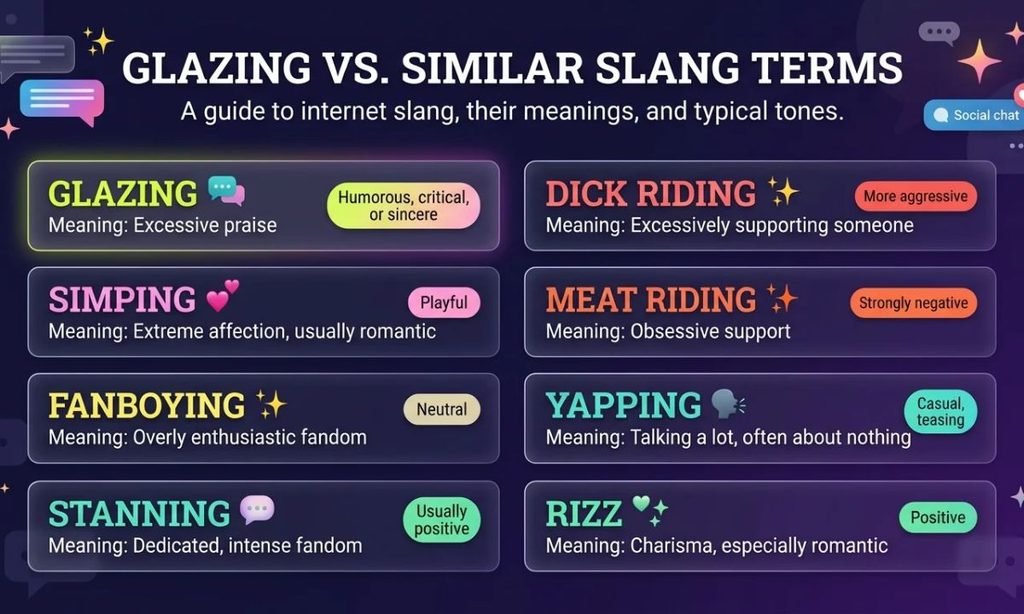
Plenty of slang overlaps with glazing, and the terms are easy to mix up. Here’s a side-by-side look.
| Term | Meaning | Tone |
| Glazing | Excessive praise | Humorous, critical, or sincere |
| Simping | Extreme affection, usually romantic | Playful |
| Fanboying | Overly enthusiastic fandom | Neutral |
| Stanning | Dedicated, intense fandom | Usually positive |
| Dick riding | Excessively supporting someone | More aggressive |
| Meat riding | Obsessive support | Strongly negative |
| Yapping | Talking a lot, often about nothing | Casual, teasing |
| Rizz | Charisma, especially romantic | Positive |
A quick heads-up: a couple of those terms are crude, so treat them as NSFW and keep them out of anything you’d say at work or in front of family.
The key difference is focus. Glazing targets over-the-top praise, while the others lean on loyalty, obsession, or romantic admiration. Support and fandom aren’t the problem. What matters is how far the praise drifts past reality.
A few of these deserve a closer look:
- Yapping is about the quantity of words. Glazing is about the content of them.
- Rizz is something you have. Glazing is something you do.
- Stan describes an extreme fan, and stanning often leads to glazing. But glazing doesn’t require stanning, and today it’s mostly positive, with intensity as its only leftover trace. And if you want the donut emoji treatment, that belongs to glazing alone.
- Simping involves strong admiration or affection, usually with romantic undertones. Glazing is praise in general.
Is Glazing the Same as Flirting?
Not really. Flirting involves romantic or sexual interest, while glazing is praise. There’s some overlap, since a flirty compliment is technically glazing, but most of it is platonic.
Is Glazing Positive or Negative?
It depends on context, and that’s the honest answer.
Positive or playful use: Among friends, someone might say, “Yeah, I’m glazing my favorite player today.” The tone is jokingly self-aware. Newer usage, like glazing a friend’s cooking or work, is warm and sincere.
Negative use: The word criticizes excessive admiration, as in “You’re glazing because you’re biased.”
Most of the time, the tone is mildly negative or teasing, and rarely cruel. So is glazing an insult? Not necessarily. It’s often said jokingly, but it can be real criticism if someone seems overly obsessed with praising a person. Pay attention to who’s speaking and how, because the same words can land very differently.
Is It Cringe to Glaze Someone?
Historically, yes, because the word was coined to call out cringe-level praise. Today’s use is mostly sincere. Complimenting a friend’s haircut is fine. Writing a paragraph of worship under every YouTuber’s comment might still count.
Can Men Glaze Each Other?
Yes, and it’s one of the term’s best contributions. It gave straight guys a way to say something nice to each other without it feeling awkward.
What’s the Opposite of Glazing?
Roasting, or hating. In GlazeTrain, when the content checker rejects a non-positive message, the error reads “Hating detected.”
Common Misunderstandings About Glazing
“Any compliment is glazing.” Not true. Calling someone a talented singer is a normal compliment. Saying she’s the greatest singer in human history and nobody can compare is glazing.
“It’s always negative.” Also wrong. People use it jokingly, like someone making fun of themselves for cheering on their favorite team.
“It’s only for celebrities.” Anyone can be the subject: athletes, streamers, influencers, friends, teachers, bosses, brands, and companies. Celebrities may get it most, but the label fits any person or team.
Why Glazing Became So Popular
Several things pushed the word forward:
- Social media culture rewards short, memorable words that go viral.
- Sports communities gave it daily use, since fans accuse each other of glazing favorite players all the time.
- Meme culture turned the word into a joke, and then the word itself became a joke.
- Influencer discussions and online debates, where fans and creators defend creators, made it a perfect fit.
Today it’s one of the most recognizable internet slang words around, and a word like that rarely stays niche.
When Should You Use Glazing, and When Should You Skip It?

When to Use It
Use it when someone is over-praising a celebrity, defending a person no matter what, exaggerating achievements, or acting like someone is perfect. Instead of saying “You’re praising him too much,” just say “You’re glazing.” It’s shorter, funnier, and fits how people talk online. I use it mostly with close friends, where a single word does the job of a whole sentence.
When to Avoid It
Skip it in professional emails, formal business settings, academic writing, and serious workplace discussions. It’s still popular online far more than anywhere else, and it just doesn’t fit those spaces. In formal situations, reach for alternatives like “excessive praise,” “overly complimentary,” “biased support,” or “uncritical admiration.”
Popular Sentences Using Glazing
These lines are common across social media:
- “The whole comment section is glazing.”
- “Bro is glazing for no reason.”
- “That’s elite-level glazing.”
- “Stop glazing and be objective.”
- “The fans are glazing again.”
- “You’re glazing way too hard.”
Each one works because it’s short and direct.
Pro Tips for Using Glazing Correctly
These come from watching people get it wrong:
- Know your audience. Older audiences may not recognize the word.
- Keep the tone light. That’s how most people use it.
- Don’t overuse it. Treating every compliment as glazing gets annoying fast, and people who genuinely admire someone deserve some slack.
- Understand the context first. Think before you make a glazing accusation.
- Use it naturally. “The comments are glazing him” sounds natural. “Glazing behavior” sounds stiff and awkward.
How GlazeTrain Reclaimed the Word
Here’s the theory behind the app GlazeTrain: every generation invents a word for hyping someone up because people want to do more of it and just need permission and vocabulary. Boomers had “props.” Millennials had “tea” and “queen.” Gen Z has glazing.
GlazeTrain takes the word at face value. Here’s how it works:
- You send Glazes to people, with an optional anonymous mode.
- Hype Level scoring runs from 1 to 5.
- Glaze Trains let several people pile onto one person.
- Glaze Battles pit two people against each other to write the best compliment.
Every message goes through a content checker before delivery. It filters out sarcasm and backhanded compliments, and it stops anyone from using anonymous mode as a back door for being mean.
The app is free on iOS and Android, with no ads, no subscriptions, and no catch. You can download it from the App Store or Google Play.
Is Glazing in the Dictionary Yet?
Slang dictionaries added the modern sense in 2024, and major dictionaries are catching up. The word has moved beyond internet talk and is now officially a word.
Final Thoughts
The glazing slang meaning comes down to this: giving someone excessive praise, admiration, and support, often more than they’d strictly earn. What started as a TikTok and gaming-chat tease has grown into a word that can mean either “you’re being a bit much” or “I think you’re great,” and the speaker’s tone tells you which.
Whether you’re scrolling TikTok, watching YouTube, debating sports, or chatting with friends on Discord, you’ll run into it regularly. Next time someone says “stop glazing,” you’ll know exactly what they mean. And if you feel like glazing someone yourself, be specific, be sincere, and watch how well it lands.
FAQs
What does glazing mean in slang?
Glazing means praising someone far more than the situation calls for. It’s usually aimed at a celebrity, athlete, or creator. The tone can be a teasing call-out or a sincere compliment, depending on who’s talking.
What does “stop glazing” mean?
It means “you’re praising this person way too much.” The speaker thinks you’re defending or hyping someone without being honest about their flaws. It’s usually said jokingly among friends.
What does glazing mean on TikTok?
On TikTok, glazing means exaggerated or biased praise, often in comment sections under a creator’s or celebrity’s videos. The meaning is the same as on other platforms. It’s just most visible in fan comments and reaction videos.
Where did the term glazing come from?
It comes from the idea of glazing a donut: a thick, sweet coating on top. Around 2022 to 2023, gaming communities and TikTok comedians started using it for coating someone in too many compliments. Sports Twitter helped it spread.
Is glazing an insult?
Not always. Among friends it’s usually a light tease, and newer usage is often warm and sincere. It can sting as criticism if you’re accused of being biased or obsessed with someone.
Is glazing positive or negative?
It depends on context. Older usage leans negative, calling out over-the-top fandom. Newer usage leans positive, like hyping up a friend’s work, cooking, or outfit.
What’s the difference between glazing and simping?
Glazing is excessive praise of any kind. Simping is strong admiration or affection, usually with romantic undertones. You can glaze a streamer without simping for them.
What’s the difference between glazing and stanning?
Stanning means being an extreme, dedicated fan. Glazing is the act of piling on praise, which stanning often leads to. You can glaze without being a stan.
Is glazing the same as flirting?
No. Flirting involves romantic or sexual interest, while glazing is praise. A flirty compliment can technically be glazing, but most glazing is platonic.
Is it cringe to glaze someone?
It used to be, since the word was coined to call out cringe-level praise. Today, complimenting a friend sincerely is fine. Writing paragraphs of worship under every creator’s post may still get side-eyed.
Can guys glaze each other?
Yes. Glazing gave guys an easy way to say something nice to each other without it feeling awkward. It’s now common in friend groups and group chats.
What is the opposite of glazing?
Roasting or hating. Where glazing is over-the-top praise, hating is negativity toward someone. Apps built around glazing, like GlazeTrain, even flag non-positive messages with a “Hating detected” error.
Can you use glazing at work or in school?
Skip it in professional emails, formal writing, and serious workplace talk. Use phrases like “excessive praise” or “uncritical admiration” instead. Save “glazing” for casual chats with friends.
Is glazing in the dictionary?
Slang dictionaries added the modern sense in 2024, and major dictionaries are catching up. It has moved beyond internet talk and is now officially a word.
What is GlazeTrain?
GlazeTrain is a free app for iOS and Android built around glazing. You send compliments with optional anonymity and Hype Level scores from 1 to 5. It has no ads or subscriptions.
