

Picture this. A friend texts, “ion care, you pick,” and you spend a few seconds wondering what chemistry has to do with dinner. Nothing, as it turns out.
Plenty of people first meet this word on TikTok, in a comment that makes no sense until the second read. Then it starts showing up everywhere: Snapchat chats, Instagram captions, memes, gaming lobbies, group texts. This guide covers the ion meaning in text, where it came from, how to read it, and when to leave it out of your own messages.
Quick Answer: What Does Ion Mean in Text?
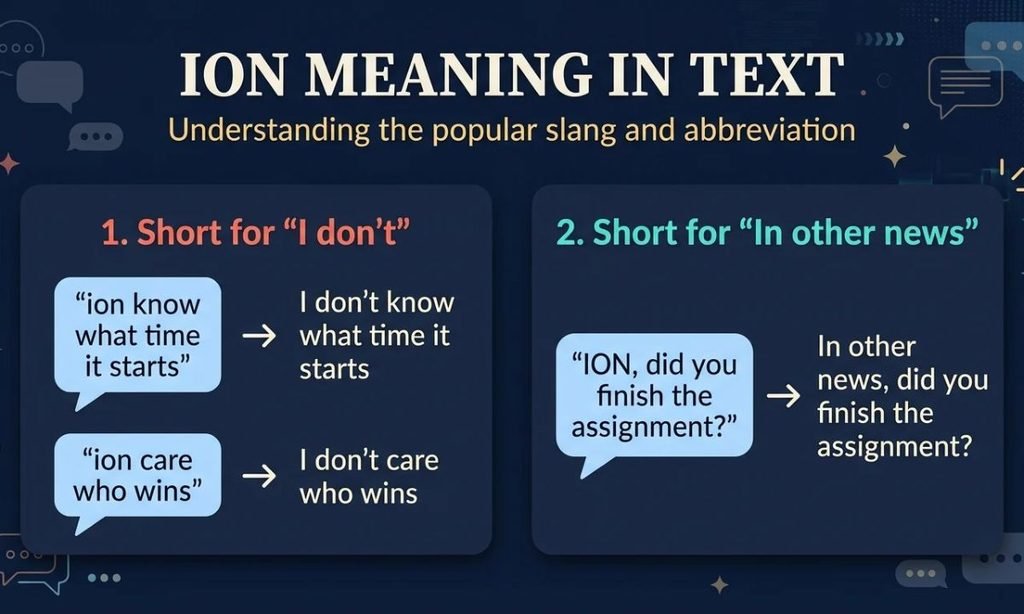
Ion in text is slang for “I don’t.” It’s a phonetic spelling that shortens two words into one. Less often, ION (usually capitalized and followed by a comma) stands for “In Other News,” a phrase that signals a change of subject.
The sentence around it tells you which one you’re reading:
| Example | Meaning |
| “ion know what time it starts” | I don’t know what time it starts |
| “ion care who wins” | I don’t care who wins |
| “ION, did you finish the assignment?” | In other news, did you finish the assignment? |
That’s the whole trick. The three letters are simple, but the two meanings are the only real trap.
The Two Meanings of Ion in Texting
Tone and sentence structure decide which reading is right. In “ion know,” the slang stands in for “I don’t know.” In “ION, the game tonight was wild,” it opens a brand-new subject. Informal language like this exists so people can type faster on social media and messaging apps, and ion sits comfortably next to other popular abbreviations.
Ion as “I Don’t”
This is the dominant meaning by a wide margin. It goes wherever “I don’t” would naturally go in a sentence, and the rest of the sentence stays standard. When someone asks, “Are you going to the game tonight?” and you answer, “ion really feel like it tbh,” you’ve said “I don’t really feel like it, to be honest.”
The tone is relaxed and quick. You’ll see it on TikTok, Snapchat, Discord, Instagram, Twitter/X, WhatsApp and in gaming chats. Lines like “ion like that movie,” “ion care anymore” and “ion even know him” all work the same way. Ion simply replaces words you’d otherwise type out.
Here are the phrases you’ll run into most often:
- ion know: “I don’t know,” as in “ion know what to eat rn” (right now).
- ion care: “I don’t care.”
- ion think so: “I don’t think so.”
- ion even: “I don’t even,” as in “ion even know where to start.”
- ion wanna: “I don’t want to.”
- ion fw that: “I don’t f*ck with that,” a blunt way to say you want no part of something.
Each one means exactly what its spelled-out version means. It just reads faster.
Ion as “In Other News”
This is the smaller bucket. Here the term works as a transition, a way of moving the conversation somewhere new. Say two people have just finished dissecting some drama, and one of them writes, “Anyway, that’s all about that. ION, did you see what happened last night?” That one word turns the whole conversation.
Other examples look like “ION, school starts next week” or “ION, my exams are next week.” You can also use it to ask about a new update or a movie. It does the same job as “anyway” or “by the way,” just in three letters.
This reading isn’t new, either. “In Other News” showed up in journalism and online forums long before chat apps picked it up.
How to Tell the Two Meanings Apart
Capitalization helps. Lowercase “ion” in the middle of a sentence is almost always “I don’t,” while uppercase ION at the start of a message usually means “In Other News.” But people type in all caps for plenty of reasons, so don’t rely on it alone. Two other clues are more dependable:
- Position. If it opens a new topic, it’s “In Other News.” If it sits before a verb, it’s “I don’t.”
- The comma. A comma right after ION is usually the giveaway for a topic change.
If you’re still stuck, read the line out loud. Context almost always settles it.
Ion Full Form and Definition
The full form depends on the reading, but the definition most people mean is “I don’t.” The slang drops the apostrophe and merges two words into one three-letter chunk. That makes typing quicker, which is a big part of why younger users love it.
Where Does Ion Slang Come From?
Ion has its roots in African American Vernacular English, or AAVE. AAVE is a well-documented dialect of American English with its own grammar, vocabulary and pronunciation patterns. The Linguistic Society of America has long affirmed that it is systematic and rule-governed, like every natural speech variety. When “I don’t” is spoken quickly, it blends into one flowing sound, close to “eye-on.” Someone wrote it down the way it sounds, and everyday speech turned into digital slang.
So yes, ion originates from AAVE. Like a lot of AAVE, it spread into mainstream digital culture through hip-hop, youth culture, social media and TikTok. Gen Z carried it the rest of the way into everyday texting.
This is a familiar pattern in digital language, where formal spelling gives way to how people actually talk:
- “going to” becomes gonna
- “want to” becomes wanna
- “out of” becomes outta
- “I don’t” becomes ion
All four are the same move. You write what the mouth does. Internet users also popularized the shortened spelling in the same way they did with IDK, TBH, NGL and IMO.
Ion Meaning in Slang vs. the Traditional Meaning
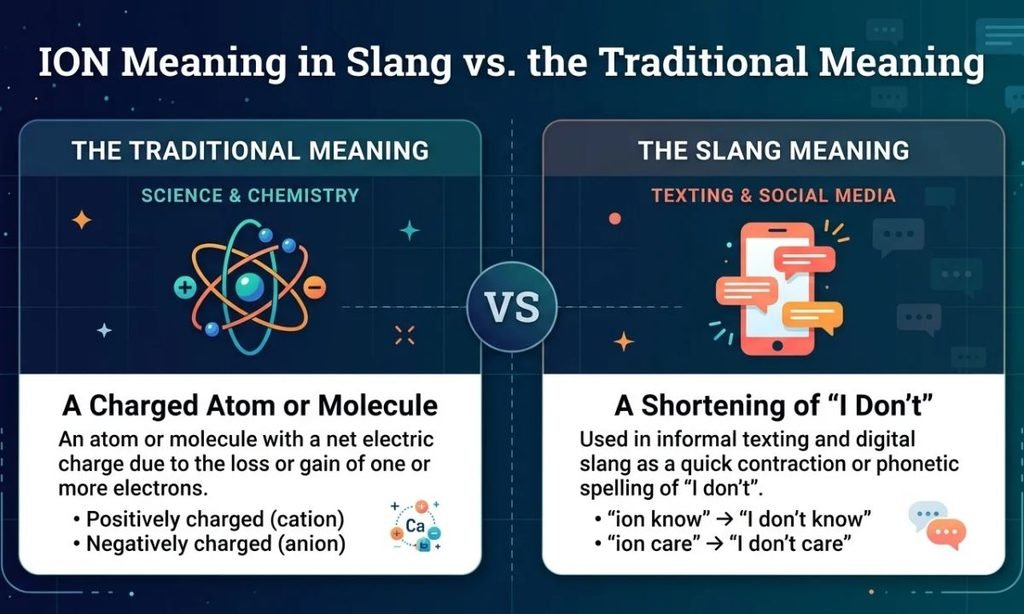
There’s also a traditional meaning with no link to texting. In science, an ion is an electrically charged atom or molecule, like a positive ion or a negative ion. Capital or lowercase letters won’t help you here, because context decides. In a chat message, nobody is talking chemistry.
Is Ion Rude, Offensive or Neutral?
Ion is neutral slang. It fits casual texting, friendly conversations, online comments and social media captions. It isn’t a bad word, and only the words after it can make it sound harsh.
The rude part comes from what follows. “ion wanna talk” can sound dismissive or cold. “ion care what they think” depends heavily on tone and on the relationship between the two people. I’ve seen the same line read as a joke between friends and as a slap between strangers.
Is it safe for social media? Yes. It’s harmless, and most people won’t take offense. The risk is being aggressive with it, so know your audience. “ion understand this trend” sounds fine. “ion care about your opinion” can land as an insult.
Where Is Ion Commonly Used?
Ion shows up wherever digital communication is fast, especially among younger internet users. What I notice is that the platform barely matters. Wherever people type quickly and informally, ion fits.
| Platform | How ion shows up |
| TikTok | Comments, captions and video replies. “ion know” and “ion fw that” are among the most common. |
| DMs, comments, story replies and captions | |
| Snapchat | Snaps and quick chat messages, mostly as “I don’t” |
| Twitter/X | Casual tweets and replies |
| WhatsApp and Messenger | Group chats and personal threads |
| Comments | |
| Gaming chats and Discord | Live match chatter, where short typing wins |
| Memes and reaction posts | Captions and online humor |
TikTok has the strongest AAVE-influenced slang culture and a big Gen Z audience, so it’s where you’ll see the widest range of ion phrases.
Why People Use Ion Slang
There are three simple reasons. It’s faster to type, it feels current, and it signals that you belong to certain internet communities. Quick conversations favor it, and it brings a relaxed tone. “ion think that’s true” sounds more casual than the full sentence, and that informal tone is the whole appeal.
Real-Life Examples of Ion in Conversations
Examples make the tone easier to feel. Here’s how ion sounds in different settings:
- Friendly: “ion wanna miss the party tonight.”
- Casual: “ion know what time it starts.”
- Argumentative: “ion got time for drama.”
- Gaming: “ion lagging today” or “ion got enough coins for that skin.”
- Social media: “ion think this update is good” or “ion think this song is bad honestly.”
- Topic change: “ION, have you seen the latest movie?”
And here’s how a short exchange might play out:
Person A: Are you coming tonight?
Person B: ion know yet, maybe later.
Person A: Cool. ION, did you finish the assignment?
The first reply is “I don’t.” The second line from Person A changes the subject, so it’s “In Other News.”
A couple of practical samples from everyday life:
- A friend asks, “Do you know when the party starts?” You reply, “ion know, check the group chat.” That’s four words for “I don’t know.”
- The same trick turns “I don’t care” into “ion care.” After a few times in casual texting, it stops looking strange and starts looking efficient.
Ion vs. IDK: What Is the Difference?
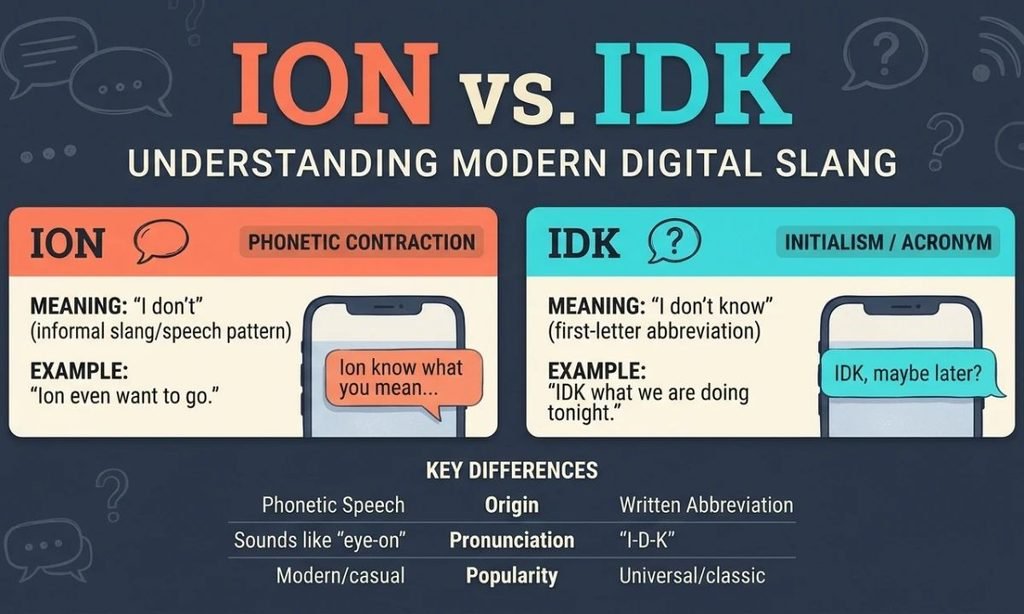
Both express not knowing something, and both come from “I don’t know,” so the full form is the same. The difference is tone and reach.
IDK is neutral and universal. Every demographic and age group understands it, and lowercase “idk” is just the casual version. “Ion know” is more conversational and AAVE-rooted, and it belongs to a culturally specific digital register. Someone who uses it sounds relaxed and fluent in that online style.
If you want the option nobody will puzzle over, IDK is safer. If you want the energy of real speech, ion is closer. Ion is also broader, because it can sit in front of many different verbs, while IDK covers just one phrase.
Ion Compared With Similar Slang Terms
Several abbreviations live in the same space as ion, each with its own style:
| Slang | Meaning | Typical use |
| IDK | I don’t know | Neutral, universal not-knowing |
| IMO | In my opinion | Sharing a view |
| TBH | To be honest | Casual honesty |
| NGL | Not gonna lie | Casual honesty |
| FR | For real | Agreement or emphasis |
| SMH | Shaking my head | Disappointment |
Related Slang for “I Don’t” and Topic Changes
If you like decoding texts, these relatives are worth knowing.
Similar to “I don’t” and related shorthand:
- IDC: I don’t care
- IKR: I know, right
- IMK: In my knowledge
- NVM: Never mind
Similar to “In Other News”:
- BTW: By the way
- “Anyway”
- “Speaking of that”
- “On another note”
Want to keep decoding? Our guide to FWM meaning covers another abbreviation you’re likely to spot in the same cha
What Is GNG? A Slang Term You’ll See Next to Ion
While researching ion, I kept noticing “GNG” turning up right beside it. It’s short for “gang,” and it means close friends or your crew. It started mostly as street slang in the US and UK.
It has since gone global. In Pakistan, India and the rest of South Asia, it appears in Instagram comments to show hype, friendship and online bonding. Among Gen Z worldwide it means “my people” or “my circle,” and in gaming it covers squad members and teammates. Overall, it signals unity and community identity.
When Should You Avoid Using Ion?
Skip it in professional emails, job applications, academic writing, formal business communication and customer service messages. It reads as unprofessional, and anyone who doesn’t know the slang may not understand it. School assignments, official documents and anything formal call for standard English, full stop.
My rule is simple: check the context before typing it. If I wouldn’t say it out loud to that reader in that way, I don’t write it informally either.
Where ion works well:
- Texting close friends
- Group chats and DMs
- Instagram, TikTok or Snapchat messages
- Spaces where everyone is already using Gen Z slang
“ion even want to think about it rn” is perfectly at home in those places.
Polite and Professional Alternatives to Ion
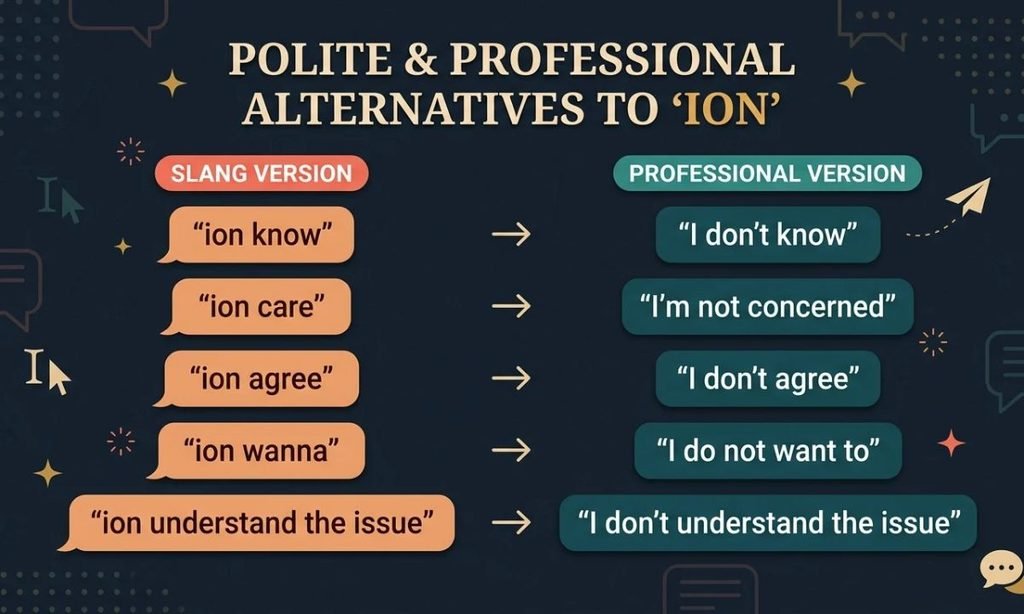
When you want to sound respectful or professional, swap the slang for plain wording. The result is clearer communication.
| Slang version | Professional version |
| ion know | I don’t know |
| ion care | I’m not concerned |
| ion agree | I don’t agree |
| ion wanna | I do not want to |
| “ion understand the issue” | “I don’t understand the issue” |
The Impact of Slang on Everyday Communication
Slang cuts both ways. On the plus side, it speeds up conversations, adds expression, builds online community culture and makes casual interaction easy. On the downside, it can confuse older readers, come across as rude, and look out of place in formal settings. Context always decides which side wins.
Final Thoughts
Ion is a fast, phonetic slang abbreviation that grew out of natural speech and spread through digital culture. Most of the time it means “I don’t,” and now and then, usually with a comma, it means “In Other News.” The ion meaning in text is easy to pin down once you watch where the word sits in a sentence.
It’s harmless in most cases, but watch your audience and your tone. Keep it in texts, comments and chats between friends, and switch to clear standard English when the setting turns formal. And now that you know what it means, ion think you’ll be confused by it again.
FAQs
What does “ion” mean in text?
In text, “ion” is slang for “I don’t.” It’s a phonetic spelling that merges two words into one, as in “ion know” (I don’t know) or “ion care” (I don’t care). Less often, capitalized ION means “In Other News.”
What does “ion know” mean?
“Ion know” means “I don’t know.” It’s the most common way people use the slang, and it works exactly like “idk” in a casual chat.
What does ION mean on TikTok?
On TikTok, ION almost always means “I don’t.” You’ll see it in comments, captions and video replies, often as “ion know” or “ion fw that.”
What does ION mean on Snapchat?
On Snapchat, ION mostly means “I don’t.” It appears in quick snaps and chat messages. If a comma follows it at the start of a message, it likely means “In Other News.”
Can ION mean “In Other News”?
Yes. When ION opens a new topic, usually followed by a comma, it means “In Other News.” For example: “ION, did you finish the assignment?”
How can I tell if ion means “I don’t” or “In Other News”?
Check its position in the sentence. If it sits before a verb, like “ion care,” it means “I don’t.” If it starts a message and introduces a new subject, it means “In Other News.”
What does “ion fw that” mean?
“Ion fw that” means “I don’t f*ck with that.” It’s a blunt way of saying you want no part of something, so keep it for casual chats with friends.
Is “ion” a bad word or rude slang?
No, “ion” is neutral slang. It only sounds harsh because of what follows it. “Ion wanna talk” can come across as cold, depending on tone and who you’re texting.
Is “ion” Black slang or AAVE?
Ion has its roots in African American Vernacular English (AAVE), a recognized dialect of American English. Like much AAVE, it spread into mainstream digital culture through hip-hop, TikTok and social media.
Where does the slang “ion” come from?
It comes from how “I don’t” sounds when spoken fast, close to “eye-on.” Someone typed it the way it sounds, and social media and Gen Z spread it widely.
What is the difference between “ion” and “idk”?
Both come from “I don’t know,” but they differ in tone. “Idk” is neutral and understood by all ages. “Ion know” is more conversational and AAVE-rooted, and “ion” can sit before many verbs, not just “know.”
Does “ion” have anything to do with chemistry?
Only in science class. In chemistry, an ion is an electrically charged atom or molecule. In a text message, it’s slang, and context makes that obvious.
Is it okay to use “ion” in emails or at work?
No. Avoid it in professional emails, job applications, school assignments and formal writing. Use plain wording like “I don’t know” instead.
What are professional alternatives to “ion”?
Swap “ion know” for “I don’t know,” “ion care” for “I’m not concerned,” and “ion wanna” for “I do not want to.” Clear, standard English is always safer in formal settings.
What does GNG mean in text?
GNG is short for “gang,” meaning close friends or your crew. It started as US and UK street slang and now appears worldwide in Instagram comments and gaming chats.
What are other slang terms similar to “ion”?
Related terms include IDK (I don’t know), IDC (I don’t care), NVM (never mind), TBH (to be honest) and NGL (not gonna lie). For topic changes, BTW (by the way) does a similar job to “In Other News.”
