

I first ran into IDW in a friend’s message at about 11 p.m., and I honestly assumed it was a typo. If you landed here after a quick search, you probably had the same reaction. The IDW meaning in text is simple once you see it: it stands for “I Don’t Want.”
That’s the quick answer. The longer answer is where it gets interesting, because three letters can sound relaxed, blunt, playful, or dismissive depending on who sends them. This guide covers what the term means, where it came from, how to read it without misjudging the sender, and how to reply. I’ll also share a few things I’ve learned from using it and watching others use it in group chats over the past couple of years.
IDW Meaning in Text: The Quick Answer
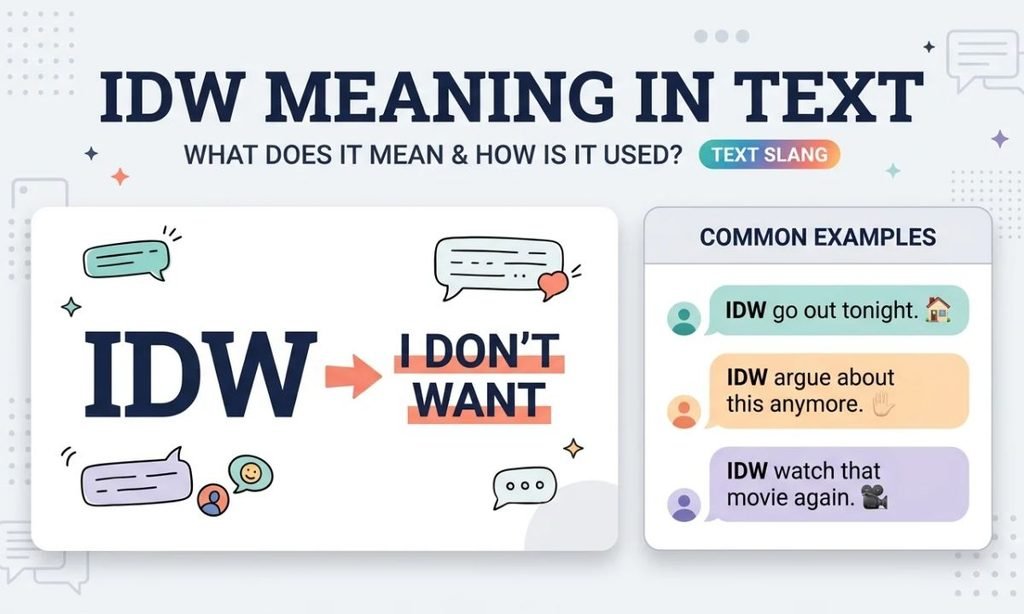
IDW means “I Don’t Want.” It’s a short way to signal a lack of interest, a refusal, or plain unwillingness. You’ll see it in texting, WhatsApp chats, Instagram messages, and TikTok comments.
Think of it as a verbal shrug turned into text. The simple definition is a person saying “I don’t feel like doing this” in three letters. It skips the explanation, and that’s the whole appeal in digital communication, where brevity wins and acronyms pack sentiments into a few keystrokes.
Here are a few example text messages:
- “IDW go out tonight.”
- “IDW argue about this anymore.”
- “IDW watch that movie again.”
The first usually means the sender is tired. The second is more blunt and direct. The abbreviation itself carries no tone at all. Tone is the whole difference, and you have to pull it from the context.
Why IDW Confuses People
Short internet abbreviations can feel confusing. A single message can leave you uncertain whether the sender is being dismissive or just casual. Even sites that sell degrees or language courses, such as Find Media Degrees or Learn a Language, sit beside slang guides like this one, because people keep searching for what these short forms mean. The good news is that IDW is quick, honest, and rarely mysterious once you see it in context.
What Does IDW Stand For? The Definition Explained
IDW is an acronym for “I Don’t Want.” It delivers a clear, direct message about a lack of desire or preference. There’s no decoration, and that straightforwardness is the point.
Three traits explain how it behaves:
- Direct communication: You use it when you need to say you’re not wanting something, with no hedging.
- Contextual relevance: It fits many situations, from declining offers to expressing disinterest in a particular activity.
- Informality: It belongs in informal digital conversations, where brevity is valued and nobody expects full sentences.
Here’s a quick reference:
| Aspect | IDW Acronym |
| Meaning | Conveys “I Don’t Want,” indicating a lack of desire or preference |
| Usage | Informal, suitable for various digital communication contexts |
| Core strength | Clear, unambiguous expression of preference |
Where Did IDW Come From?
IDW belongs to the family of internet shorthand that grew out of SMS texting in the late 1990s and early 2000s. A character space limit and the sheer typing effort of phone keypads pushed people to compress everything. That gave us LOL (Laughing Out Loud), BRB (Be Right Back), and IDK (I Don’t Know). IDW follows the same pattern, simply swapping “know” for “want.”
How Messaging Apps Pushed It Forward
Then came Snapchat, WhatsApp, Instagram DMs, and TikTok comments. The influence of messaging apps made short expressions even more natural, because quick responses became the norm in fast-paced chat environments.
Younger internet users picked IDW up for moments like:
- Feeling lazy
- Avoiding a plan
- Declining an invitation
- Expressing disinterest without writing a paragraph
IDW Examples in Real Conversations
Natural conversations show this better than any definition. Here are three I’ve seen versions of.
WhatsApp chat. Person A asks if Person B is heading to the gym. Person B writes, “Honestly IDW go today, I’m exhausted.” Person A replies, “Fair enough, rest day then.”
Instagram DM. Person A suggests another TikTok video. Person B answers, “IDW do that trend again 😂”. Person A shrugs it off with, “Okay okay we’ll try something new.”
Text message conversation. Person A asks, “Want to join us for dinner?” Person B writes, “IDW go out tonight. Maybe tomorrow.” Person A says, “No problem!”
Nobody gets offended in any of these. IDW usually flags a personal preference and isn’t aggressive.
Polite Examples You Can Copy
Two more examples show how to stay warm while using it.
“Thanks for the coffee offer, but IDW. I already had my morning cup.” The context is declining an offer. The purpose is expressing gratitude while politely declining. Coffee is a harmless topic, and the “thanks” up front keeps the tone friendly.
“IDW to go out tonight. Just want a quiet evening at home.” Here the sender is expressing disinterest and communicating a preference for a quiet night in over going out. I’ve sent messages almost exactly like this, and friends have never taken offense, because the reason follows right behind the acronym.
The Emotional Meaning Behind IDW
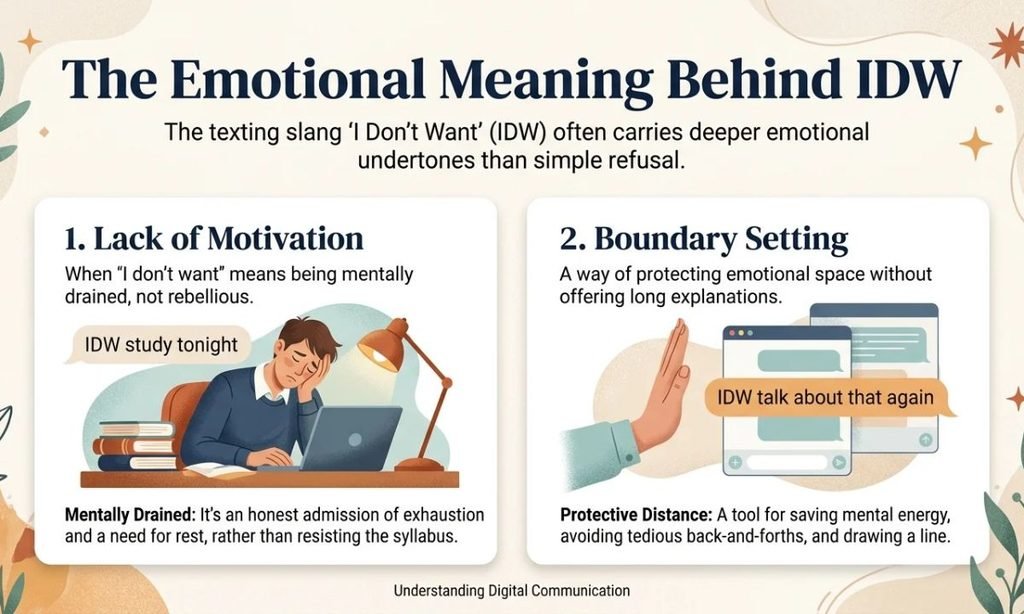
Three letters can still send emotional signals. A few themes come up again and again.
Lack of motivation. “IDW study tonight” usually means the person is mentally drained, not rebelling against the syllabus.
Boundary setting. Saying “IDW talk about that again” is a way of protecting emotional space without offering long explanations. I’ve used it this way myself, and it saved me a tedious back-and-forth.
Casual honesty. In close friendships, comfort breeds bluntness. “IDW watch horror movies” is a harmless preference with no negative intention behind it.
Avoidance. Occasionally the message hints that someone would rather not confront a situation, as in “IDW deal with drama today.” Tone and relationship context are what you need when interpreting that one.
How IDW Changes by Context
The same three letters can land very differently depending on where they appear.
Social Media
On social media, IDW often shows up in comments, replies, direct messages, and captions as playful reluctance. Something like “IDW grow up 😭” under a post about a childhood show is a joke, not a refusal.
Friends and Relationships
Among friends, it leans honest. “IDW go to that party” or “IDW wake up early tomorrow” reads as normal. With a partner, though, “IDW talk right now” can sound dismissive, or it may simply mean the person needs space. Context decides.
Work and Professional Settings
At work, skip it. Professional settings call for polite, complete sentences. Instead of “IDW do that task,” try “I’m unable to take that task right now.”
Casual vs. Serious Tone
The gap between casual and serious tone is real. “IDW cook tonight” is lighthearted. “IDW continue this discussion” is firm. Same acronym, very different weight.
IDW Across Platforms
Usage across platforms differs in small ways. On social media, it appears as a quick way to show a lack of interest. In messaging apps, it turns up in one-on-one chats and group chats, where quick communication is the whole appeal. The platform sets the pace, and the audience sets the tone.
Common Mistakes When Reading IDW
Plenty of people misunderstand IDW the first time they see it. The usual mistakes:
- Reading it as “I don’t worry.” That’s incorrect in almost every online exchange.
- Assuming it’s automatically rude. It can be blunt, but the relationship between the speakers, the message context, and the conversation history all shape how it lands.
- Using it in formal situations. Internet slang in emails looks unprofessional. “IDW attend the meeting” would raise eyebrows, and clear language is always safer in professional environments.
Is IDW Rude? Politeness and Clarity
Politeness is the part people get wrong. IDW is direct, but it can be used politely to communicate preferences without offending anyone. A thank-you, a short reason, or a friendly emoji does the work.
The second strength is clarity. The straightforwardness of IDW gives an unambiguous expression of your desires, so the other person never has to guess whether you’re secretly interested. That’s a real kindness in a world of vague “maybe” replies.
IDW vs. IDK, IDC, NVM and Other Abbreviations
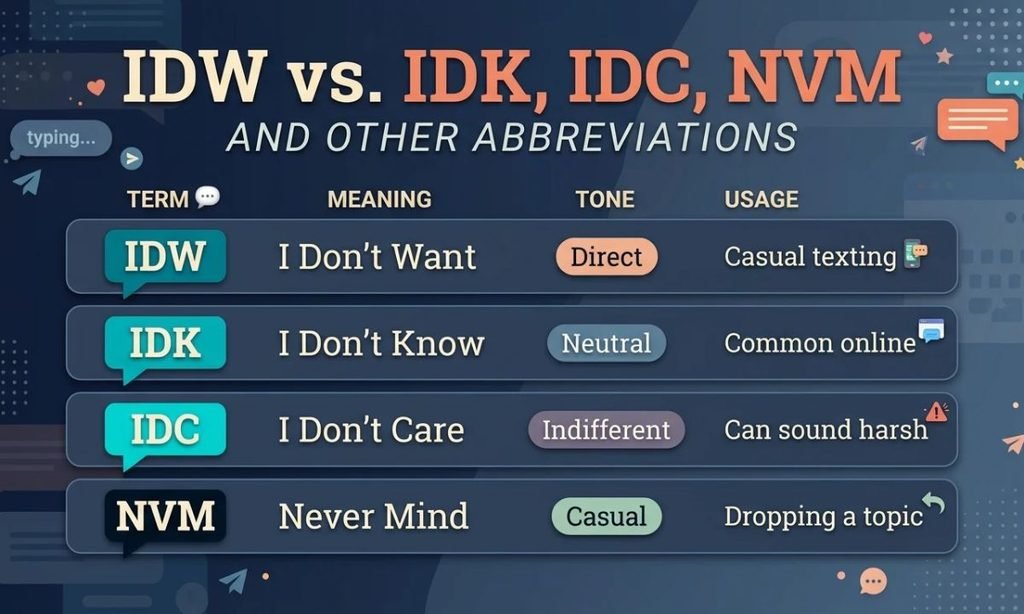
IDW has neighbors, and knowing the differences keeps you from mixing them up.
| Term | Meaning | Tone | Usage |
| IDW | I Don’t Want | Direct | Casual texting |
| IDK | I Don’t Know | Neutral | Common online |
| IDC | I Don’t Care | Indifferent | Can sound harsh |
| NVM | Never Mind | Casual | Dropping a topic |
| Sure | Agreement | Positive | Accepting plans |
The key insight: IDW expresses refusal, while IDC leans negative because it signals detachment. Both depend on tone, usage, and interpretation.
Similar and Related Expressions
IDW has a whole set of related expressions:
- IDWTT (I Don’t Want To Talk): the sender wants silence or space.
- IDWK (I Don’t Want to Know): avoidance of information.
- IDWM (I Don’t Want More): often used jokingly.
- IDWR (I Don’t Want Responsibility): used humorously for avoiding tasks.
- DW (Don’t Worry): a positive expression, and a much friendlier one.
- IDC (I Don’t Care): emotionally detached.
- IDTS (I Don’t Think So): polite disagreement.
- NTY (No Thank You): a polite alternative when you want to decline.
- Meh and Pass: ways of declining casually or showing a lack of interest.
Look-Alike Acronyms to Avoid Confusing
Two other acronyms are worth knowing so they don’t trip you up:
- WRYD stands for What Are You Doing. It’s an acronym inquiring about someone’s current activity or plans.
- SLAT means Slime Love All the Time, a phrase signaling constant, unwavering love within a community.
Some abbreviations go even further and change meaning completely depending on where you see them. “PT” is the classic case. It can mean physical therapy, part-time, Pacific Time, and more. If that one has ever thrown you off, this PT meaning guide breaks down every common use and how to tell which one fits.
How to Respond When Someone Uses IDW
Your reply depends on the situation, but here is what has worked for me.
- Casual replies: “No worries!”, “That’s okay,” or “Maybe another time.”
- Funny replies: “Too late, you’re already coming 😂” or “IDW accept that answer.”
- Mature and confident replies: “I understand,” “Let’s plan another day,” or “Thanks for letting me know.”
- Respectful and private replies: “Take your time” or “If you change your mind, let me know.”
Any of these keeps positive communication going and leaves the other person free to say no.
Is It Okay to Use IDW? Appropriateness and Guidance
Direct communication works best when directness is appreciated, such as among close friends or in fast group threads. In those spaces, expressing preferences this plainly saves everyone time.
With people you know less well, add a considerate tone. Staying straightforward while softening the delivery keeps a positive communication atmosphere. A simple checklist helps:
- Is this a close friend or a casual group chat? IDW is fine.
- Is it a coworker, boss, or client? Use a full sentence.
- Could it read as cold? Add a thank-you or a reason.
- Is the topic emotional? Consider a short explanation instead.
Appropriateness comes down to reading the room before you hit send.
IDW Across Cultures and Regions
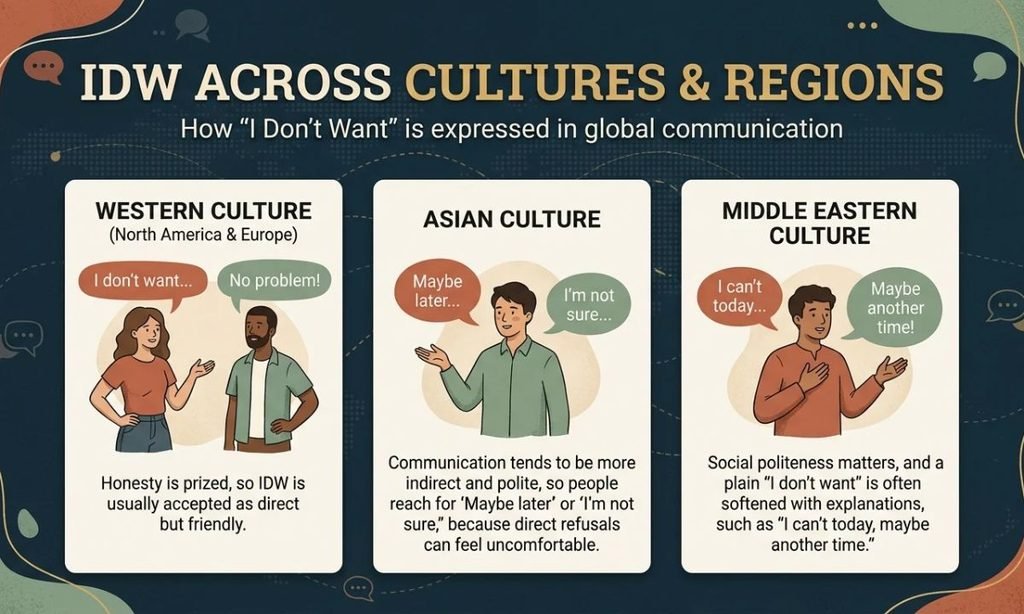
Internet slang is global, but culture still colors interpretation.
- Western culture (North America and Europe): Honesty is prized, so IDW is usually accepted as direct but friendly.
- Asian culture: Communication tends to be more indirect and polite, so people reach for “Maybe later” or “I’m not sure,” because direct refusals can feel uncomfortable.
- Middle Eastern culture: Social politeness matters, and a plain “I don’t want” is often softened with explanations, such as “I can’t today, maybe another time.”
Even so, global internet usage has created a shared global slang culture. Online platforms spread terms like IDW fast, and younger internet users worldwide find them widely understood.
How Common Is IDW?
It’s moderately common, mainly among people who like short internet abbreviations. “I Don’t Want” is the dominant meaning, and other meanings are rare. You’ll mostly see it in text messages, social media chats, and other informal conversations. Stick to complete sentences and polite language in professional messages.
Final Thoughts on IDW
IDW is a quick, casual way to voice a preference, a refusal, or a lack of interest in digital conversations. Its tone depends on context, relationship, and timing. Among friends, it sounds honest and relaxed. In formal situations, full sentences are still the better choice.
Messaging culture keeps evolving, but everyday communication will keep leaning on shortcuts like this one. Now that you can recognize it, you’ll spot it in group chats and social media comments, and you’ll know when a thoughtful reply is worth more than a quick one. Understanding it makes online conversations much easier to follow.
FAQs
What does IDW mean in text?
IDW means “I Don’t Want.” It’s a quick way to say you’re not interested in something or don’t feel like doing it. You’ll mostly see it in texts, WhatsApp chats, Instagram DMs, and TikTok comments.
What does IDW stand for on social media?
On social media, IDW stands for “I Don’t Want.” People use it in comments, replies, and captions to show a lack of interest. It’s often playful, like “IDW grow up 😭” under a post about a childhood show.
Is IDW rude to send in a text?
Not by default. IDW is direct, but tone and your relationship with the person decide how it lands. Adding a thank-you or a short reason keeps it friendly.
How do you reply when someone texts IDW?
Match the mood of the message. A simple “No worries!” or “Maybe another time” works for most situations. If the person seems upset, try “I understand” or “Take your time.”
What is the difference between IDW and IDC?
IDW means “I Don’t Want” and states a personal preference. IDC means “I Don’t Care” and signals indifference. IDC usually sounds colder and more negative.
Is IDW the same as IDK?
No. IDK means “I Don’t Know,” while IDW means “I Don’t Want.” They look similar, but one shows uncertainty and the other shows refusal.
Does IDW ever mean “I don’t worry”?
In almost every online conversation, no. Some people guess that meaning, but it’s incorrect. If you want to say “don’t worry,” the common abbreviation is DW.
Can I use IDW in an email or at work?
It’s best to avoid it. Professional settings call for complete, polite sentences. Try “I’m unable to take that task right now” instead.
Where did the abbreviation IDW come from?
IDW comes from internet shorthand that grew out of SMS texting in the late 1990s and early 2000s. Character limits pushed people to shorten phrases, giving us LOL, BRB, and IDK. IDW follows the same pattern.
How can I say IDW politely?
Start with a thank-you, then add a short reason. For example: “Thanks for the offer, but IDW. I already had my morning cup.” A friendly emoji can also soften the tone.
What do IDWTT, IDWK, and IDWM mean?
IDWTT means “I Don’t Want To Talk,” IDWK means “I Don’t Want to Know,” and IDWM means “I Don’t Want More.” They’re variations of IDW with a more specific focus.
Is IDW popular slang in the US?
It’s moderately common, especially among younger people who use short internet abbreviations. It appears most in casual texts, group chats, and social media. It isn’t as widespread as IDK or LOL.
What is a polite alternative to IDW?
NTY (“No Thank You”) is a gentle option for declining. You can also say “Maybe later” or “I’ll pass.” All three keep the message warm without a long explanation.
