

You’re reading an email, a job posting, or a bank’s website, and there it is: “SME.” Does it mean a company? A person? Both?
Here’s the quick answer. SME meaning depends on context. In business and finance, SME stands for small and medium-sized enterprise. In jobs, projects, and tech, SME stands for subject matter expert. Same three letters, two very different ideas.
This guide walks through both definitions, shows how the meaning of SME shifts from banking to IT to project management, and gives you simple ways to tell which one is meant. We’ll also cover the question people ask about texting and slang.
What Does SME Stand For?
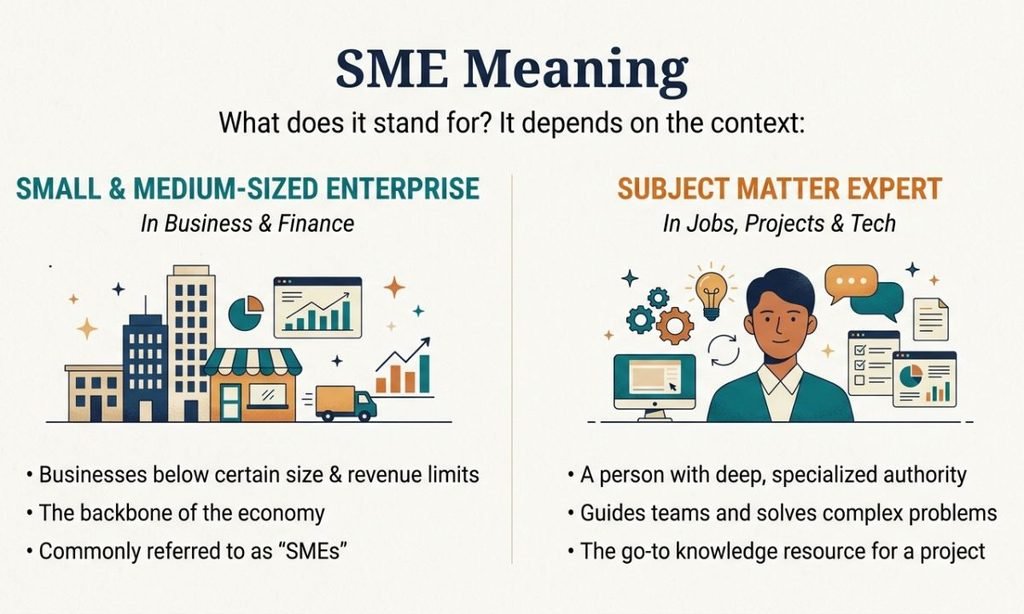
SME is an abbreviation with two common expansions:
| Acronym | Full Form | Refers To | Where You’ll See It |
| SME | Small and Medium-sized Enterprise | A type of company | Business news, banking, government, insurance |
| SME | Subject Matter Expert | A type of person | Job postings, IT, training, project teams |
People search “what is the meaning of SME” or “the meaning of SME” because both versions are everywhere. Neither is wrong. You just need the surrounding words to tell them apart.
A Fast Way to Tell Which SME Is Meant
Look at what the word is attached to:
- Talks about loans, owners, customers, markets, or sectors? It’s the company type.
- Talks about a role, a review, a workshop, or “our SME”? It’s the expert.
- Says “SME lending” or “SME insurance”? Company type.
- Says “consult the SME” or “SME input needed”? Expert.
SME Meaning in Business: Small and Medium-Sized Enterprise
When someone asks for the SME business meaning, this is usually what they’re after. An SME is a company that falls below certain limits for headcount and revenue. It’s bigger than a tiny startup or a one-person shop, but far smaller than a corporation.
SME companies are often called the backbone of the economy. They employ a huge share of workers, supply larger firms, and keep local markets running.
How Big Is an SME?
There’s no single worldwide definition. Each region sets its own thresholds. The European Commission’s official SME definition is one of the most widely referenced.
| Region | Typical SME Definition |
| European Union | Fewer than 250 employees, plus turnover up to about €50 million or a balance sheet up to about €43 million |
| United Kingdom | Generally fewer than 250 employees (similar to the EU approach) |
| United States | No official “SME” label; the SBA sets size standards by industry, often 500 employees or fewer for manufacturing and many other sectors |
The EU breaks it down further:
| Category | Employees | Annual Turnover (approx.) |
| Micro | Under 10 | Up to €2 million |
| Small | Under 50 | Up to €10 million |
| Medium | Under 250 | Up to €50 million |
Why Americans Hear “SME” Less Often
In the U.S., most people just say “small business.” The Small Business Administration (SBA) uses that language, and it estimates that there are more than 33 million small businesses in the country. You’ll still run into SME when reading international news, dealing with global banks, or working with overseas partners.
SME Company, SME Sector, and SME Market: Same Idea
You’ll see a lot of phrasing built around the same definition:
- SME company or SME firm: one business that qualifies.
- SME sector or SME industry: all such businesses together.
- SME market: the group of customers a bank, software vendor, or insurer sells to.
- SME owners: the founders and managers running these businesses.
- SME customers or clients: companies of this size buying a product or service.
For example, a payroll software firm might say, “Our SME customers usually have 20 to 200 employees.” That tells you who they’re targeting.
SME Meaning in Finance and Banking
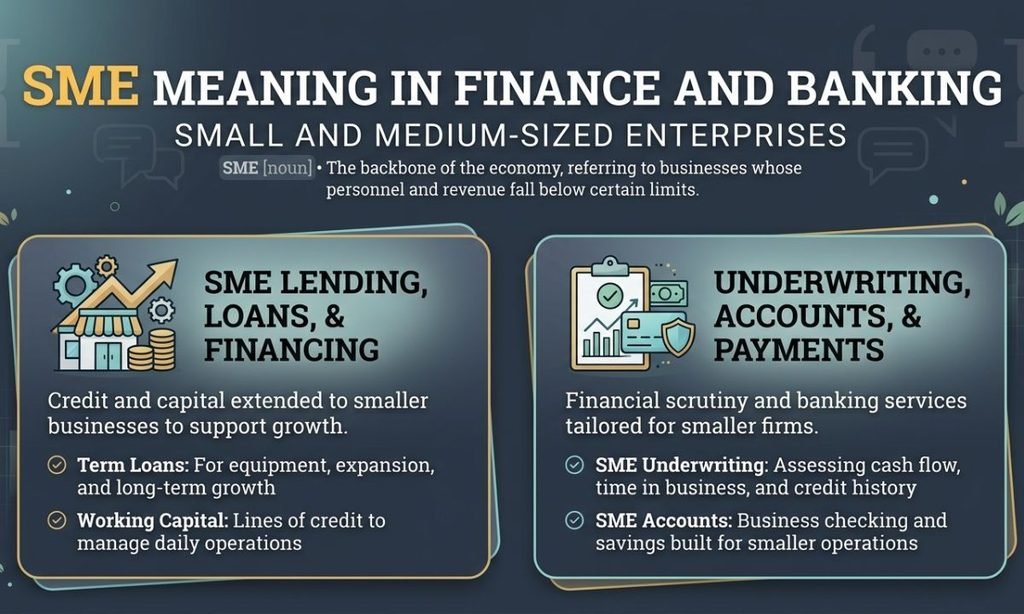
Banking is where the SME acronym shows up most. Lenders split their customers into groups, and SMEs get their own category.
SME Lending, Loans, and Financing
SME lending covers any credit extended to these businesses. SME loans and SME financing include:
- Term loans for equipment or expansion
- Working capital lines of credit
- Invoice financing
- Business credit cards
- Government-backed loans, such as SBA loans in the U.S.
An SME bank or SME banking division focuses on this segment. The meaning of SME in banking really boils down to “business customers too big for consumer banking and too small for corporate banking.”
SME Underwriting, Accounts, and Payments
Underwriters look at cash flow, time in business, and credit history when reviewing an SME loan. SME accounts are business checking and savings accounts built for smaller firms. SME payments refers to card processing, invoicing tools, and transfers aimed at the same group.
Quick Banking Example
“We’re launching a new SME banking package with lower fees on business accounts.”
Here, SME means companies. No one is being asked for expertise.
SME Meaning in Insurance and Accounting
Insurance
SME insurance, sometimes shown as SME business insurance, is coverage packaged for small and mid-sized companies. Think general liability, property, workers’ compensation, cyber, and professional liability. Insurers use the term because these businesses have different risks and budgets than either sole proprietors or large corporations.
Accounting
In accounting, SME meaning leans toward reporting standards. International standards-setters publish a simplified framework for smaller companies that don’t have public accountability. U.S. companies typically follow U.S. GAAP instead, so you’ll see “SME” mostly in international accounting discussions.
SME Meaning in Marketing and Sales
Marketers use SME to name a target segment. SME marketing means promoting products to small and mid-sized businesses, and an SME sales team sells to them.
There’s a twist, though. In marketing departments, SME can also mean the expert who helps shape content. A writer might say, “I interviewed our SME to fact-check the guide.” Always check the context.
| Phrase | Likely Meaning |
| “SME marketing strategy” | Marketing aimed at small and mid-sized companies |
| “SME sales pipeline” | Sales to smaller businesses |
| “Ask the SME for a quote” | Talk to the subject matter expert |
| “SME review of this blog post” | Expert fact-check |
SME Meaning in Construction and Manufacturing
Both industries are packed with small and mid-sized firms, so the company meaning is common here.
- Construction: Many subcontractors, specialty trades, and regional builders are SMEs. Government projects often set aside work for them.
- Manufacturing: SME manufacturers are small and mid-sized producers. Supply chains depend on them for parts, tooling, and components.
The expert meaning also appears. On a building project, an SME could be a structural engineer or code specialist brought in to review a plan. On a factory floor, it might be the person who knows a specific machine better than anyone.
SME Meaning as a Person: Subject Matter Expert
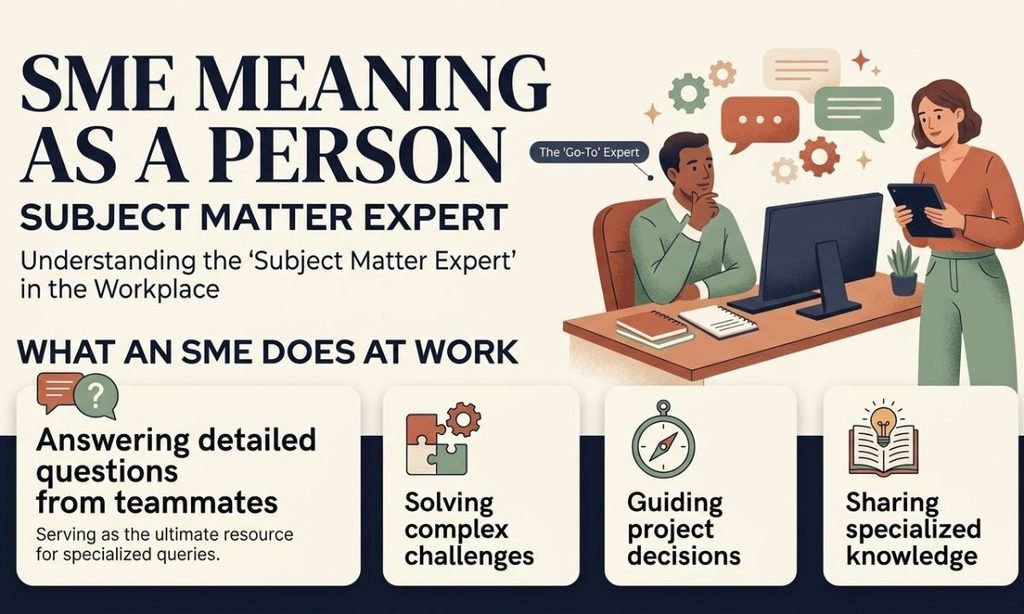
Now for the second definition. A subject matter expert is someone with deep, proven knowledge in one area. They’re the person colleagues go to when a question gets too specific to guess at.
The SME person meaning is about depth, not job title. An SME isn’t necessarily a manager. Often they’re an individual contributor with years of hands-on experience.
What an SME Does at Work
An SME role usually involves:
- Answering detailed questions from teammates
- Reviewing documents, designs, or code for accuracy
- Helping build training materials
- Advising leadership on decisions
- Validating that a project meets technical or regulatory requirements
SME Job and Position: Is It a Real Title?
Sometimes. A few companies list “SME” as an official job title, as in “SME, Cloud Security.” More often, it’s an informal label for someone’s role on a project. If you see an SME position in a corporate job post, expect requirements like several years of experience, certifications, and the ability to explain complex topics clearly.
Types of Subject Matter Experts
| Type | What They Know | Example |
| Technical SME | Systems, tools, engineering | A network architect |
| Functional SME | A business function | A payroll specialist |
| Process SME | How a workflow runs | Someone who knows the claims approval process |
| Industry SME | A whole sector | A healthcare compliance veteran |
Is an SME the Same as an Expert or Consultant?
Close, but not identical. An SME is defined by knowledge, and the term often implies someone inside the organization or project. A consultant is typically an outside advisor, and the two roles can overlap. A SME officer, where that label exists, usually describes a staff role tied to supporting small-business clients or programs, so check the employer’s own description.
SME Meaning in IT and Technology
In tech, the answer is nearly always the expert. If you see SME meaning in IT, read it as subject matter expert.
- Software and software engineering: The SME knows a codebase, a platform, or a domain such as payments or healthcare data.
- Cybersecurity: A security SME advises on threats, audits, and controls.
- DevOps: A DevOps SME understands pipelines, infrastructure, and deployment.
- Vendor-specific roles: You’ll see a Microsoft SME, Cisco SME, or SharePoint SME for people with deep expertise in those products.
IT teams lean on SMEs when building requirements. Developers rarely know the full business rules behind a system, so they interview the SME to get them right.
Example in an IT Context
“Before we migrate the database, we need the SME for the billing system to confirm the data rules.”
That sentence is about a person, clearly.
One exception: tech companies selling to small businesses may say “SME customers.” Same acronym, company meaning again. The word that follows usually settles it.
SME Meaning in Project Management and Other Work Settings
Project managers rely on SMEs constantly. Here, SME means someone who isn’t necessarily on the core team but whose knowledge the project needs.
Project Management and Agile
In project management, SMEs help define scope, estimate effort, and spot risk early. In Agile settings, an SME may join backlog refinement or sprint reviews to clarify requirements, then step out again.
Training and Research
In training, an SME supplies the content that instructional designers turn into courses. In research, SMEs are consulted to guide study design or interpret results.
Procurement, Logistics, and Operations
Procurement teams use SMEs to evaluate vendor proposals. In logistics and operations, an SME might be the person who understands carrier contracts, warehouse systems, or compliance rules.
Clinical Trials and Healthcare
In clinical work, a clinical SME is a medical or scientific expert who advises on protocols, safety, or regulatory matters.
HR
SME HR meaning also usually refers to expertise. An HR SME may be the benefits specialist or employment-law expert. Note, though, that HR teams also talk about hiring for SMEs, meaning small and mid-sized employers.
Is SME Texting Slang?
Short answer: not really. SME isn’t a standard text abbreviation the way LOL or BRB are. If you got a text with “SME” in it, there are a few likely explanations:
- It’s a work message and means subject matter expert.
- It’s a typo or shorthand for something like “send me” or “smell.”
- It’s shorthand in a specific group or game that the sender made up.
If you enjoy decoding everyday words and phrases like this, check out our guide on the dapper meaning too.
Sample Text Messages
| Message | Likely Meaning |
| “Can you loop in the SME for the audit?” | Subject matter expert |
| “We’re an SME so the grant applies to us” | Small and medium-sized enterprise |
| “SME the details when you can” | Probably “send me” (informal) |
When a message is unclear, just ask. “Do you mean the expert or the company type?” takes five seconds.
SME on YouTube
You might see SME in YouTube comments, video titles, or channel descriptions. Usually it’s the expert meaning, such as “I’m an SME in network security.” Creators who focus on small-business advice may also use it to describe their audience. Context again does the work.
Quick Comparison: Which SME Meaning Fits Where?
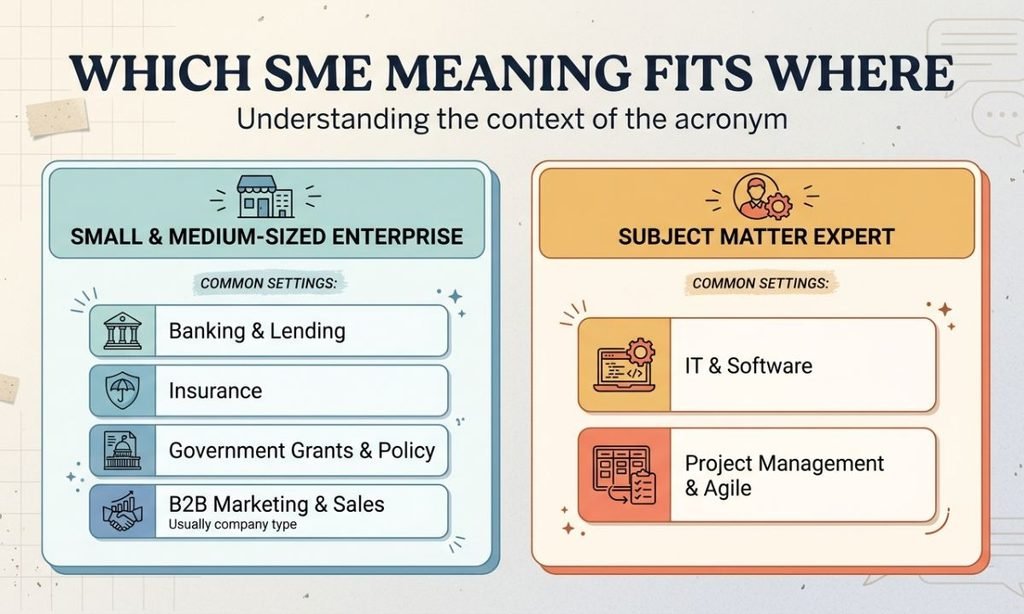
| Setting | Most Likely SME Meaning |
| Banking and lending | Small and medium-sized enterprise |
| Insurance | Small and medium-sized enterprise |
| Government grants and policy | Small and medium-sized enterprise |
| Marketing and sales to businesses | Usually company type |
| IT and software | Subject matter expert |
| Project management and Agile | Subject matter expert |
| Training, research, clinical | Subject matter expert |
| Construction and manufacturing | Either, check context |
| Texting and social media | Usually expert, sometimes unclear |
Common Mistakes When Using or Reading SME
A few slip-ups come up often:
- Assuming one meaning. The biggest error. Read the sentence before deciding.
- Calling any employee an SME. Having a job in a field doesn’t make you the go-to expert. Depth matters.
- Using SME in a U.S. business context without explaining it. Many Americans will say “small business” instead, so spell out the term the first time.
- Mixing up “SME” and “SMB.” SMB (small and medium-sized business) is the more common U.S. phrase and means nearly the same thing as the company meaning of SME.
How to Use SME Clearly in Your Own Writing
Want to avoid confusion? Try these habits:
- Spell it out on first use: “subject matter expert (SME).”
- Pick one meaning per document.
- Pair it with a clarifying word, like “SME lending” or “SME reviewer.”
- Skip it in casual messages if your reader might not know it.
Final Thoughts
SME meaning isn’t complicated once you know there are two answers. If the talk is about companies, loans, or markets, it’s a small and medium-sized enterprise. If the talk is about people, projects, or technical know-how, it’s a subject matter expert.
When you’re stuck, check the nearby nouns. They almost always give it away, and if they don’t, a quick question to the sender will. Now that you’ve got both definitions, you can read business news, job posts, and work emails without guessing.
FAQs
What does SME stand for?
SME stands for either “small and medium-sized enterprise” or “subject matter expert.” The first describes a type of company. The second describes a person with deep knowledge in one area.
What is the meaning of SME in business?
In business, SME means small and medium-sized enterprise. It’s a company that stays below set limits for employees and revenue. Banks, governments, and insurers use the term to group smaller companies together.
What is the full meaning of SME?
The full meaning is either small and medium-sized enterprise or subject matter expert. Which one applies depends on the context. Words like “loans” or “owners” point to the company type, while “role” or “review” point to the expert.
How many employees does an SME have?
In the EU and UK, an SME generally has fewer than 250 employees. The U.S. has no official SME label, but the SBA sets size standards by industry. Many industries use 500 employees or fewer.
What does SME mean in banking and finance?
In banking, SME refers to small and mid-sized business customers. SME lending, SME loans, and SME accounts are products built for that group. These customers are too big for personal banking and too small for corporate banking.
What is an SME in a job or at work?
At work, an SME is a subject matter expert. This is the person colleagues turn to for detailed, specialized answers. It’s usually an informal role on a project, though some companies use it as a job title.
What does SME mean in IT?
In IT, SME almost always means subject matter expert. It could be a software engineer, a cybersecurity specialist, or someone who knows a platform such as SharePoint or Cisco inside out. Teams consult them to get requirements and technical details right.
What does SME stand for in project management?
In project management, SME means subject matter expert. These are people whose knowledge the project needs, even if they aren’t on the core team. They help define scope, check accuracy, and flag risks.
What is the difference between an SME and an SMB?
Both usually describe smaller companies, and the meaning is nearly the same. SMB (small and medium-sized business) is the more common phrase in the U.S. SME is more common in international and banking contexts.
Is SME a slang or texting term?
No, SME isn’t common texting slang. In a work message, it usually means subject matter expert. In a casual text, it may be a typo or personal shorthand, so ask the sender if it’s unclear.
How do I know which SME meaning is being used?
Check the words around it. Mentions of lending, customers, markets, or sectors mean the company type. Mentions of a role, review, or consultation mean the expert.
Is an SME the same as a consultant?
Not exactly. An SME is defined by deep knowledge and is often part of the organization or project team. A consultant is usually an outside advisor, though the two roles can overlap.
