

You’re reading a water quality report, and it says your tap water contains 0.8 ppm of something. Or you’re setting up a hydroponic garden and the nutrient meter reads 900 ppm. Or a friend texts you a photo of a pool test strip with “is 5 ppm bad??” and you aren’t sure what to say.
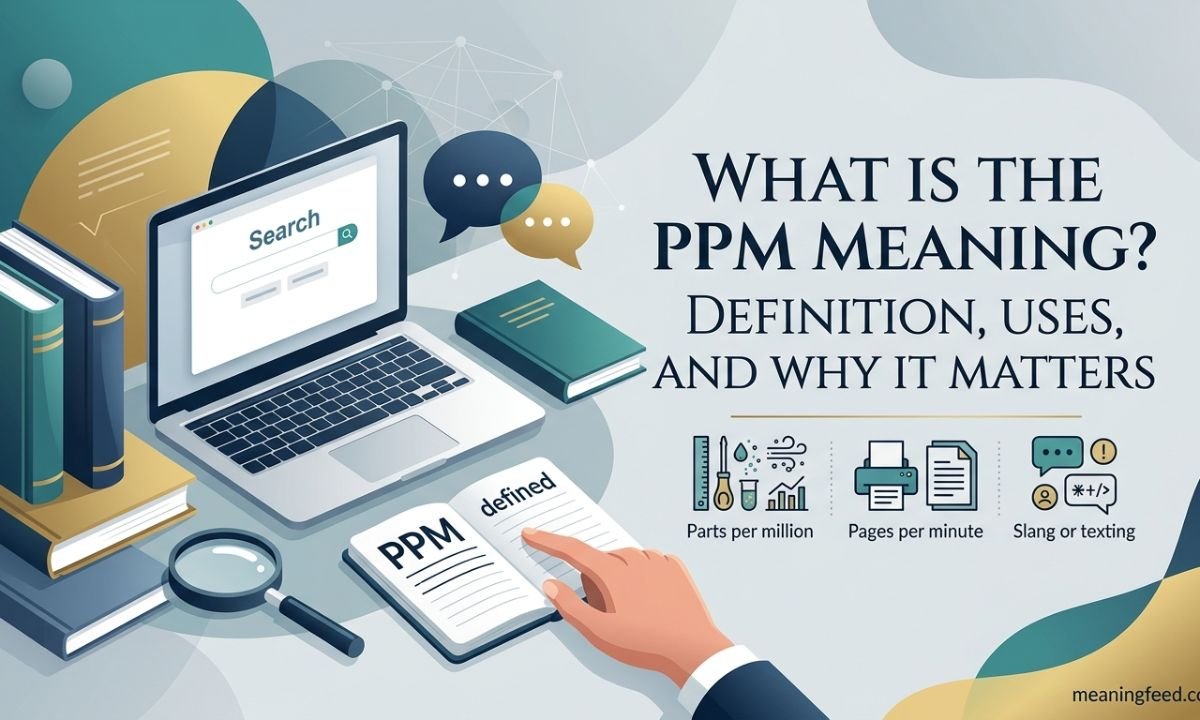
The PPM meaning most people are looking for is parts per million, a way of describing how much of one substance is mixed into a million parts of something else. That’s the short answer. The longer one is more interesting, because “PPM” shows up in chemistry, health, gardening, manufacturing, printing, and even business finance, and it means something different in each.
Let’s go through all of it.
PPM Meaning: The Quick Answer
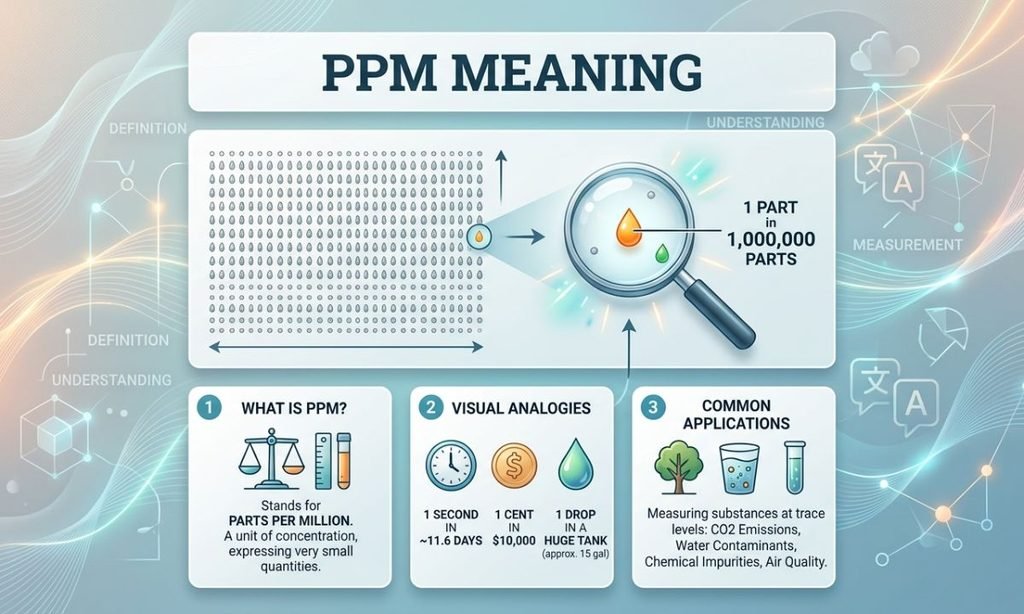
PPM stands for parts per million. It’s a unit that expresses a tiny concentration. One ppm means one part of a substance for every 1,000,000 parts of the whole mixture.
Here’s the same idea in everyday terms:
- One drop of ink in about 13 gallons of water
- One second in roughly 11.5 days
- One penny in $10,000
- One inch in about 16 miles
If those numbers feel impossibly small, that’s the point. PPM exists because percentages get awkward when you’re measuring trace amounts. Saying “0.0001%” is clumsy. Saying “1 ppm” is clean.
Where PPM Comes From and Why It Exists
Scientists needed a simple way to describe very dilute mixtures. Percent works well when you’re talking about milk that’s 2% fat. It doesn’t work well for things like lead in drinking water or carbon monoxide in the air, where even a very small amount matters.
PPM fills that gap. It’s the same idea as a percentage, just scaled up. A percentage is parts per hundred. PPM is parts per million. And for even smaller amounts, there’s parts per billion (ppb) and parts per trillion (ppt).
PPM vs. Percent vs. PPB
This table shows how the units relate to each other.
| Unit | Stands For | Ratio | Equivalent |
| % | Percent | 1 in 100 | 10,000 ppm |
| ppm | Parts per million | 1 in 1,000,000 | 0.0001% |
| ppb | Parts per billion | 1 in 1,000,000,000 | 0.001 ppm |
| ppt | Parts per trillion | 1 in 1,000,000,000,000 | 0.001 ppb |
A handy shortcut: to convert percent to ppm, multiply by 10,000. So 0.05% equals 500 ppm. To go the other way, divide ppm by 10,000.
How to Calculate PPM
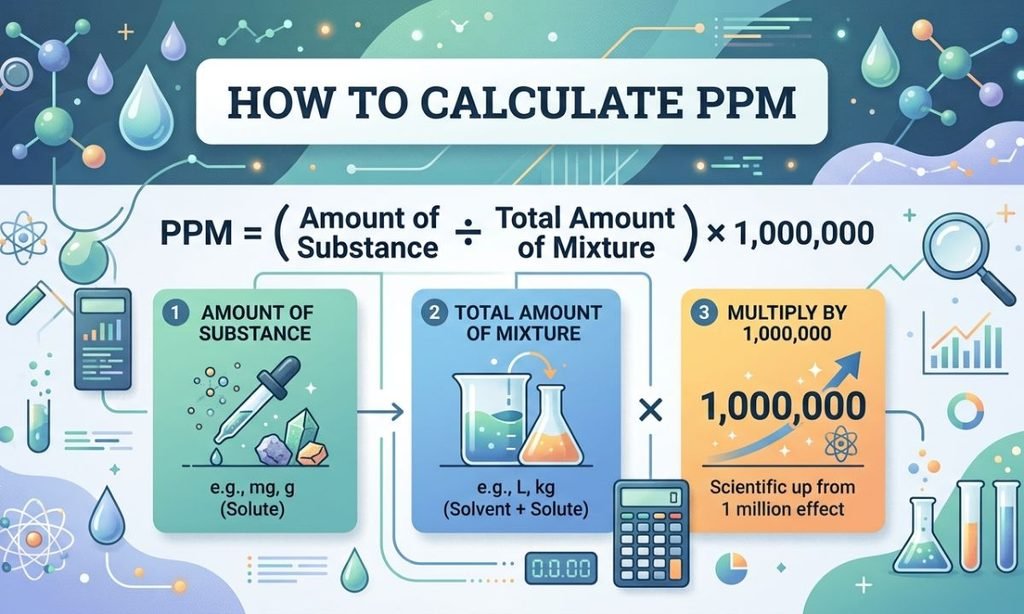
The formula is simple:
PPM = (amount of substance ÷ total amount of mixture) × 1,000,000
Both amounts need to be in the same unit, such as grams, milligrams, or liters.
A Worked Example
Say you dissolve 5 milligrams of salt into 1 liter of water. One liter of water weighs about 1,000,000 milligrams.
- 5 ÷ 1,000,000 = 0.000005
- 0.000005 × 1,000,000 = 5 ppm
The Water Shortcut
For water-based solutions, there’s a convenient rule: 1 ppm equals 1 milligram per liter (mg/L). This works because a liter of water weighs about a kilogram, and a kilogram contains a million milligrams.
That’s why you’ll often see water test results listed in either unit. They mean the same thing in dilute water solutions. The shortcut doesn’t hold for thick liquids, gases, or solids, so keep that in mind.
PPM Meaning in Water Quality
This is probably the most common place Americans run into the term. If you’ve ever looked at a Consumer Confidence Report from your local water utility, you’ve seen ppm and ppb everywhere.
What the EPA Measures
The U.S. Environmental Protection Agency sets limits for contaminants in public drinking water, usually called maximum contaminant levels. Some are expressed in ppm, others in ppb, depending on how toxic the substance is. Stronger toxins get tighter limits, which is why they’re measured in smaller units.You can check the EPA’s National Primary Drinking Water Regulations for current federal standards and regulated contaminant limits.
Here are a few familiar examples:
| Substance | Typical Limit or Guideline | Why It Matters |
| Nitrate (as nitrogen) | 10 ppm | Risk to infants under six months |
| Chlorine (disinfectant) | Up to 4 ppm | Kills bacteria in tap water |
| Copper | 1.3 ppm action level | Can cause stomach distress at high levels |
| Fluoride | 0.7 ppm recommended for dental health | Prevents tooth decay |
| Total dissolved solids (TDS) | 500 ppm secondary guideline | Affects taste and appearance |
Lead is measured in ppb rather than ppm, because even tiny amounts are a concern. If you’re worried about your own water, check your utility’s annual report or use a certified lab. Home test kits are fine for a rough idea, but they aren’t a substitute for lab testing.
What a TDS Meter Tells You
Those small handheld TDS meters you can buy online display a reading in ppm. They actually measure electrical conductivity, then convert it to an estimate of total dissolved solids. That means they can’t tell you what is dissolved, only roughly how much.
A reading of 50 ppm might be clean filtered water. A reading of 600 ppm might be very hard water. Neither number tells you whether the water is safe. It’s a clue, not a verdict.
PPM Meaning in Swimming Pools and Hot Tubs
Pool owners deal with this constantly. Chlorine levels in pools are measured in ppm, and getting the number right is the difference between a sparkling pool and a green, irritating one.
- Free chlorine: most pool guidance lands around 1 to 3 ppm
- Hot tubs and spas: usually a bit higher, since warm water breeds bacteria faster
- Too low: bacteria and algae can take hold
- Too high: eye and skin irritation, plus a strong chemical smell
Here’s the kind of text exchange that happens every summer:
Mike: Test strip says 6 ppm chlorine. Can the kids swim?
Dana: Hold off. That’s way above the usual range. Let it drop to 1–3 first.
That’s a perfectly normal use of the term, and a good reminder that context is everything.
PPM Meaning in Air Quality and Safety
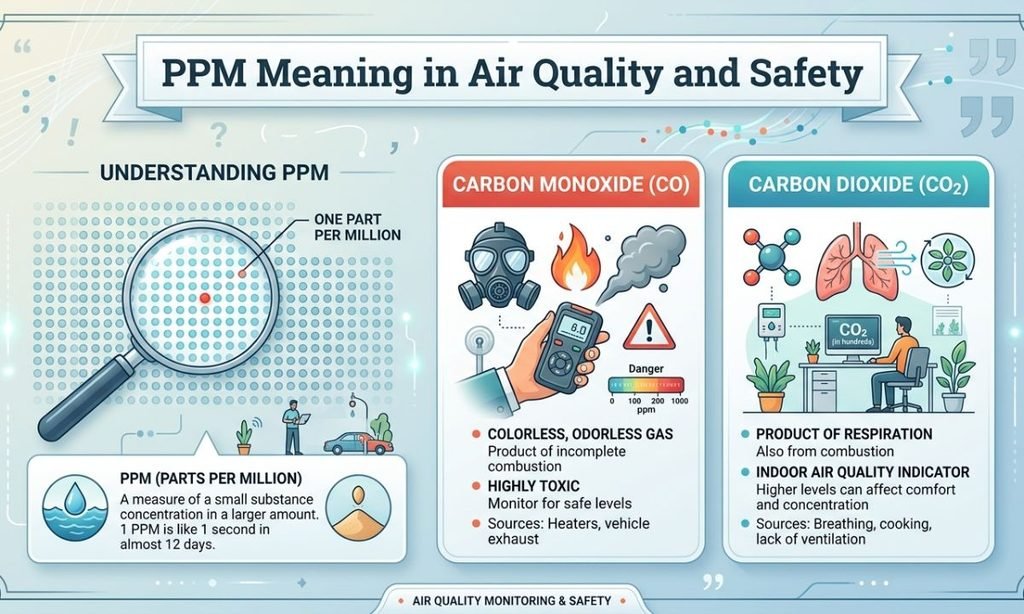
PPM also describes gases in the air, which is where it gets serious.
Carbon Monoxide
Carbon monoxide is colorless and odorless, and it’s measured in ppm. The EPA’s outdoor air standard is 9 ppm averaged over eight hours. OSHA’s workplace exposure limit is 50 ppm over an eight-hour shift. Home CO detectors are designed to alarm well before you’d reach dangerous levels, which is exactly why you should keep batteries fresh.
Carbon Dioxide
Outdoor air currently holds a bit over 420 ppm of carbon dioxide, a number that climate scientists track closely because it keeps climbing. Indoors, CO2 above roughly 1,000 ppm is a sign of poor ventilation. You might notice the room feels stuffy, or that you get drowsy in a packed conference room. That’s often CO2 buildup talking.
PPM Meaning in Gardening and Hydroponics
If you grow plants in water instead of soil, you’ll quickly learn to love and hate your ppm meter.
Nutrient solutions are measured in ppm so growers can keep plants fed without burning them. Seedlings usually need a much weaker solution than mature, fruiting plants. Leafy greens like lettuce tend to prefer lower concentrations than tomatoes or peppers.
One thing trips up beginners: different meters use different conversion scales. Some convert conductivity to ppm using a 0.5 factor, others use 0.7. So a reading of 800 ppm on one meter might be 1,120 ppm on another, even though the water is identical. Always check which scale your meter uses before you follow a feeding chart.
PPM Meaning in Everyday Products
You’ve likely seen ppm on labels without noticing:
- Toothpaste: fluoride content is often around 1,000 to 1,500 ppm
- Hand sanitizer and cleaning solutions: disinfectant strength, such as quaternary ammonium or bleach dilutions, is often given in ppm
- Food and beverages: preservatives like sulfites in wine are listed in ppm
- Cannabis and hemp products: pesticide and heavy metal testing results
Other Common PPM Meanings
Here’s where it gets confusing. Outside of science, the acronym stands for several completely different things. The right one depends entirely on where you saw it.
| PPM | Full Name | Where You’ll See It |
| Parts per million | Concentration unit | Science, water, air, food |
| Project portfolio management | Business discipline | Corporate offices, IT teams |
| Pages per minute | Printer speed | Printer and copier specs |
| Private placement memorandum | Legal document | Investing, startups, funds |
| Planned preventive maintenance | Maintenance strategy | Facilities, manufacturing |
| Pulse position modulation | Signal encoding | Electronics, communications |
| Pre-production meeting | Film planning | TV and movie production |
| Portable pixmap | Image file format (.ppm) | Programming, image processing |
Let’s look at the ones you’re most likely to bump into.
Project Portfolio Management
In a business setting, PPM almost always means project portfolio management. It’s how organizations decide which projects to fund, how to allocate people and budget, and how to track progress across many projects at once. If your manager says “we’re rolling out a new PPM tool,” they mean software, not trace chemicals.
Pages Per Minute
On a printer spec sheet, ppm tells you how fast the machine prints. A home inkjet might manage 10 to 20 ppm, while a busy office laser printer can go well beyond that. Note that manufacturers measure this with simple black-and-white text pages, so real-world speed with photos or color is usually slower.
Private Placement Memorandum
In finance, a private placement memorandum is the document a company gives investors when raising money outside of a public offering. It lays out the business, the risks, and the terms. It’s a serious legal document, and you’d want an attorney to look at it before you invest anything.
Pulse Position Modulation
Engineers use this one. It’s a way of encoding information by changing the timing of electrical or optical pulses. You’ll run into it in certain remote-control systems and optical communications.
Planned Preventive Maintenance
Facilities teams and manufacturers schedule regular upkeep before equipment breaks. “PPM schedule” on a maintenance calendar means exactly that: the inspections and servicing planned in advance to avoid costly failures.
Does PPM Mean Anything in Text Messages?
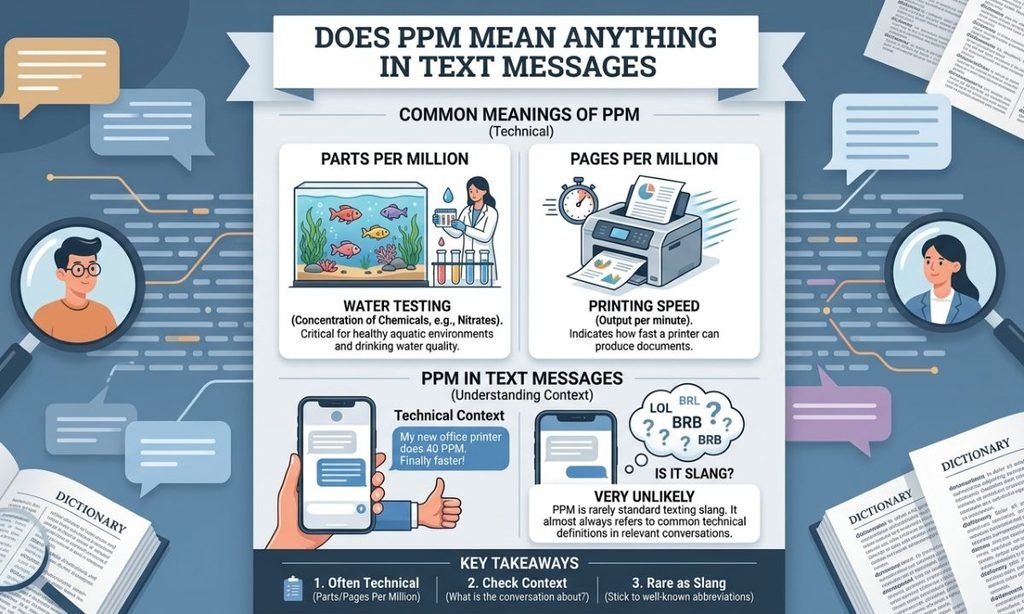
Honestly, not really. Unlike “BRB” or “IDK,” PPM isn’t common texting slang. If you see it in a message, it’s almost certainly one of the technical meanings above.
If you’re researching other abbreviations or unfamiliar terms that appear in texts, you may also come across slang-style questions such as WYLL meaning, which is used in a completely different context.
That said, here are realistic ways it pops up in casual conversation:
Sam: My aquarium test says nitrate is 40 ppm. Is that okay?
Jo: Kind of high. Do a water change and test again tomorrow.
Priya: New office printer does 40 ppm. We’ll finally stop waiting in line.
Lee: Finally.
Chris: Our company is switching to a PPM platform next quarter.
Alex: Ugh, another tool to learn.
Notice that you can tell which PPM someone means from the surrounding words. Pool, printer, project. Context solves it every time.
How to Figure Out Which PPM Someone Means
If you’re stuck, ask yourself these questions in order:
- Is it attached to a number and a substance? (like “2 ppm chlorine”) It’s parts per million.
- Is it about a printer or copier? It’s pages per minute.
- Is it in a business or IT conversation? It’s likely project portfolio management.
- Is it in an investing or legal document? Think private placement memorandum.
- Is it on a maintenance schedule? Planned preventive maintenance.
When in doubt, just ask. People rarely mind clarifying.
Common Mistakes People Make With PPM
A few errors come up over and over.
Assuming ppm and mg/L are always interchangeable. They are for dilute water solutions. They aren’t for air, soil, or dense liquids.
Mixing up ppm and ppb. A thousand-fold difference is huge. A result of 10 ppb is 0.01 ppm, a very different thing from 10 ppm.
Trusting a TDS meter as a safety test. It measures dissolved solids, not whether those solids are harmful.
Ignoring the meter’s conversion scale. This catches hydroponic growers all the time.
Treating ppm as good or bad on its own. Context decides everything. 1 ppm of fluoride in water is beneficial. 1 ppm of lead would be a major problem, since lead’s concern level sits in the ppb range.
A Quick Way to Remember the PPM Meaning
If you want to lock this in, think of it as a very, very small slice.
- One ppm is one slice of a pie cut into a million pieces.
- It’s a drop in a bathtub, not a bucket.
- It’s the same idea as a percent, just with more zeros behind it.
Once you’ve got that picture in your head, reading any report or label gets easier. The unit stops being intimidating and starts being useful.
Final Thoughts
So, what’s the PPM meaning? In most cases, it’s parts per million, a clean, compact way to talk about tiny concentrations in water, air, food, and chemicals. But the same three letters can also point to printers, project management, investment paperwork, or maintenance schedules.
The trick is reading the context. A number next to a substance? Concentration. A tool or a department meeting? Probably business. Once you know what to look for, the confusion fades fast.
And if you’re testing something at home, like pool water, a fish tank, or your tap, remember that the number only tells part of the story. Know what’s normal for your situation, use a reliable test, and don’t hesitate to call a professional when health or safety is on the line.
FAQs
What does PPM stand for?
PPM most commonly stands for parts per million. It’s a unit that shows how many parts of a substance are present in one million parts of a mixture. Outside of science, it can also mean project portfolio management or pages per minute.
What is the PPM meaning in chemistry?
In chemistry, PPM describes a very small concentration of one substance within another. One ppm equals one part of a substance per 1,000,000 parts of the whole. It’s used when percentages would be too clumsy for trace amounts.
How do you calculate PPM?
Divide the amount of the substance by the total amount of the mixture, then multiply by 1,000,000. Both amounts must use the same unit. For example, 5 mg of salt in 1 liter of water equals 5 ppm.
Is 1 ppm the same as 1 mg/L?
In dilute water solutions, yes. A liter of water weighs about one kilogram, which contains one million milligrams. This shortcut doesn’t work reliably for air, soil, or thick liquids.
How do you convert percent to PPM?
Multiply the percentage by 10,000. For instance, 0.05% equals 500 ppm. To go the other way, divide ppm by 10,000.
What is the difference between PPM and PPB?
PPM means parts per million, while PPB means parts per billion. One ppm equals 1,000 ppb, so ppb is used for even tinier amounts. Lead in drinking water, for example, is typically measured in ppb.
What is a good PPM level for drinking water?
For total dissolved solids, the EPA’s secondary guideline is 500 ppm, mainly for taste and appearance. Readings below that are generally considered fine for everyday use. A TDS reading alone can’t tell you whether water is actually safe.
What does PPM mean on a TDS meter?
It shows an estimate of total dissolved solids in your water. The meter measures electrical conductivity and converts it to ppm. It can’t identify what’s dissolved, only roughly how much.
What PPM should pool chlorine be?
Most pool guidance recommends 1 to 3 ppm of free chlorine. Hot tubs often run slightly higher. Levels well above that range can irritate eyes and skin.
What does PPM mean for carbon monoxide?
It shows how many parts of carbon monoxide are in a million parts of air. The EPA’s outdoor standard is 9 ppm averaged over eight hours. OSHA’s workplace limit is 50 ppm over an eight-hour shift.
What is a normal CO2 PPM level indoors?
Outdoor air holds a little over 420 ppm of carbon dioxide. Indoor levels below about 1,000 ppm usually indicate decent ventilation. Higher readings often mean a stuffy, poorly ventilated room.
What does PPM mean in business?
In business, PPM usually means project portfolio management. It’s the practice of choosing, funding, and tracking multiple projects at once. Companies often use dedicated PPM software to do this.
What does PPM mean on a printer?
It stands for pages per minute and measures how fast a printer produces pages. Manufacturers usually test with simple black-and-white text. Color documents and photos typically print slower.
What is a private placement memorandum (PPM)?
It’s a legal document companies give investors when raising money outside a public offering. It outlines the business, risks, and investment terms. Consulting an attorney before investing is strongly advised.
What is a good PPM for hydroponic nutrients?
It depends on the plant and growth stage. Seedlings and leafy greens generally need weaker solutions than fruiting plants like tomatoes. Check whether your meter uses a 0.5 or 0.7 conversion scale before following any feeding chart.
Does PPM mean anything in texting?
Not really. PPM isn’t common texting slang, so it almost always refers to a technical meaning. The surrounding words, such as pool, printer, or project, usually make the meaning clear.
