

You send a message. A minute later, your phone buzzes with a single word: “Uhm.”
Now you’re staring at the screen, wondering what just happened. Is your friend confused? Annoyed? Trying to let you down gently? Or did they just type the sound they’d make out loud?
The uhm meaning in text depends on context, but the core idea is simple. “Uhm” is a written version of a spoken pause. It shows hesitation, uncertainty, or awkwardness. Depending on the situation, it can also signal disagreement, sarcasm, or a shy, softer tone.
This guide breaks down every common meaning, shows real text examples, and explains how to reply. You’ll also learn when it’s smart to use “uhm” yourself and when to skip it.
Uhm Meaning in Text: The Quick Answer
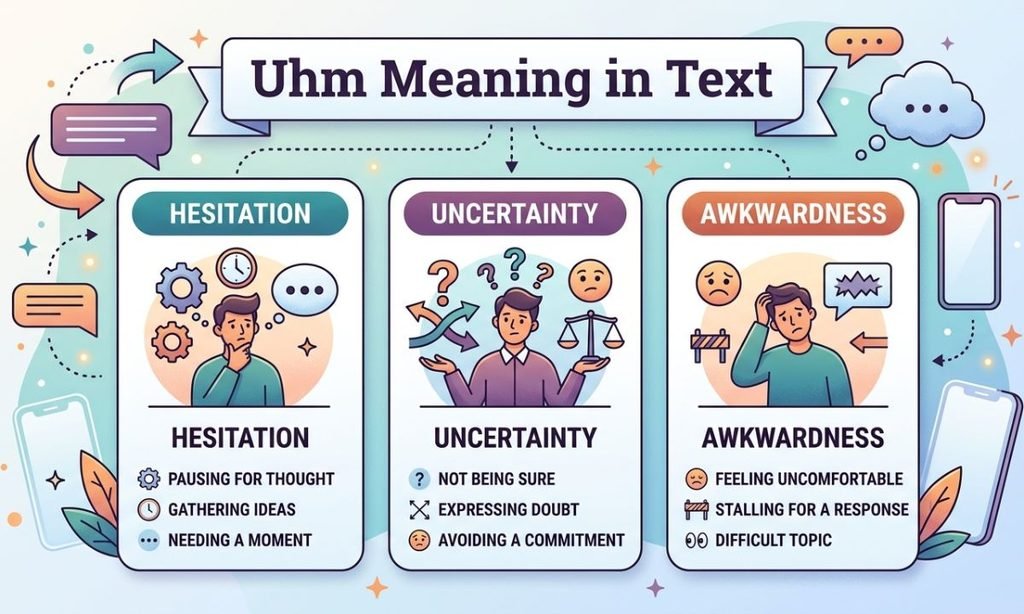
“Uhm” is a filler word that people type to show hesitation, uncertainty, or awkwardness in a conversation. It works like the pause you’d take before saying something tricky out loud.
Here’s the short version:
- Hesitation: “Uhm, I’m not sure yet.”
- Awkwardness: “Uhm… that was a bit much.”
- Disagreement: “Uhm, that’s not what happened.”
- Buying time: “Uhm, let me check.”
- Softening bad news: “Uhm, so I can’t make it tonight.”
Most of the time, “uhm” isn’t rude or dramatic. It’s a way to make a message sound more human and less blunt.
Where Does “Uhm” Come From?
“Uhm” is a spelling variation of “um,” one of the most common filler sounds in spoken English. Linguists call these sounds disfluencies, which are interruptions or hesitations that occur during natural speech. Britannica – Speech Disfluency They’re the small sounds we make while our brains catch up with our mouths.
Everyone does it. Even confident public speakers slip in an “um” or “uh” without noticing.
When texting took off, people started typing those sounds to copy the rhythm of real conversation. Texting strips out your tone of voice and facial expressions, so typing “uhm” is a shortcut. It tells the other person, “I’m thinking, or I’m a little uncomfortable, or I’m not totally sure about this.”
The spelling “uhm” isn’t as formal as “um,” and some style guides prefer the shorter version. But in texts, DMs, and social media comments, both are widely used and understood. If you’re also curious about another texting abbreviation, you can read our guide to SPWM meaning in text.
Uhm vs. Um vs. Uh: Is There a Difference?
Not really. In everyday texting, they’re interchangeable. But small differences in feel do exist.
| Spelling | Typical Feel | Example |
| Uh | Short, casual, sometimes blank or unsure | “Uh, what?” |
| Um | Neutral, the standard filler | “Um, I think so.” |
| Uhm | Slightly softer, a little more drawn out | “Uhm, can we talk later?” |
| Umm / Ummm | Longer pause, more thinking or more awkward | “Ummm, I don’t know about that.” |
| Uhmm | Very hesitant or dramatic | “Uhmm, are you serious?” |
Some linguistics research suggests speakers tend to use “um” before a longer pause and “uh” before a shorter one. That idea carries into texting, where extra letters stretch the pause. More letters usually means more hesitation.
The Different Meanings of Uhm in Text
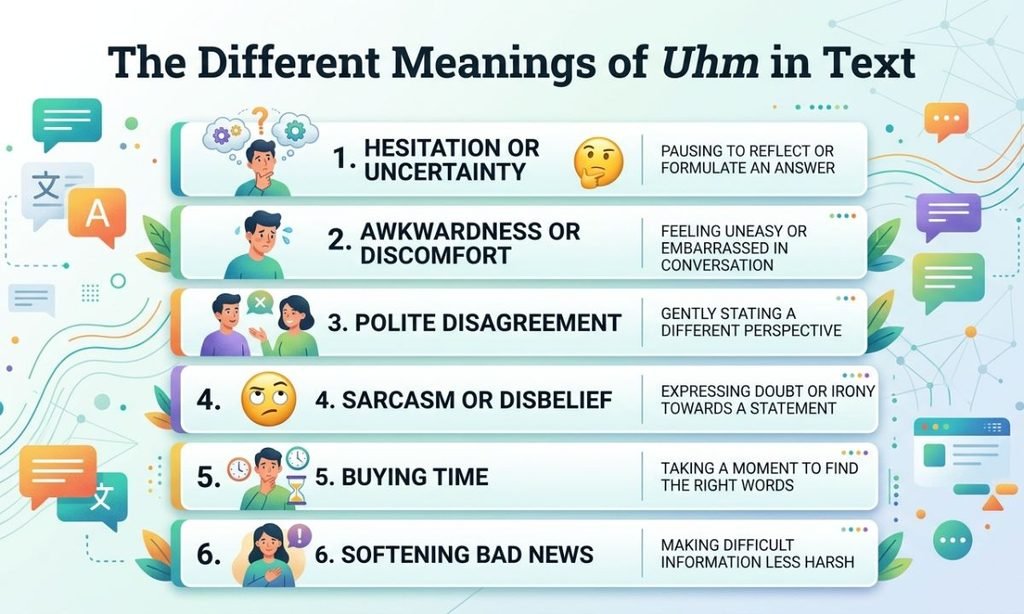
The same three letters can carry very different messages. Here’s how to read each one.
1. Hesitation or Uncertainty
This is the most common use. The sender doesn’t have a clear answer and is filling the gap.
Text: Do you want to grab dinner Friday?
Reply: Uhm, maybe? Let me check my schedule.
Nothing negative is going on here. The person just isn’t ready to commit.
2. Awkwardness or Discomfort
Sometimes “uhm” shows up when a message lands badly, or when someone says something that makes the other person squirm.
Text: I told my boss his idea was dumb in front of everyone.
Reply: Uhm… okay. How did he take it?
The ellipsis (…) adds to the awkward feeling. It’s the texting version of an uncomfortable silence.
3. Polite Disagreement
People often use “uhm” to push back without sounding harsh. It’s a gentle way to say, “Wait, I don’t think that’s right.”
Text: I’m pretty sure you were the one who forgot the tickets.
Reply: Uhm, I texted you the confirmation twice.
Here the “uhm” softens the correction while still making the point.
4. Sarcasm or Disbelief
Add a question mark or a capital letter, and “uhm” can turn sharp. It becomes a way to say, “Are you kidding me?”
Text: Can you cover my shift again? It’s my third time asking this month.
Reply: Uhm, no?
Context and punctuation matter a lot in these cases. A flat “Uhm.” with a period can feel cold or annoyed.
5. Buying Time
Sometimes the sender just needs a moment. They might be looking something up, doing math, or working out how to phrase an answer.
Text: How much did the concert tickets cost again?
Reply: Uhm, one sec, let me look.
This is the harmless, practical version of “uhm.”
6. Softening Bad News
If someone has to cancel, decline, or admit a mistake, “uhm” can act like a cushion before the hard part.
Text: Uhm, so I might be running about 30 minutes late.
The word signals, “Heads up, this isn’t ideal, and I know it.” It can make the message feel more considerate.
7. Shy, Nervous, or Flirty Energy
In romantic or crush-related conversations, “uhm” often shows nerves rather than negativity.
Text: Uhm, I was wondering if you’d want to hang out sometime?
Here it reads as sweet and a little vulnerable. It shows the person cares about how the message lands.
How Punctuation and Spelling Change the Tone
The word itself is only part of the message. How it’s typed changes everything.
| How It’s Typed | What It Usually Signals |
| Uhm | Mild hesitation or a soft pause |
| Uhm, | Getting ready to say something, often a correction or request |
| Uhm… | Awkwardness, discomfort, or trailing off |
| Uhm? | Confusion, disbelief, or a challenge |
| Uhm. | Flat, cold, or annoyed |
| UHM | Strong shock, frustration, or dramatic emphasis |
| uhmmmm | Extended thinking or exaggerated awkwardness |
| Uhm 😬 | Cringe, embarrassed, or “yikes” |
| Uhm 🥺 | Shy, pleading, or sweet |
Notice how much emojis and punctuation do here. When you can’t hear someone’s voice, these small details do the work of tone.
Real-Life Text Examples of Uhm
Seeing “uhm” in action is the fastest way to understand it. Here are a few realistic exchanges.
Example 1: Making plans
Jess: Are you free Saturday?
Maya: Uhm, I think I have a thing in the afternoon. Evening works though!
Meaning: Mild uncertainty, followed by a helpful alternative.
Example 2: Calling out a mistake
Dan: I already paid the electric bill.
Chris: Uhm, the bill’s still showing as due.
Meaning: Polite correction. Chris isn’t angry, just pointing out a mismatch.
Example 3: Reacting to something surprising
Alex: I quit my job today. No backup plan.
Sam: Uhm… wow. Okay. Are you alright?
Meaning: Shock mixed with concern.
Example 4: Sarcastic pushback
Ryan: Since you’re already up, can you make me breakfast?
Leah: Uhm, are you serious right now?
Meaning: Disbelief with an edge.
Example 5: Nervous asking
Tom: Uhm, hey. Would you maybe want to grab coffee this week?
Meaning: Nerves and sincerity. This is a person working up the courage.
How to Respond When Someone Texts You “Uhm”
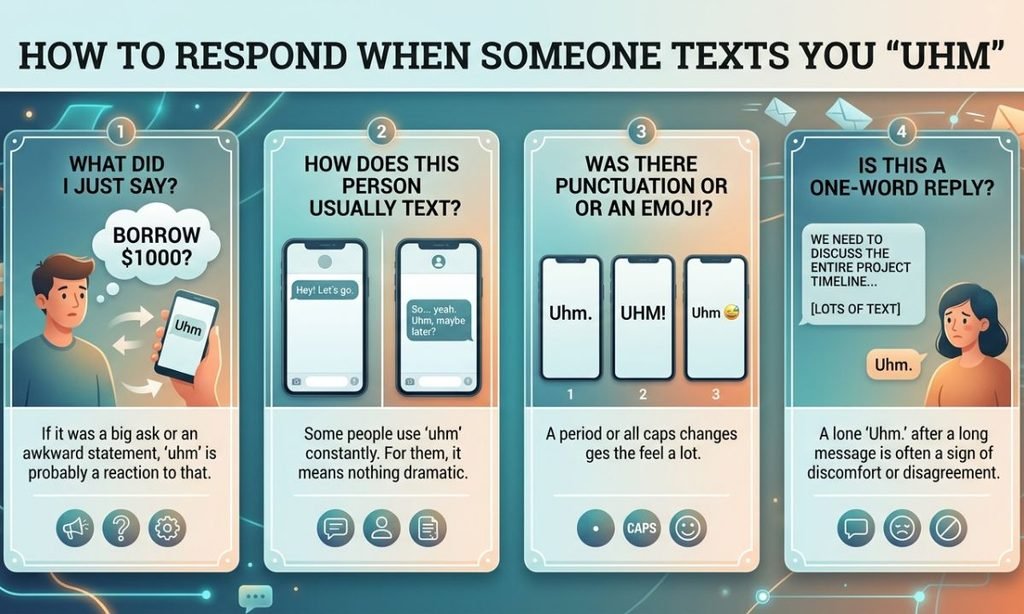
Since “uhm” can mean so many things, the smartest move is to read the situation first. Ask yourself:
- What did I just say? If it was a big ask or an awkward statement, “uhm” is probably a reaction to that.
- How does this person usually text? Some people use “uhm” constantly. For them, it means nothing dramatic.
- Was there punctuation or an emoji? A period or all caps changes the feel a lot.
- Is this a one-word reply? A lone “Uhm.” after a long message is often a sign of discomfort or disagreement.
Once you have a read on it, you can respond to match:
| If “Uhm” Seems To Mean… | You Could Reply With… |
| Hesitation | “No pressure, take your time.” |
| Awkwardness | “Sorry, was that a weird thing to say?” |
| Disagreement | “Fair enough. What’s your take?” |
| Buying time | “Sure, no rush.” |
| Bad news coming | “What’s up? You can tell me.” |
| Shyness or nerves | “Go ahead, I’m listening!” |
If you can’t tell what someone means, just ask. A simple “Everything okay?” or “Did I say something off?” clears up confusion faster than guessing ever will.
When to Use “Uhm” Yourself
Now that you know how it reads, you can use “uhm” on purpose. It works well in these situations:
- Casual chats with friends or family. It makes you sound relaxed and natural.
- Softening a tough message. Cancelling plans or correcting someone feels gentler with a small pause first.
- Showing real uncertainty. If you’re truly unsure, “uhm” is honest and human.
- Adding humor. A well-timed “uhm…” can make a joke land, especially after something ridiculous.
- Asking for something a bit awkward. It signals that you know you’re asking a lot.
Using Uhm Without Sounding Unsure
There’s a fine line between sounding thoughtful and sounding like you have no idea what you’re doing. If you want to keep your confidence, place the “uhm” carefully.
- Weak: “Uhm, I think maybe we could possibly try this?”
- Better: “Uhm, let’s try this. I think it’ll work.”
Use it once, then commit to the point. Stacking filler words on top of vague language makes any message feel shaky.
When to Avoid “Uhm”
“Uhm” isn’t always the right choice. Skip it in these cases:
- Professional emails. In formal writing, filler words can make you seem unprepared. Write clearly and directly instead.
- Job applications and cover letters. Stick to polished language.
- Serious or emotional conversations. If someone shares something painful, an “uhm” up front can feel dismissive.
- Apologies. “Uhm, sorry about that” sounds half-hearted. A clean “I’m sorry” carries more weight.
- Texts to someone you’re trying to impress with confidence. Too many filler words can undercut your tone.
For workplace chats like Slack or Teams, a quick “uhm” among close coworkers is usually fine. But for anything going to a client, boss, or wider group, cut it.
Uhm on Social Media: Instagram, Snapchat, and TikTok
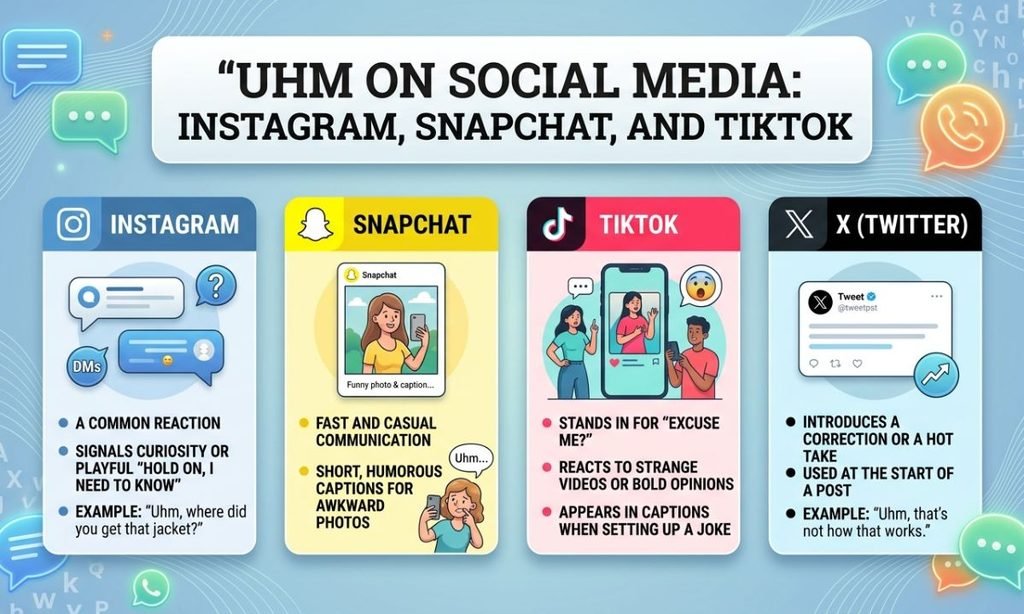
Filler words show up everywhere online, and they often take on a slightly different flavor depending on the platform.
- Instagram comments and DMs: “Uhm” is commonly used as a reaction. Think of comments like “Uhm, where did you get that jacket?” It signals curiosity or a playful “hold on, I need to know.”
- Snapchat: Because Snaps are fast and casual, “uhm” tends to show up as a short, humorous caption for an awkward photo.
- TikTok: In comments, “uhm” often stands in for “excuse me?” It’s used to react to a strange video or a bold opinion. It also appears in captions when someone is setting up a joke.
- X (Twitter): People often use “uhm” at the start of a post to introduce a correction or a hot take, like “Uhm, that’s not how that works.”
Across all of these, the tone leans playful, teasing, or mildly shocked rather than truly angry.
Uhm vs. Other Common Text Reactions
“Uhm” belongs to a family of similar expressions. Here’s how it compares.
| Expression | Meaning | Tone | Example |
| Uhm / Um | Hesitation, pause | Neutral to awkward | “Uhm, maybe.” |
| Uh | Confusion, short pause | Casual, blank | “Uh, what?” |
| Hmm | Thinking, doubt | Thoughtful or skeptical | “Hmm, not sure.” |
| Erm | Hesitation (more British) | Polite, awkward | “Erm, I’ll think about it.” |
| Uh-oh | Something went wrong | Worried or playful | “Uh-oh, I forgot the keys.” |
| Uh-huh | Agreement or acknowledgment | Neutral, sometimes sarcastic | “Uh-huh, sure you did.” |
| Uh-uh | No | Firm, informal | “Uh-uh, not happening.” |
| Ahem | Getting attention or hinting | Teasing or pointed | “Ahem, you owe me lunch.” |
Two of these are worth a closer look, because people mix them up.
Uhm vs. Hmm
“Hmm” shows that someone is actively thinking or has doubts. “Uhm” shows they’re hesitating or feeling awkward. If your friend texts “Hmm,” they’re weighing something. If they text “Uhm,” they’re probably a little uncomfortable or not sure how to say the next thing.
Uhm vs. Uh-huh
These look similar but mean different things. “Uh-huh” usually means yes or “I hear you,” and it can turn sarcastic depending on context. “Uhm” doesn’t confirm anything. It just fills space.
Common Mistakes People Make With Uhm
A few missteps can change how your message comes across.
- Overusing it. If every message starts with “uhm,” you’ll sound perpetually nervous, even when you’re not.
- Using it in serious moments. Starting a sensitive reply with “uhm” can feel like you don’t care.
- Assuming it always means something negative. Many people use it as a habit, not a signal. Don’t read too much into it.
- Ignoring the surrounding clues. The punctuation, emojis, and history of the conversation matter as much as the word.
- Using it to avoid saying something clearly. If you need to say no, say no. “Uhm, maybe?” can leave people confused.
Why People Type Filler Words at All
It might seem odd to bother typing a sound that carries no real information. But there’s a good reason.
Written conversation lacks the cues we rely on in person. There’s no tone, no facial expression, no body language. So we add small signals to fill the gap. Emojis do it. Punctuation does it. And filler words like “uhm” do it too.
Typing “uhm” tells the reader that a real person is on the other end, thinking in real time. It makes a text feel warmer and less like a cold statement. That’s why even people who write perfectly polished emails often sprinkle “uhm” and “umm” into their casual messages.
In that sense, “uhm” isn’t sloppy writing. It’s a tool for tone.
Quick Tips for Reading Uhm Correctly
Keep this short checklist handy:
- Look at the context first. What came right before the message?
- Check the punctuation. A period is colder than an ellipsis. A question mark suggests disbelief.
- Notice the length. “Uhmmmm” is more drawn out and often more awkward or playful.
- Consider the person. Some people use “uhm” as a default, others rarely do.
- When in doubt, ask. A quick check-in beats a long spiral of overthinking.
Final Thoughts
The uhm meaning in text comes down to a simple idea: it’s a typed pause. Sometimes that pause means “I’m not sure.” Sometimes it means “this is awkward.” Occasionally it’s a polite way of saying “I don’t agree.” And every so often, it’s just a habit with no hidden message at all.
The trick is reading the clues around it. Punctuation, emojis, timing, and the person behind the message all shape what “uhm” is really saying. Once you start noticing those details, you’ll rarely misread it again.
And if you’re the one typing it, use it with a purpose. A well-placed “uhm” can make your message warmer, softer, and more human. Just don’t lean on it so heavily that your point gets lost.
FAQs
What does uhm mean in text?
“Uhm” is a typed version of a spoken pause. It shows hesitation, uncertainty, or awkwardness, and sometimes polite disagreement or sarcasm depending on the context.
Is uhm the same as um?
Yes, they mean the same thing. “Uhm” is just a spelling variation that often feels slightly softer or more drawn out in texts and DMs.
Is it “uhm” or “umm”?
Both are accepted in casual texting, and neither is a formal spelling. “Umm” usually signals a longer pause, while “uhm” feels a bit more casual and subtle.
What does it mean when a girl or guy texts “uhm”?
It usually means they’re unsure, nervous, or a little uncomfortable. In a flirty conversation, it often shows shyness rather than disinterest.
Does uhm mean someone is annoyed?
Not always. A flat “Uhm.” with a period can sound annoyed, but “uhm” on its own is usually just hesitation or a pause to think.
What does “uhm…” with dots mean?
Dots stretch the pause and add awkwardness. It often means the sender is uncomfortable, surprised, or unsure how to reply.
What does “uhm?” mean in a text message?
A question mark turns it into confusion or disbelief. It often means “Wait, what?” or “Are you serious?”
How do you reply when someone texts “uhm”?
Check the context first, then respond to match the tone. If you’re unsure, a simple “Everything okay?” or “Did I say something off?” works well.
Is it rude to say uhm in a text?
No, it’s not rude in casual chats. It can sound unprofessional or dismissive in formal messages, apologies, or serious conversations.
Can I use uhm in professional emails or work chats?
Avoid it in emails to clients, managers, or job applications. In casual Slack or Teams chats with close coworkers, it’s usually fine.
What is the difference between uhm and hmm?
“Hmm” shows someone is thinking or has doubts. “Uhm” shows hesitation or awkwardness, often before saying something difficult.
Why do people type uhm instead of just saying what they mean?
Texting lacks tone of voice and facial expressions, so filler words add a human touch. “Uhm” softens a message and makes it feel more natural.
What does uhm mean on TikTok or Instagram?
It’s often used as a playful “excuse me?” or “hold on.” Commenters use it to react to something surprising, funny, or questionable.
What is another way to say uhm in text?
You can use “hmm,” “erm,” “well,” “uh,” or “let me think.” Each has a slightly different tone, so pick the one that fits the moment.
Does using uhm make you sound unsure?
Occasionally, yes, especially if you stack it with vague words like “maybe” or “I guess.” Use it once, then state your point clearly to keep your confidence.
