

You’re scrolling through a text thread, a dating app match asks “u dtf?” and you freeze. Is this a compliment? A red flag? A joke you’re not in on?
You’re not alone. Thousands of people search for the DTF meaning in text every single month, usually right after seeing it pop up somewhere unexpected — a group chat, a Tinder message, a Snapchat reply, or even a comment on social media.
This guide breaks it all down in plain English. No confusing jargon, no dancing around the point. By the time you’re done reading, you’ll know exactly what DTF means, where it came from, when people use it, and how to respond if someone sends it your way.
What Does DTF Mean in Text?
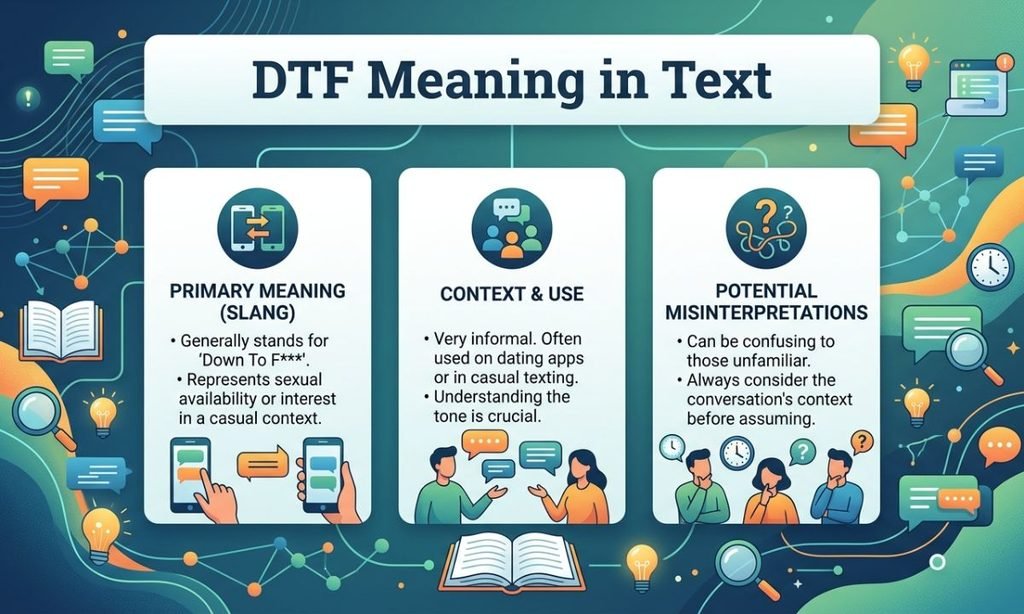
DTF stands for “Down to F*”** — a blunt, casual way of asking or stating that someone is interested in having sex, usually with no strings attached.
For a detailed definition, you can also check DTF definition from Dictionary.com.
It’s slang. It’s informal. And it shows up almost exclusively in texting, dating apps, and social media, not in face-to-face conversation or formal writing.
Here’s the quick version if you’re in a hurry:
DTF = Down to F*, meaning someone is open to or interested in a casual sexual hookup.**
That’s the core definition. But like most slang, the real meaning depends heavily on context, tone, and who’s sending it — which is exactly what we’ll dig into next.
Where Did DTF Come From?
DTF isn’t a new invention of the dating app era, though that’s where it really took off. The phrase has roots in casual American slang from the early 2000s, popularized through hip-hop culture, party lingo, and later, reality TV.
It gained massive mainstream traction thanks to MTV’s Jersey Shore, where cast members used the term openly and repeatedly. That single show did more to spread DTF into everyday vocabulary than almost anything else.
Once texting and dating apps like Tinder and Bumble exploded in popularity, DTF found its natural home. It’s short, easy to type, and gets straight to the point — which is exactly what a lot of casual daters want.
How Is DTF Used in Texting?
DTF shows up in a few different ways depending on the situation. Understanding the format helps you read the room a little better.
As a Direct Question
Someone might send it as a straightforward ask, usually to gauge interest before meeting up.
- “hey u dtf tonight?”
- “dtf rn?”
As a Statement
Sometimes it’s used to describe someone’s mood, intentions, or general openness to hooking up.
- “not gonna lie, I’m kinda dtf”
- “she’s always dtf on weekends”
As a Label or Description
People also use it more generally to describe someone’s personality or reputation, though this usage can come across as judgmental or crude.
- “he’s such a dtf guy”
In Group Chats or Jokes
Not every use is serious. Friends often use DTF sarcastically or as a joke, especially when teasing someone about a date or a crush.
- “so are you two dtf or just vibing lol”
Common DTF Text Examples
Seeing the term in real conversation examples makes the meaning click faster than any dictionary definition. Here are a few realistic scenarios.
| Text Message | Meaning |
| “hey, u still up? dtf?” | Direct, casual hookup invitation, usually late at night |
| “not looking for anything serious, just dtf” | Setting expectations upfront on a dating app |
| “lol he asked if I was dtf on the first message” | Sharing a story about being propositioned quickly |
| “we’re just friends, not dtf or anything” | Clarifying that a relationship is not sexual or casual |
DTF vs. Other Similar Texting Acronyms
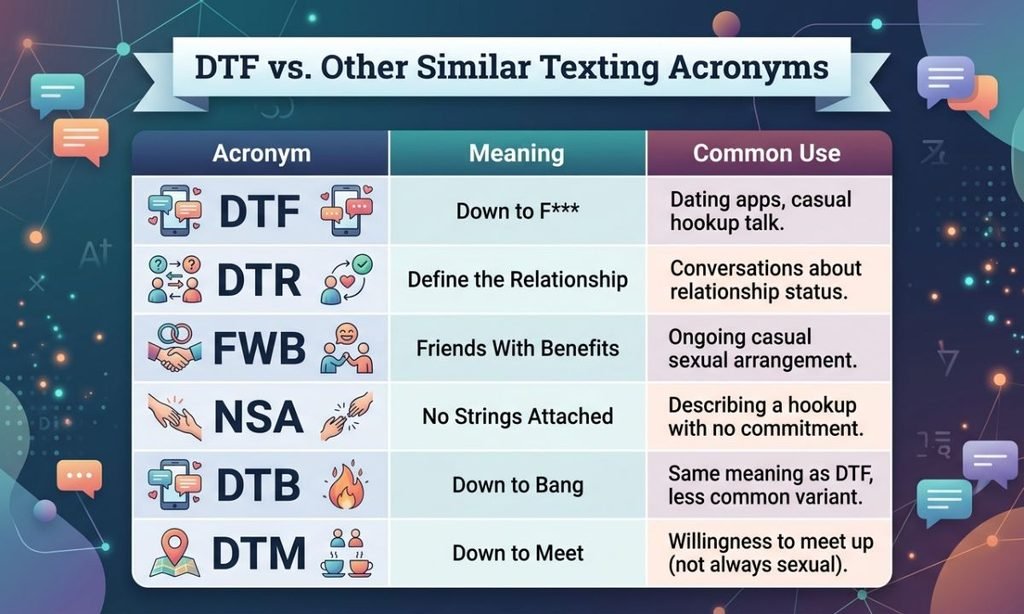
DTF often gets mixed up with other slang terms that sound similar or appear in the same kinds of conversations. Here’s how they stack up against each other.
| Acronym | Meaning | Common Use | Tone |
| DTF | Down to F*** | Dating apps, casual hookup talk | Blunt, casual, sometimes crude |
| DTR | Define the Relationship | Conversations about relationship status | Serious, direct |
| FWB | Friends With Benefits | Ongoing casual sexual arrangement | Casual, informal |
| NSA | No Strings Attached | Describing a hookup with no commitment | Casual, matter-of-fact |
| DTB | Down to Bang | Same meaning as DTF, less common variant | Blunt, casual |
| DTM | Down to Meet | Willingness to meet up (not always sexual) | Neutral, casual |
Mixing these up is easy, especially since several of them show up in the same dating-app conversations. DTR, for instance, is actually the opposite energy of DTF — it signals someone wants clarity and commitment, not a casual fling.
Is DTF Always About Sex?
Mostly, yes. In the overwhelming majority of cases, DTF is a sexual reference, and that’s how most people will interpret it if you send it to them.
That said, context matters. A small number of people use DTF loosely and jokingly to mean “down to do anything,” almost like a playful stretch of the original phrase. For example:
- “dtf… down to food, obviously” (a joking twist used to soften the term)
This kind of wordplay is intentional and usually obvious from the conversation. But unless someone clearly signals a joke or a twist, assume the standard meaning applies.
Who Uses DTF?
DTF is most common among younger adults, roughly late teens through thirties, particularly in:
- Dating app conversations (Tinder, Bumble, Hinge)
- Text messages between people who already know each other casually
- Social media comments and captions, often jokingly
- Group chats among close friends
It’s rare to see DTF used in professional settings, family conversations, or formal writing — and for good reason. It’s explicit slang, and using it in the wrong context can come across as inappropriate or even offensive.
How to Respond If Someone Texts You “DTF”
Getting a DTF text can feel like a lot, especially if it comes out of nowhere. Here’s how to handle it based on how you actually feel.
If You’re Interested
Keep it simple and honest. You don’t need a clever comeback.
- “yeah, definitely”
- “depends, what did you have in mind?”
If You’re Not Interested
A direct, polite decline works best. There’s no need to overexplain.
- “not really my thing, but thanks for asking”
- “I’m good, appreciate the honesty though”
If You’re Unsure or Uncomfortable
It’s completely fine to set a boundary, especially with someone you don’t know well.
- “I don’t really do casual hookups, but no hard feelings”
- “let’s just chat for now, not looking for that”
Whatever you choose, a blunt question deserves an honest answer. You’re never obligated to say yes just because someone asked directly.
Is It Okay to Send DTF First?
If you’re the one considering sending it, a little context awareness goes a long way. DTF works best when:
- You already have a mutual, obvious sexual tension or history
- The other person has signaled interest in something casual
- You’re comfortable with a potential “no” and won’t take it personally
It tends to backfire when:
- You barely know the person
- The conversation has been friendly but not flirty
- You’re hoping it leads to something more serious later
Dating coaches and relationship writers generally agree on one thing here: directness isn’t the problem, timing and context are. Sending DTF to the wrong person at the wrong moment can come across as disrespectful rather than confident.
DTF on Dating Apps vs. Regular Texting
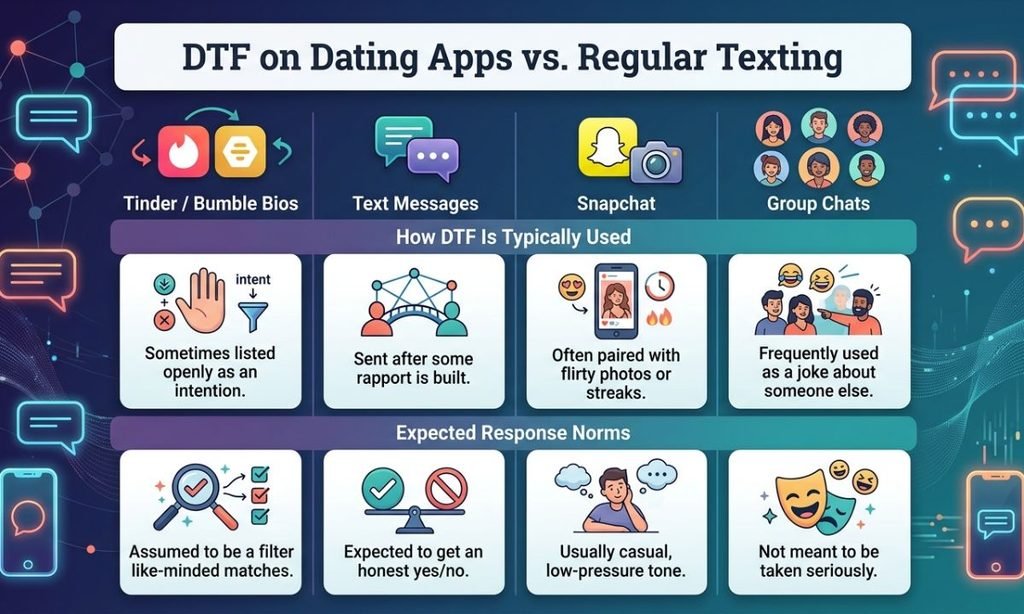
The meaning of DTF doesn’t change much between platforms, but the expectations around it do.
| Platform | How DTF Is Typically Used | Expected Response Norms |
| Tinder / Bumble bios | Sometimes listed openly as an intention | Assumed to be a filter for like-minded matches |
| Text messages | Sent after some rapport is built | Expected to get an honest yes/no |
| Snapchat | Often paired with flirty photos or streaks | Usually casual, low-pressure tone |
| Group chats | Frequently used as a joke about someone else | Not meant to be taken seriously |
On dating apps specifically, some users put “DTF” directly in their bio as a way of filtering out people looking for something more serious. It’s blunt, but it saves everyone time.
Other Meanings of DTF (Less Common)
While the sexual meaning dominates online slang, DTF technically has a few unrelated meanings in other contexts. These are far less common but worth knowing so you don’t get confused.
- DTF (Direct to Film): A printing method used in the apparel and merchandise industry for transferring designs onto fabric.
- DTF (Down to Fly): Occasionally used in travel or gaming contexts, though rare.
If you ever see “DTF” in a business, printing, or product context, it almost certainly refers to Direct to Film printing technology, not the slang term. Context clears this up instantly — nobody’s confusing a T-shirt printing forum with a dating app conversation.
How to Tell If Someone Is Joking or Serious
This is where a lot of people get tripped up. Texting strips away tone of voice and facial expressions, so DTF can land very differently depending on how it’s framed.
Signs it’s probably a joke:
- It’s sent in a group chat, not a one-on-one conversation
- It’s followed by laughing emojis or “lol”
- It’s clearly a callback to an inside joke or previous conversation
Signs it’s probably serious:
- It’s sent privately, one-on-one
- There’s no joking tone or emoji softening it
- It follows a flirty or increasingly personal conversation
When in doubt, it’s always fine to ask directly. “Wait, are you serious?” is a completely normal and reasonable response to a blunt question like this.
Why DTF Feels So Blunt Compared to Other Slang
Part of what makes DTF stand out is how direct it is. Unlike softer phrases like “wanna hang out” or “you up?”, DTF skips the small talk entirely. There’s no ambiguity about what’s being asked.
For some people, that bluntness is refreshing — it saves time and avoids mixed signals. For others, it can feel jarring or even disrespectful, especially without any prior flirting or rapport.
Understanding this helps explain why reactions to DTF vary so much. It’s not really about the letters themselves; it’s about the tone, timing, and relationship between the two people texting.
Related Slang You May See in Texts
If you’re researching texting acronyms, you may also come across BMF meaning in text, which can have completely different meanings depending on the context.
Learning related texting abbreviations can make it easier to understand conversations across social media, messaging apps, and online communities.
Quick Reference: DTF Meaning in Text Summary
To wrap the core idea into one easy-to-remember snapshot:
- Full meaning: Down to F***
- General use: Asking or stating interest in a casual hookup
- Common platforms: Texting, Tinder, Bumble, Snapchat, group chats
- Tone: Blunt, casual, sometimes joking
- Best response: Honest and direct, whether yes or no
- Rare alternate meaning: Direct to Film (printing industry)
Final Thoughts
Slang like DTF spreads fast because it’s short, direct, and easy to type — but that same simplicity is exactly what makes it confusing the first time you see it. Now that you know what it means, where it comes from, and how people actually use it in real conversations, you won’t be caught off guard the next time it shows up in your messages.
At the end of the day, texting slang like this only works if both people understand it the same way. If you’re ever unsure whether someone’s serious, joking, or testing the waters, there’s nothing wrong with just asking. A little clarity goes a lot further than guessing.
FAQs
What does DTF mean in a text message?
DTF stands for “Down to F***,” a slang term used to say someone is open to a casual, no-strings-attached hookup. It’s most common in texting, dating apps, and social media.
Is DTF always sexual?
In almost every case, yes. A small number of people use it jokingly to mean “down to do anything,” but that twist is usually obvious from the context of the conversation.
What does DTF mean on Tinder or Bumble?
On dating apps, DTF usually signals that someone is looking for something casual rather than a serious relationship. Some users even put it directly in their bio to filter matches quickly.
Is it rude to send someone DTF?
It depends on the relationship and timing. Sending it to someone you barely know or without prior flirting can come across as disrespectful, while sending it after mutual interest is usually fine.
How do you respond to a DTF text?
Answer honestly and keep it short, whether that’s a yes, a no, or a boundary-setting reply. You’re never obligated to say yes just because someone asked directly.
What’s the difference between DTF and FWB?
DTF refers to being open to a one-time or occasional casual hookup, while FWB (Friends With Benefits) describes an ongoing casual arrangement between two people who stay friends. FWB implies more repetition and familiarity than DTF.
Does DTF have a non-sexual meaning?
Yes, in the printing and apparel industry, DTF stands for “Direct to Film,” a method used to transfer designs onto fabric. This meaning is unrelated to the slang term and easy to tell apart by context.
Who typically uses the term DTF?
DTF is most common among younger adults on dating apps, in texts, and in casual group chats. It’s rarely used in professional, formal, or family conversations.
