
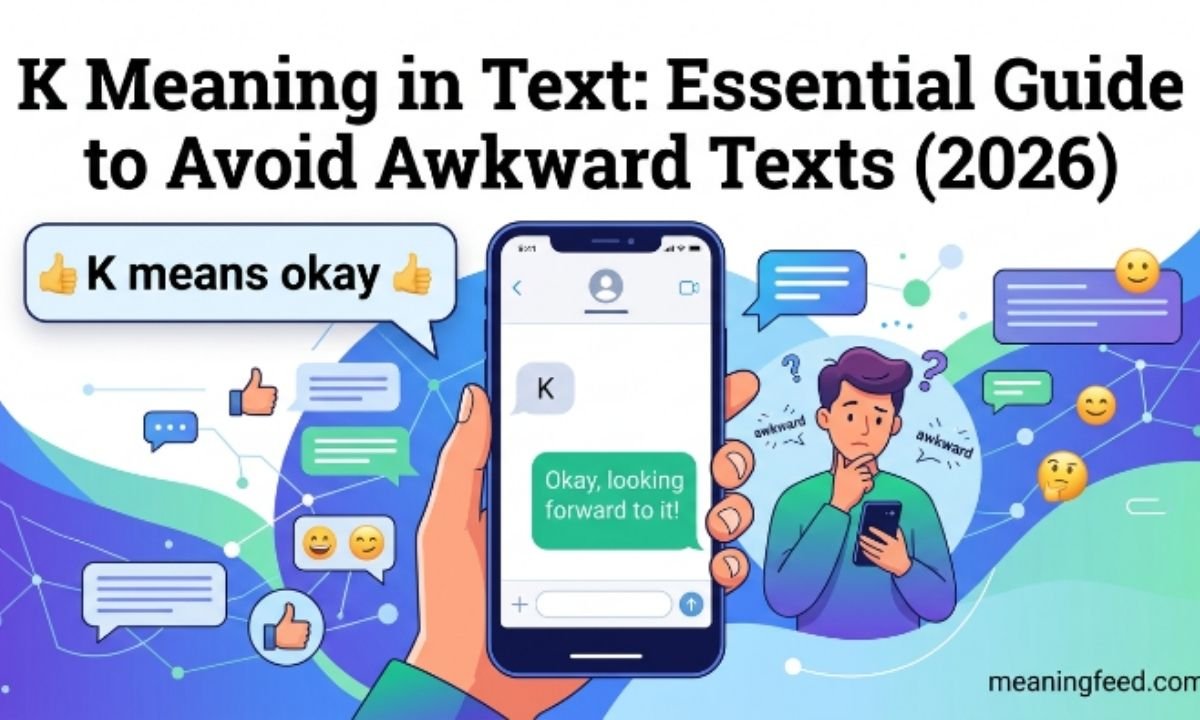

You send someone three paragraphs explaining your whole day, and they text back “k.”
Your stomach drops a little. Are they mad? Bored? Did you say something wrong?
The K meaning in text is almost never as loaded as it feels in the moment. Most of the time it just means “okay.” But if that were the whole story, nobody would be googling it at 11 p.m. after staring at their phone for ten minutes.
Most guides on the K meaning in text stop at “K means okay, tone depends on context” and call it a day. That’s true, but it’s not actually useful. It doesn’t tell you how to read the tone, why one letter can wreck your mood, or what’s different about getting a “k” from your boss versus your boyfriend versus your group chat. That’s what this guide is for.
What K Actually Means When Someone Sends It
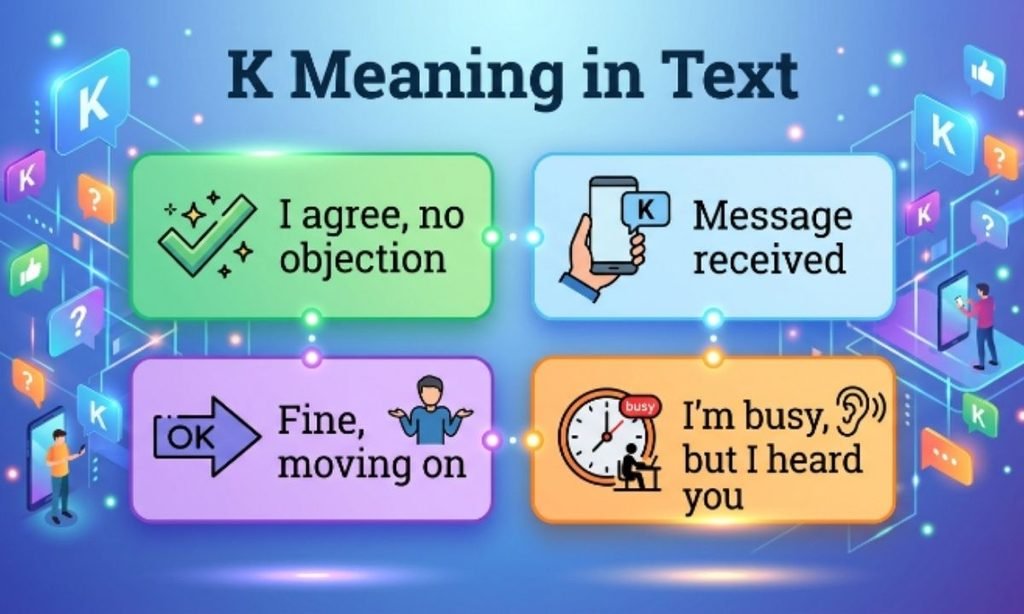
To understand the K meaning in text, start with the basics: “k” is a clipped version of “okay,” which is itself a shortened “OK.” People type it to confirm they’ve read and understood something, without spending the extra half-second on more letters.
In plain terms, “k” usually signals one of these:
- Message received
- I agree, no objection
- Fine, moving on
- I’m busy, but I heard you
That’s it. There’s no hidden acronym, no secret backstory. It’s just efficiency. The confusion doesn’t come from the word itself — it comes from what we assume about the person sending it.
Why a Single Letter Can Feel Like a Bigger Deal Than It Should
Here’s the part most articles about the K meaning in text skip entirely: the psychology behind why “k” stings.
Texting strips out tone of voice, facial expression, and pacing — the things your brain normally uses to judge whether someone is annoyed with you. When those cues disappear, your brain doesn’t just shrug and move on. It fills the gap with a guess, and that guess is usually shaped by how you’re already feeling about the relationship.
This is sometimes called a minimal response in conversation research — a reply that keeps a conversation technically alive while offering the least possible effort. The problem is that “least effort” reads completely differently depending on who’s reading it:
- If you’re already anxious about a relationship, “k” reads as rejection.
- If you’re confident and relaxed, “k” reads as normal, maybe even efficient.
- If you’re mid-argument, “k” reads as a wall going up.
In other words, the letter doesn’t carry the emotion. You do. That’s not a cop-out — it’s genuinely how digital communication research explains why short replies get over-interpreted so often. Recognizing this pattern in yourself is more useful than any list of “what k means from a girl” or “what k means from a guy,” because those lists pretend the letter has a fixed emotional charge. It doesn’t.
A Simple Framework for Reading “K” Correctly
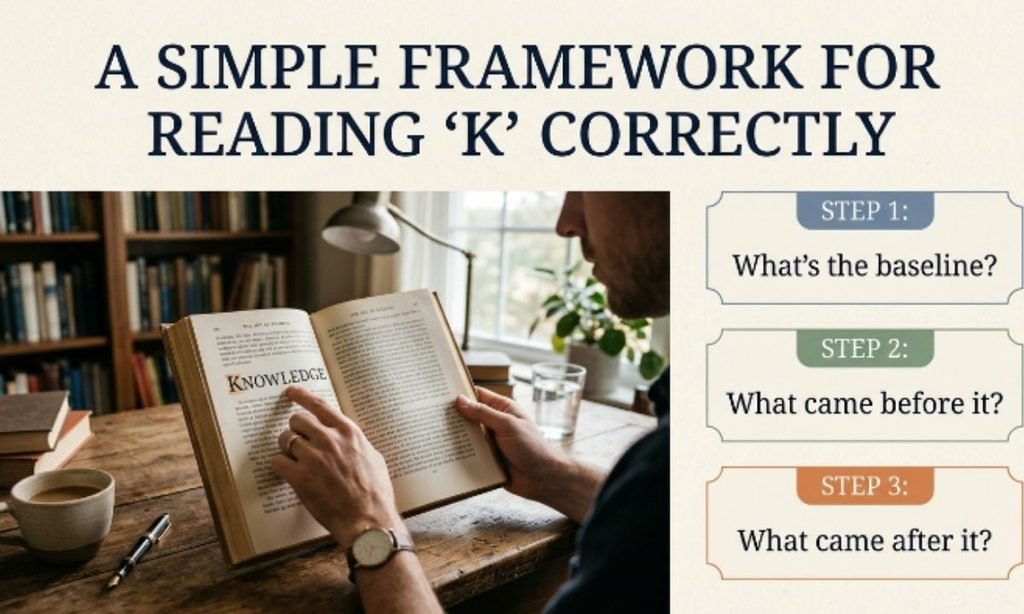
Instead of guessing, run the message through three quick questions:
- What’s the baseline? Does this person always text in short bursts, or do they usually write full sentences?
- What came before it? Was the conversation calm, or was there tension?
- What came after it? Did they follow up, go quiet, or leave you on read?
A “k” that breaks someone’s normal pattern is worth noticing. A “k” that matches how they always text isn’t a signal at all — it’s just their style.
Texting a Friend
Among friends, “k” is close to meaningless in a bad way. It’s the digital equivalent of a nod. Friend groups run on efficiency, inside jokes, and half-finished sentences, so a bare “k” rarely means anything beyond acknowledgment.
Texting a Partner
This is where “k” causes the most damage, because relationships run on emotional bids — small moments where one person reaches for connection and hopes the other reaches back. A one-letter reply to something vulnerable can feel like a bid going unanswered, even if that’s not what was intended.
If a partner’s “k” bothers you, the better move isn’t guessing — it’s asking directly: “Hey, that felt short, everything okay?” That single sentence solves more than any amount of re-reading the message ever will.
Texting a Coworker or Boss
In work chats, “k” usually just means “acknowledged, no further action needed.” Busy people use it constantly. The catch is that it can read as curt to someone who doesn’t know you well, so it’s worth reading the room before using it upward in a hierarchy.
Texting Someone You’re Dating
Early in dating, effort is the message. A “k” from someone you’re just getting to know carries more weight than the same “k” from a five-year relationship, simply because you don’t have a baseline for their texting habits yet. Give it a few exchanges before deciding it means anything.
Generational Differences: Who Actually Uses “K” and How
One thing the existing guides barely touch is how the K meaning in text actually shifts across generations. It’s not just “younger people use it more” — the interpretation itself changes.
| Generation | Typical Use of “K” | How It’s Usually Read |
| Gen Z | Rare on its own; often replaced with “kk,” “bet,” or emoji reactions | A bare “K.” without punctuation softness can read as passive-aggressive |
| Millennials | Common, especially for quick logistics | Neutral, practical, not usually loaded |
| Gen X | Common, especially in work and family texts | Efficient, no strong emotional read |
| Boomers | Less common; more likely to type “Ok” or “OK” in full | Seen as a complete, polite reply, not a shortcut |
This matters because a lot of the “is k rude” panic comes from generational mismatches. A Gen Z texter sending “K.” to a Boomer parent might just be saving time. The parent, unfamiliar with texting shorthand norms, may read the same message as cold. Neither person is wrong — they’re just running different unwritten rules.
The Punctuation Trap: Why “K.” Feels Colder Than “K”
Punctuation is one of the biggest hidden factors in the K meaning in text, and it deserves more explanation than “adding a period makes it feel annoyed,” which is where most articles leave it.
In texting, punctuation isn’t grammatically necessary — a text is already a complete thought without a period. So when someone adds one anyway, it reads as a deliberate choice, not a habit. Deliberate choices get interpreted as tone.
Here’s how the variations typically land:
| Version | Common Read |
| k | Neutral, quick |
| K | Slightly more formal or flat, especially capitalized |
| k. | Often read as clipped or annoyed |
| K. | Frequently read as cold or final |
| kk | Friendly, casual |
| k! | Enthusiastic or reassuring |
| k 🙂 | Warm, softens the shortness |
None of this is a hard rule — it’s a pattern people have picked up unconsciously from years of texting. But it explains why the exact same three letters can feel completely different depending on what’s attached to them.
Autocorrect and Predictive Text: The Overlooked Factor
Almost nobody talks about this, but your phone’s keyboard quietly shapes how “k” gets sent — and it’s worth knowing before you assume intent.
- On iPhones, typing “k” and hitting send is a deliberate two-key action; predictive text doesn’t push you toward it.
- On many Android keyboards, swipe-typing can auto-suggest short replies, meaning some “k” texts are genuinely just the fastest option the keyboard offered, not a calculated choice.
- Voice-to-text rarely produces a lone “k” — so if you got one, it was typed, not spoken, which at least tells you the person had their phone in hand and was paying attention.
This doesn’t prove anything about someone’s mood, but it’s a useful reality check: a chunk of “k” replies exist purely because they were the path of least resistance on a small keyboard, not because someone sat there deciding how short to be.
Is “K” Ever Okay at Work? Slack, Teams, and Email
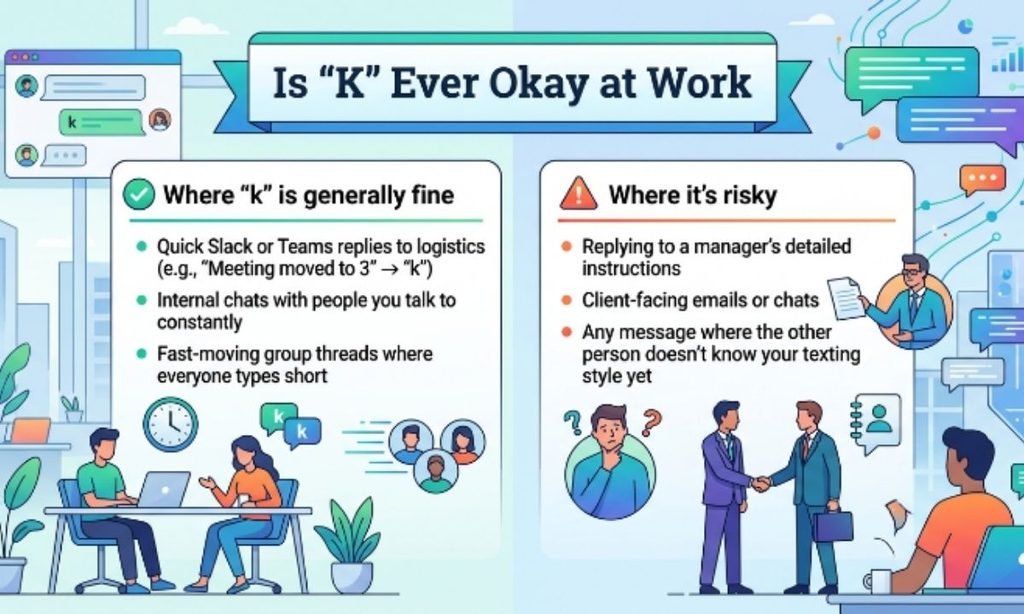
Workplace messaging has its own etiquette, and it’s different from texting a friend.
Where “k” is generally fine:
- Quick Slack or Teams replies to logistics (“Meeting moved to 3” → “k”)
- Internal chats with people you talk to constantly
- Fast-moving group threads where everyone types short
Where it’s risky:
- Replying to a manager’s detailed instructions
- Client-facing emails or chats
- Any message where the other person doesn’t know your texting style yet
A safer professional habit is to upgrade “k” to “Got it” or “Sounds good” in anything outside your closest work relationships. It costs two extra seconds and removes all the guesswork for the other person.
When “K” Is Actually a Red Flag — and When You’re Overthinking It
This is the piece most guides avoid taking a real stance on. Here’s a straightforward way to tell the difference.
Probably nothing to worry about if:
- It matches how this person always texts
- The conversation before it was calm
- They keep responding normally afterward
- You’re texting a lot in general that day (short replies happen naturally in high-volume threads)
Worth a gentle check-in if:
- It’s a sharp departure from their usual style
- It follows a request, apology, or emotional message
- It’s paired with going quiet afterward
- You’ve noticed a pattern of short replies specifically after certain topics
The fix in the second case isn’t decoding the letter harder. It’s asking a real question. “That felt short — are we good?” resolves more uncertainty in five seconds than an hour of rereading the same text will.
Better Alternatives When You Want to Sound Warmer
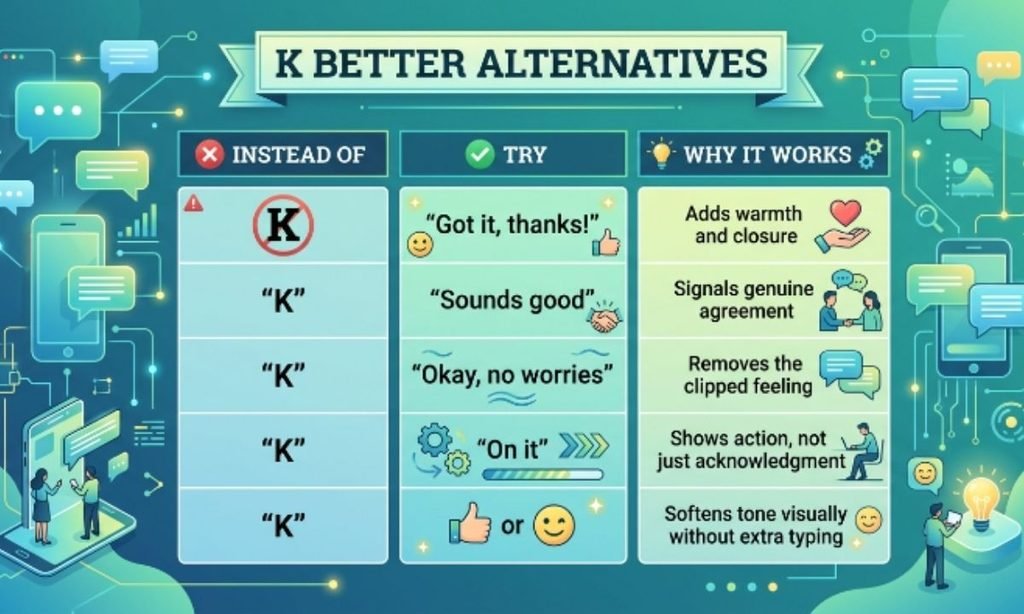
If you’re the one sending the reply and want to avoid the cold read entirely, a few extra characters go a long way.
| Instead of | Try | Why It Works |
| k | Got it, thanks! | Adds warmth and closure |
| k | Sounds good | Signals genuine agreement |
| k. | Okay, no worries | Removes the clipped feeling |
| k | On it | Shows action, not just acknowledgment |
| k | 👍 or 😊 | Softens tone visually without extra typing |
None of these take much longer to type, but they remove almost all the ambiguity that makes “k” controversial in the first place.
Final Thoughts
The K meaning in text hasn’t really changed since texting shorthand took off — it’s still just a fast way of saying okay. What’s changed is how much weight people put on it, because texting strips out every cue we normally rely on to judge someone’s mood.
The letter itself is neutral. The story you build around it is the part worth questioning. Before you spiral over a lone “k,” check the pattern, check the context, and if it still bugs you, just ask. That’s a better use of your energy than decoding a single letter for the tenth time.
If you’d like to learn more about the people and purpose behind our content, visit our About us page. For questions, suggestions, or feedback about this guide, you can also reach us through our Contact Us page.
FAQs
What does K mean in text?
No. The K meaning in text is most often just a fast way to say okay. Annoyance usually shows up through a pattern — a sudden shift from long replies to short ones — not from a single message.
Is K rude in texting?
Not usually. K only feels rude when it breaks someone’s normal texting pattern or follows an emotional message, otherwise it’s just a fast, neutral reply.
What does K mean from a girl?
In most cases, it simply means “okay” or “got it.” It only reads as distant if the conversation was serious and her replies suddenly got shorter than usual.
What does K mean from a guy?
Most of the time it means acknowledgment, nothing more. Guys often use K while multitasking or busy, not as a way to signal frustration.
What’s the difference between K and OK?
Both mean the same thing, but OK feels slightly more complete and polite, while K feels quicker and more casual in tone.
What does KK mean in text?
KK means “okay, okay” and is generally read as friendlier and warmer than a single K, especially in casual or fast-paced chats.
Why do people reply with just K instead of a full sentence?
It saves time and effort during quick conversations. Many people default to K in busy chats, group texts, or logistics-only exchanges.
Is K flirty in texting?
On its own, K isn’t flirty. It can feel warmer with an emoji or exclamation point, but a bare K is typically just a practical, neutral reply.
Does K mean something different on Snapchat, WhatsApp, or Instagram?
The meaning stays the same across platforms, but read receipts on apps like Instagram and iMessage can make a short K feel more noticeable.
Is it okay to use K in professional messages?
It’s fine in fast internal chats with close coworkers, but safer to use “Got it” or “Sounds good” in emails or messages to a manager or client.
