

You got a text. It ended with “js.” Now you’re staring at your phone wondering if your friend just insulted you or if you’re overthinking two random letters.
That’s the thing about the JS meaning in text. It looks harmless. It types in half a second. But depending on how it lands, it can soften a comment — or make it sting worse than if they’d said nothing at all.
Most guides will tell you JS means “just saying” and call it a day. That’s true, but it’s the easy half of the answer. The part nobody explains well is how to tell, in the moment, which version of JS you’re getting — the gentle one or the one with teeth. That’s what this guide actually digs into.
What Does JS Mean in Text? (Quick Answer)
Here’s the fast version, since you probably want this before anything else:
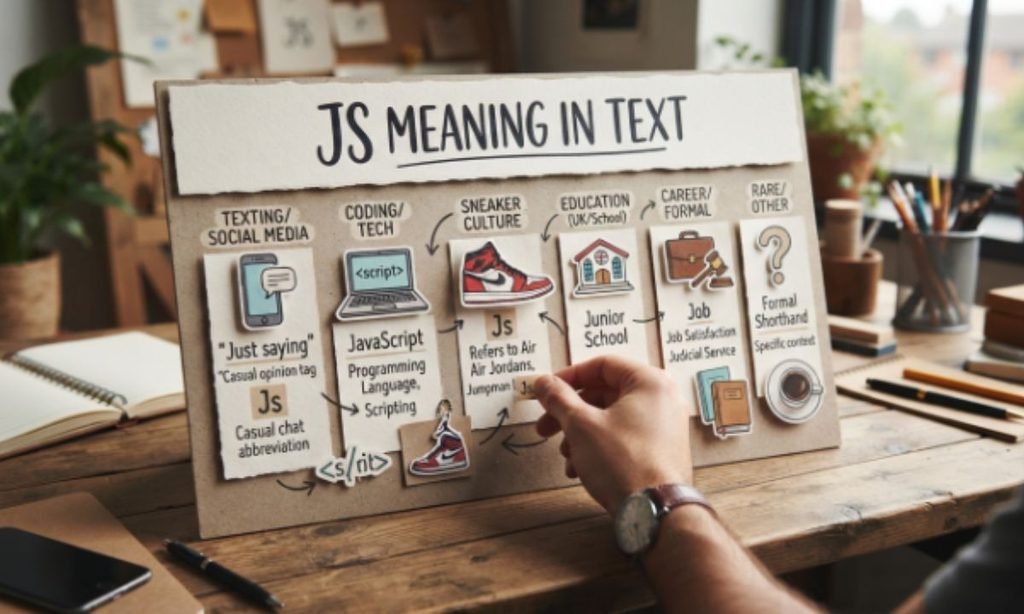
| Context | What JS Means |
| Texting, DMs, group chats | “Just saying” — a casual, opinion-softening tag |
| Coding or tech conversations | JavaScript, a programming language |
| Sneaker culture | Short for “Js,” referring to Air Jordans |
| Some school/UK contexts | Junior School |
| Rare, formal shorthand | Job Satisfaction, Judicial Service (industry-specific) |
In 95% of everyday texting, if someone drops “js” at the end of a sentence, they mean just saying. The rest of this article focuses on that meaning, because that’s the one that actually causes confusion.
Why Two Letters Carry So Much Weight
Here’s something the other guides skip entirely: JS isn’t just slang. Linguists have a name for what it’s doing — it’s a hedge.
A hedge is a small word or phrase that softens how forceful a statement sounds. “Sort of,” “I think,” “no offense,” and “just saying” all do the same job: they let the speaker say something opinionated while giving themselves a little escape hatch. If the listener pushes back, the speaker can retreat to “I was just saying” and avoid owning the comment fully.
That’s exactly why the JS meaning in text feels loaded even when it’s technically neutral. It’s designed to have it both ways — deliver the opinion, dodge the responsibility. Once you see it as a hedge instead of a random abbreviation, the whole pattern makes more sense. The tension you feel reading it isn’t in your head. It’s built into the function of the word.
The Punctuation Test: How to Tell If JS Is Genuine or Passive-Aggressive
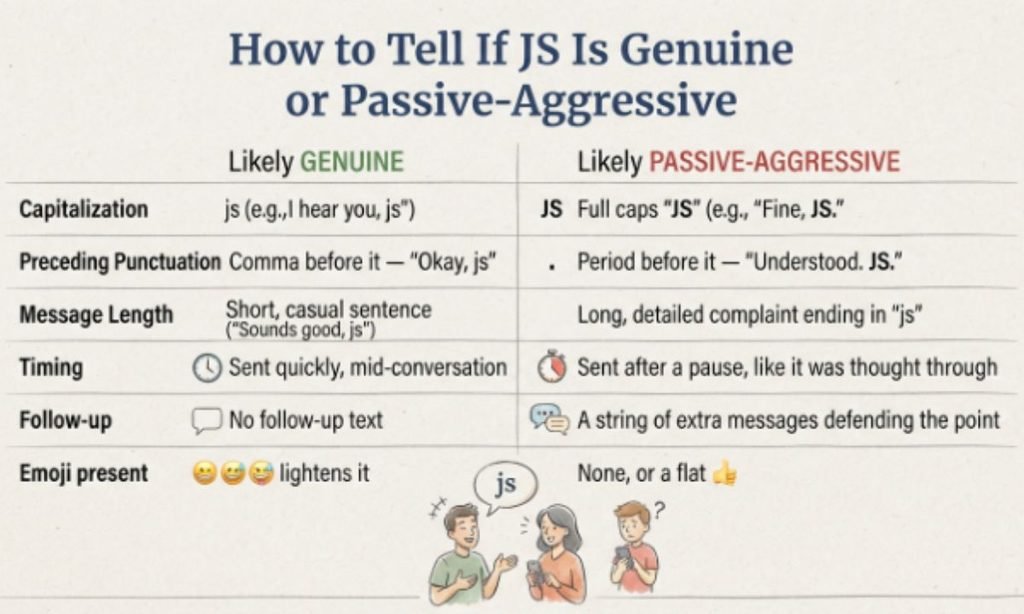
This is the part almost nobody covers, and it’s the most useful thing in this article. You don’t need to guess the tone of a “js” text. You can read it off the formatting.
| Signal | Likely Genuine | Likely Passive-Aggressive |
| Capitalization | lowercase “js” | Full caps “JS” |
| Preceding punctuation | Comma before it — “I’m just tired, js” | Period before it — “I’m just tired. JS.” |
| Message length | Short, casual sentence | Long, detailed complaint ending in “js” |
| Timing | Sent quickly, mid-conversation | Sent after a pause, like it was thought through |
| Follow-up | No follow-up text | A string of extra messages defending the point |
| Emoji present | 🙂 😅 lightens it | None, or a flat 👍 |
A quick way to remember it: the more effort someone put into the sentence before “js,” the less that “js” is actually softening anything. A rushed, comma-linked “js” is genuinely casual. A carefully worded paragraph capped off with “JS.” in caps is doing damage control after the fact — the sender knows the comment landed hard and is trying to claim they didn’t mean it that way.
JS vs. Its Cousins: TBH, NGL, IMO, FR
People often use JS interchangeably with other texting hedges, but they’re not the same tool. Swapping one for another changes what you’re actually communicating.
| Abbreviation | Meaning | What It Signals |
| JS | Just saying | Opinion offered with deniability — “don’t come at me for this” |
| TBH | To be honest | Signals you’re about to say something you’d normally hold back |
| NGL | Not gonna lie | Admits the statement might sound harsh, owns it anyway |
| IMO | In my opinion | Frames the statement as subjective, not a fact |
| FR | For real | Emphasizes sincerity — the opposite of hedging |
Notice the pattern: JS is the only one on this list built around avoiding ownership. TBH and NGL still admit “yeah, this is my real opinion.” JS is more likely to be followed by a shrug if you push back. If you want to make a point and stand behind it, “ngl” or “imo” actually communicates more honesty than “js” does — worth knowing if you’re the one typing it.
How JS Reads Differently Depending on Who Sent It
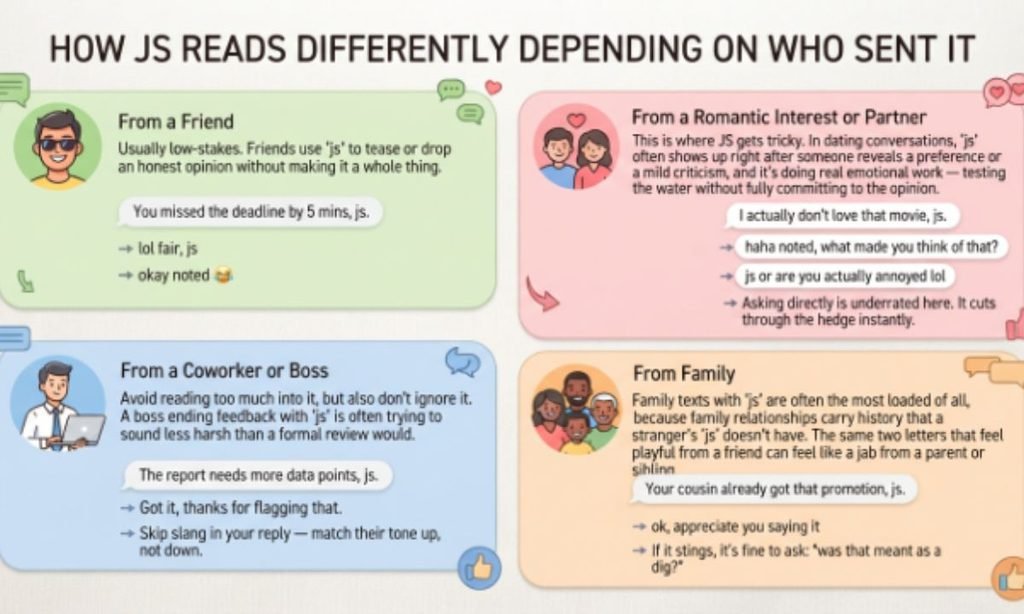
The JS meaning in text doesn’t change, but the emotional weight shifts hard based on the relationship. Here’s how to read it — and reply — across the four situations people ask about most.
From a Friend
Usually low-stakes. Friends use “js” to tease or drop an honest opinion without making it a whole thing.
- Reply option: “lol fair, js”
- Reply option: “okay noted 😂”
From a Romantic Interest or Partner
This is where JS gets tricky. In dating conversations, “js” often shows up right after someone reveals a preference or a mild criticism, and it’s doing real emotional work — testing the water without fully committing to the opinion.
- Reply option: “haha noted, what made you think of that?”
- Reply option: “js or are you actually annoyed lol”
Asking directly is underrated here. It cuts through the hedge instantly.
From a Coworker or Boss
Avoid reading too much into it, but also don’t ignore it. A boss ending feedback with “js” is often trying to sound less harsh than a formal review would.
- Reply option: “Got it, thanks for flagging that.”
- Skip slang in your reply — match their tone up, not down.
From Family
Family texts with “js” are often the most loaded of all, because family relationships carry history that a stranger’s “js” doesn’t have. The same two letters that feel playful from a friend can feel like a jab from a parent or sibling.
- Reply option: “ok, appreciate you saying it”
- If it stings, it’s fine to ask: “was that meant as a dig?”
If You’re the One Typing “JS” a Lot
Here’s an angle competitors don’t touch: what if you’re the one leaning on JS constantly?
Using it once in a while to soften a comment is normal. But if you notice a pattern, it might be worth a gut check:
- Do you add “js” mainly when you’re saying something you know might upset someone?
- Do you use it to avoid a real conversation about a bigger issue?
- Would you still say the sentence if you removed “js” from the end?
If the answer to that last one is no, the “js” isn’t softening the comment — it’s doing the opposite. It’s flagging that you already knew the comment needed softening, which usually means it needed a rethink, not a two-letter patch.
JS in Programming Chats: Don’t Get These Mixed Up
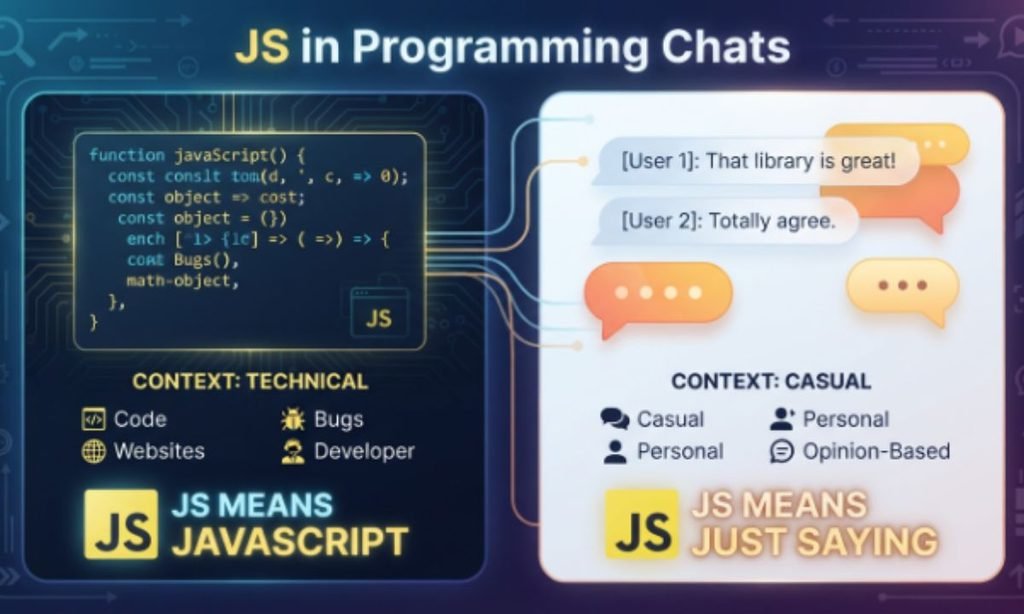
Context solves this one fast, but here’s the shortcut so you never have to think twice:
- If the conversation involves code, websites, apps, bugs, or a developer — JS means JavaScript.
- If the conversation is casual, personal, or opinion-based — JS means just saying.
The only place these genuinely collide is in mixed group chats — say, a work Slack where coworkers are both debugging a website and chatting casually. In that specific case, look at sentence position: JavaScript almost always appears mid-sentence as a noun (“the js file broke”), while “just saying” almost always appears at the very end of a sentence, tacked on like an afterthought.
Final Thoughts
The JS meaning in text comes down to two letters doing a surprisingly heavy job: delivering an opinion while dodging blame for it. Once you know to check the punctuation, the timing, and who’s actually sending it, you stop guessing and start reading it accurately — every time.
Next time someone drops a “js” on you, you won’t need to reread the message five times. You’ll already know whether to laugh it off or ask what’s really going on.
FAQs
What does JS mean in a text message?
JS most commonly means “just saying” in texting and social media. It’s used to share an opinion or comment casually, often to soften how direct the statement sounds.
Is JS rude or passive-aggressive?
Not always. It depends on tone, punctuation, and context — a lowercase “js” after a light comment is usually harmless, while a capitalized “JS” after a long, pointed message often isn’t.
Does JS always mean JavaScript?
No. JS only means JavaScript in coding, tech, or developer conversations. In everyday texting and social media, it almost always means “just saying.”
How do you reply to someone who texts “js”?
You can respond naturally without addressing the abbreviation directly — a simple “noted” or “fair enough” works fine. If the comment felt off, it’s okay to ask if they meant it seriously.
Is JS still used in 2026?
Yes. JS remains common across texting, Instagram, Snapchat, and group chats, especially among Gen Z and younger millennials, even as new slang terms continue to emerge.
What’s the difference between JS and TBH?
JS (“just saying”) softens a comment and avoids ownership of it, while TBH (“to be honest”) signals the sender is owning an opinion they’d normally hold back. They’re not interchangeable.
Can JS mean something other than “just saying”?
Yes. Outside of texting, JS can refer to Air Jordan sneakers (“Js”), Junior School, or JavaScript, depending entirely on the surrounding conversation.
