

You send someone a paragraph explaining why you’re running late, why the plan changed, why you need a favor.
They reply with three letters: SNM.
That’s it. No emoji, no “haha,” no follow-up. And now you’re staring at your phone wondering if that was warm or cold, done or dismissive.
Here’s the short version: SNM meaning in text is “Say No More.” It’s used to show that someone already understands you and doesn’t need further explanation. But if you’ve ever gotten SNM and felt a weird flicker of “wait, was that rude?” — you’re picking up on something real. The letters don’t carry the tone. The context around them does. And that’s exactly what most explainers skip.
SNM Meaning in Text: The Quick Answer
Before we go deeper, here’s the baseline definition, since that’s what brought you here.
| Term | Full Form | What It Signals |
| SNM | Say No More | Understanding, agreement, or “I’ve got it, no need to explain further” |
That’s the core meaning across texting, Instagram, Snapchat, Discord, and group chats. It’s a closer, not an opener. Someone uses it to shut the loop on a topic — usually in a good way.
But “usually” is doing a lot of work in that sentence, and that’s the part worth actually understanding.
The Part Nobody Explains: SNM Doesn’t Carry Tone on Its Own
Three letters can’t hold emotional nuance by themselves. So when someone reads SNM as flat, cold, or dismissive, it’s rarely the word itself — it’s the delivery around it.
Here’s what actually shifts the meaning, based on how people really text:
| Signal | Reads As Warm | Reads As Cold or Abrupt |
| Capitalization | “snm 😊” or “aw snm” | “SNM.” with a period |
| Response time | Immediate reply | Sent 4+ hours later, no context |
| Punctuation | “SNM!” or “SNM lol” | “SNM.” (a period after three letters reads like a door closing) |
| What came before it | Casual back-and-forth | A message where you were vulnerable or asked for something |
| Follow-up | Adds a plan, question, or emoji right after | Sends SNM and goes silent |
That period detail matters more than people admit. A trailing period on a short acronym often lands as final — almost curt — even when the sender meant nothing by it. If you’re the one sending SNM and you want it to feel warm, drop the period and add literally anything after it: an emoji, “lol,” a plan, a follow-up question. If you’re the one receiving it and it stung a little, it’s worth asking yourself whether the sting came from the word or from the silence that followed.
What SNM Actually Does to a Conversation
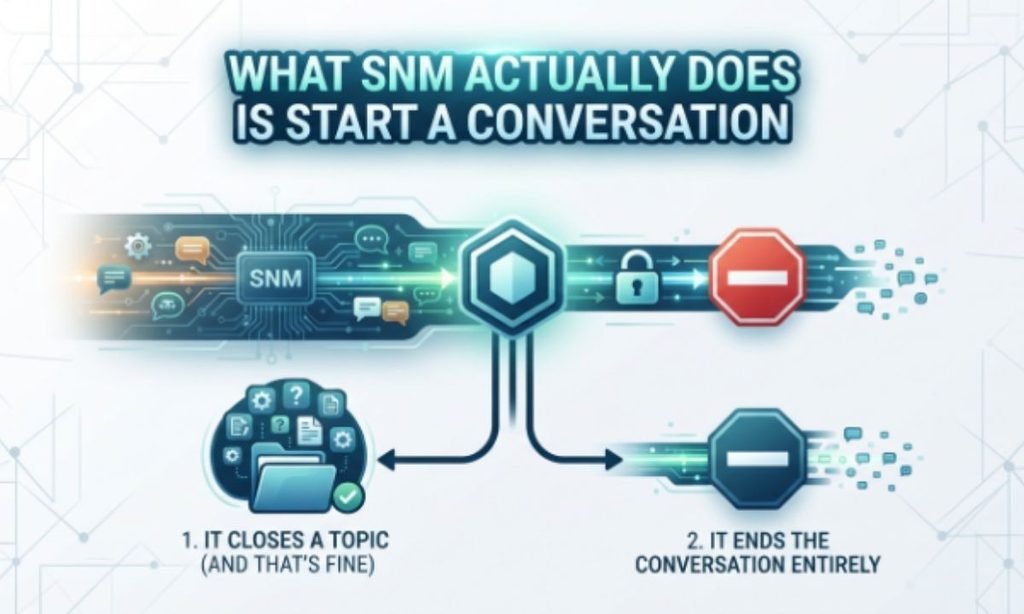
This is the piece almost every guide on this topic leaves out: SNM is a conversation-management tool, not just a definition.
It does one of two things, and figuring out which one is happening tells you everything about how to respond.
1. It closes a topic (and that’s fine)
Someone explains something, you already got it, SNM ends that specific thread cleanly. Nobody needs to keep talking about it. This is the healthy, default use case — it’s efficient, not evasive.
Example: Alex: “Running 10 minutes behind, traffic’s bad, I’ll explain when I get there.” Jamie: “SNM, drive safe.”
Here SNM plus a small addition keeps the conversation moving. It’s a soft landing, not a hard stop.
2. It ends the conversation entirely
Sometimes SNM is the last message in the thread, full stop. No plan, no emoji, no “talk later.” This version can genuinely mean the person is busy — or it can mean they want the topic dropped and aren’t going to say that directly.
The way to tell the difference isn’t the word. It’s whether the person circles back later. If they follow up an hour later with something unrelated and normal, the SNM really was just efficiency. If they go quiet for the rest of the day after a topic that mattered to you, the SNM was doing more work than its definition suggests.
This distinction — closing a topic versus closing the conversation — is the single most useful thing to understand about SNM, and it’s almost never spelled out clearly anywhere else.
How to Reply to SNM (By Relationship)
Most explainers give you one generic list of comebacks. But how you should respond to SNM actually depends heavily on who sent it.
| Who Sent It | Best Way to Respond | Why |
| A close friend | Nothing required, or a quick “😂” or “bet” | Between close friends, SNM often doesn’t need a reply at all |
| A partner or crush | A small follow-up: “okay good, see you soon 🖤” | Adds warmth back in if the SNM felt clipped |
| A coworker or boss | “Sounds good, thanks!” | Keeps things professional even if they went casual |
| Someone you just met | Mirror their tone — casual reply if they were casual | Matching energy avoids over-analyzing a low-stakes message |
| Someone you’re mid-conflict with | Don’t read into it either way; ask directly if it matters | Emotionally loaded moments are the worst time to guess at three letters |
That last row matters more than it looks. A huge number of people search “SNM meaning in text” specifically after receiving it during a slightly tense exchange, hoping the definition will tell them whether they’re in trouble. It won’t. If the stakes are real, ask. “Hey, did that come across weird?” beats fifteen minutes of re-reading a text.
SNM vs. Similar Acronyms: What Actually Separates Them
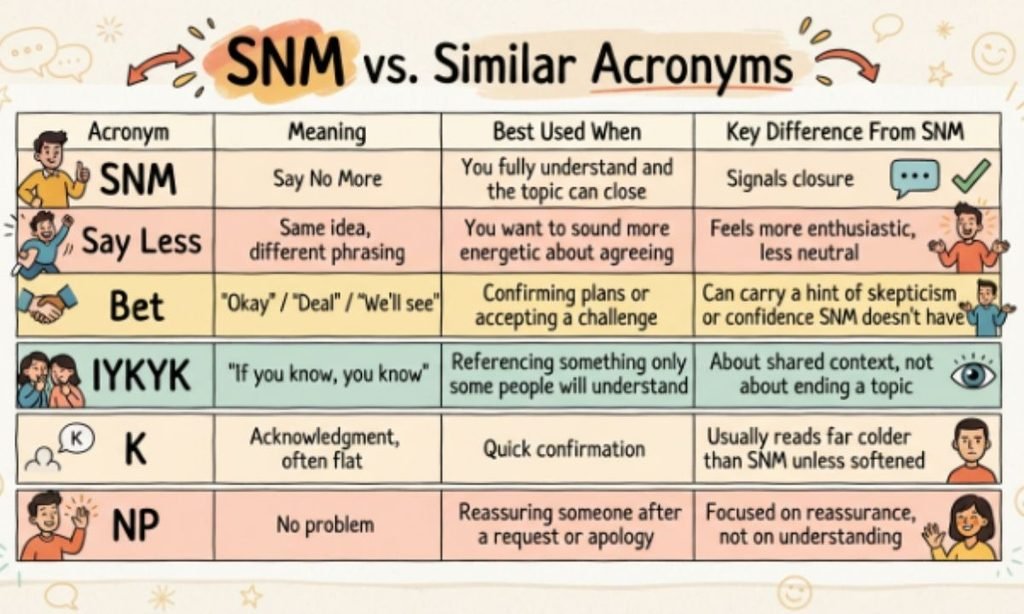
SNM gets lumped in with a handful of other short replies, but they’re not interchangeable. Here’s where each one actually sits.
| Acronym | Meaning | Best Used When | Key Difference From SNM |
| SNM | Say No More | You fully understand and the topic can close | Signals closure |
| Say Less | Same idea, different phrasing | You want to sound more energetic about agreeing | Feels more enthusiastic, less neutral |
| Bet | “Okay” / “Deal” / “We’ll see” | Confirming plans or accepting a challenge | Can carry a hint of skepticism or confidence SNM doesn’t have |
| IYKYK | “If you know, you know” | Referencing something only some people will understand | About shared context, not about ending a topic |
| K | Acknowledgment, often flat | Quick confirmation | Usually reads far colder than SNM unless softened |
| NP | No problem | Reassuring someone after a request or apology | Focused on reassurance, not on understanding |
The mix-up people make most often is treating SNM and “K” as equivalents. They’re not. “K” usually signals mild annoyance or minimal effort. SNM, even at its most clipped, still implies the sender processed and understood what you said — it’s a step above a bare acknowledgment, even when it doesn’t feel that way in the moment.
When SNM Backfires
A few real situations where sending SNM tends to land badly, even though the sender meant nothing negative by it:
- Right after an apology. If someone apologizes and you reply only “SNM,” it can read as “fine, whatever” instead of genuine acceptance. Add a line: “SNM, we’re good.”
- After someone shares something emotional. Vulnerability deserves more than three letters back, even if you genuinely do understand without more explanation.
- In a first-time conversation with someone new. Without an established texting rhythm, SNM can look like you’re rushing to end the chat.
- Right before a long gap in replying. If you send SNM and then don’t respond for hours, the recipient will assume the silence started with that message — even if it didn’t.
None of these mean you did something wrong by using the word. It just means SNM works best when the relationship already has enough context to absorb a short reply without misreading it.
Where “Say No More” Actually Comes From
The phrase itself predates texting by decades — it shows up in everyday spoken English as a way to say “I understand completely, you don’t need to keep explaining.” Texting culture simply compressed it into three letters once acronyms became the default shorthand across SMS, then carried it over to Snapchat, Instagram comments, Discord servers, and gaming chats as those platforms grew.
The letters changed. The underlying social function — signaling instant understanding without dragging out a reply — stayed exactly the same.
Final Thoughts
The SNM meaning in text is simple to look up and slightly harder to read correctly in the moment: it means “Say No More,” a quick signal that someone already gets it. Where people actually get tripped up isn’t the definition — it’s figuring out whether those three letters are closing a topic warmly or ending a conversation coldly.
The fix isn’t overthinking the word. It’s reading what surrounds it — the punctuation, the timing, whether they circle back. Get that part right, and you’ll never have to second-guess a text that’s only three letters long again.
FAQS
What does SNM mean in text?
SNM stands for “Say No More.” It’s used to show that you already understand what someone said and don’t need further explanation. It’s one of the most common ways people confirm understanding quickly in casual texting.
Is SNM meaning in text always “Say No More”?
In everyday texting and social media, yes — “Say No More” is by far the most common meaning. Rare exceptions exist in niche or industry-specific contexts, but casual chats almost always mean this.
Is SNM rude to say?
No, SNM isn’t rude on its own. It can feel abrupt if sent with a period and no follow-up, especially after something emotional. Adding an emoji or short reply after it keeps the tone friendly.
How do you reply when someone texts you SNM?
Often no reply is needed, especially with close friends. If the topic matters or the SNM felt cold, a short follow-up like “okay, sounds good” or asking directly clears up any confusion fast.
What does SNM mean on Snapchat or TikTok?
The meaning stays the same across platforms — “Say No More.” On Snapchat and TikTok, it’s often used in comments or quick replies to show instant agreement or relatability with a post.
Does SNM mean the conversation is over?
Not always. SNM usually closes one specific topic, not the whole conversation. If the person follows up normally afterward, they weren’t trying to end things — they just didn’t need more explanation.
What’s the difference between SNM and “Say Less”?
Both signal understanding, but “Say Less” tends to sound more upbeat and energetic, while SNM feels more neutral and efficient. They’re close in meaning but not identical in tone.
Can SNM be used in professional or work texts?
It’s best avoided in formal communication. In casual workplace chats among close colleagues it can pass, but phrases like “understood” or “got it” read more professional in most work settings.
